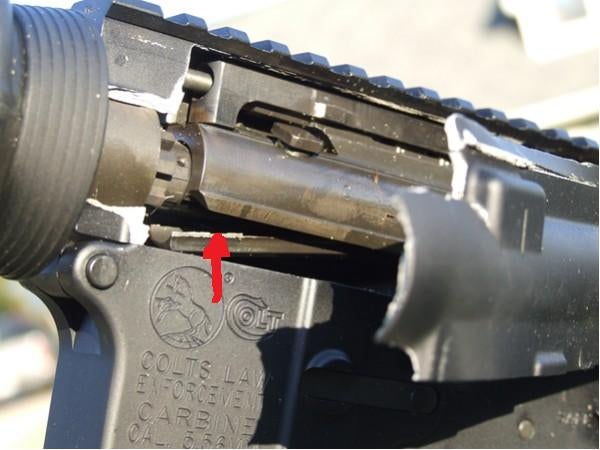
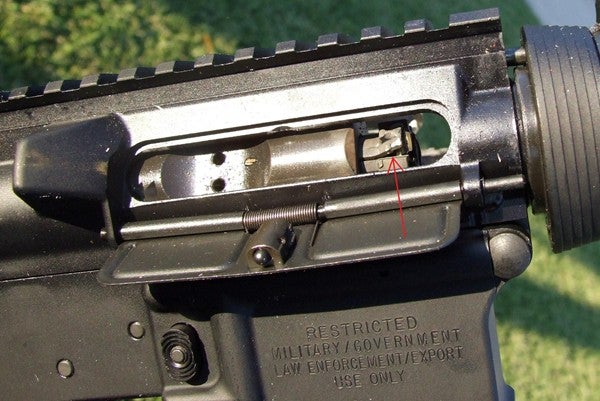
Catastrophic failure in my SA15.7 - A happy ending from Colt Canada

Status
Not open for further replies.
The rear hole does not take any recoil force on an AR as is is oval as opposed to the front hole that is round for fit tolerance on uppers. The carrier impact at the rear imparted a force in a direction the lug was never designed to take. There is no porosity, and the evidence (and there is lots) all points to an ammunition failure. There is no big conspiracy here folks.

You are correct. I just checked my US-made, non-colt AR, and the rear pin hole is an obround, not a circle. Reduces a critical manufacturing tolerance.

That said, in your scenario what force broke the upper in that location? if that pin is not loaded by recoil, then what broke it? What caused that failure mode? That part should have zero force acting on it when the rifle is fired, even with a hot shot.

I do not suggest there is any kind of conspiracy. You are participating in a public forum, and I'm far from the only engineer on here, by a long shot. Statements will be questioned. Particularly statements which do not make sense to the people reading those statements. Why a given statement doesn't make sense to people varies from "I are dumb" to "I are ignorant", generally, but sometimes the statements inherently don't make sense. I'm an old, experienced engineer specializing in mechanism design, and I've worked on things painted black and green a few times in my youth. If the scenario you present doesn't make sense to me, be concerned.
 
I mean same lower takes the force of 7.62x39, 300blackout, 50 BMG. Yet a overcharged .223 mushroomed a rubber buffer and only logical way that would tear off is the force was directed down, pulling up on the pin.

* rear of the receiver contact with the upper, the tab in the rear and front pin.
 
We are happy the shooter was unhurt.

The user reported an unusually loud bang and hard recoil. The case was difficult to extract. The case was steel not brass and did not burst as a standard brass case would have. The barrel and the bolt remained intact and there was no evidence to suggest a barrel obstruction.

The resulting high pressure caused a very energetic opening. The bumper on the rear of the buffer was mushroomed and deformed and the key recoiled hard enough to contact the lower receiver at the top of the extension hole.

All the evidence points to an overcharged cartridge. Similar damage was recreated in the lab supporting this. The upper receiver forging was examined by a metallurgist and there were no flaws or defects. There is no anodizing in the cracked metal to indicate it was cracked prior to delivery. We are satisfied that there was absolutely nothing wrong with this rifle at the time the incident occurred.

The fact that the user was uninjured despite continuing to fire after an abnormal ammunition incident would seem to show that the materials were more than up to the task. The manual does say that if you hear an abnormal sound you should stop firing.

Without having the actual case or having the evidence preserved properly, and with the tendency toward forum members making all the worst assumptions despite lacking any qualifications, we are not able to release a report laying cause on any particular ammunition manufacturer.

We chose to replace the components as a customer satisfaction gesture, despite a complete lack of liability on our part, and not because the rifle was made from pot metal and we were trying to hide a defect. It seems it will be much harder in the future to help out folks since we will also have to defend what we thought was going above and beyond for a customer to the experts on the internet.

Other folks might come to a different conclusion given the above incident. Perhaps they might note that Colt Canada is a world class manufacturer with an excellent reputation for quality and safety and that this is consistent with that. Perhaps they might notice that the consumer was able to contact the manufacture directly, someone was able to listen to their concerns. The equipment was able to be returned directly to the factory without an export license and the manufacturer went to the trouble of setting aside other work to conduct a thorough investigation of an relatively minor incident that in all likely hood had nothing to do with our manufacturing processes.

Some folks love to point out that the Diemaco rifles are expensive. Some folks might think that you get what you pay for.


I believe it was is fair to say that everyone here is happy that the shooter walked away without injury.
Secondly I would not be one to criticize the pricing or quality of Colt Canada rifles.
Thirdly nobody here claimed that Colt Canada rifles were made of "pot metal" (your words) however I still find it difficult to believe that an over pressure round, even in a steel case caused this.

The rear pin bears no load and even if the bolt carrier travelled backwards with twice the force it usually does the threads of the lower receiver/receiver extension junction would have taken the brunt of the force. (Energy of the bolt transferred to the buffer, buffer smacks rear of receiver extension, receiver extension exerts force on threads of lower receiver)
There would still be no force exerted onto the rear lug which has an oval hole 0.022" greater than the takedown pin 0.248".

If the upper receiver was traveling forward it would be the front lug which would bear the load.
Let us assume for a moment that the hole in the front lug was out of spec (I am making no such claims) and the upper receiver travelled rearward then the flat vertical surfaces between the upper and lower receivers would have met since there is only 0.006" gap between them. This would mean that the amount of force that would be able to be transferred to the rear lug would be minimal.

Once again I reiterate my pleasure that Colt Canada stood behind their product and satisfied their customer even though they claim that it was due to the ammunition.
 
Are there known issues with the MFS .556 ammo?. I have a couple of hundred rounds of it waiting for a range day. Do I need to be concerned?
 
Colt Canada covered the customer and replaced the upper. What else could they possibly do for the customer?. The customer reported hard extraction, a hallmark of excessive pressure in a cartridge. A materials flaw in the upper could not cause the case to expand excessively and be hard to extract. In the absence of evidence to the contrary It seems unfair to say that Colt Canada is being dishonest about the findings of the lab and metalurgist.
 
Seriously, Colt Canada, this is good advice. We have plenty of people here who still insist that 9/11 was an inside job and that jet planes are being used to load the atmosphere with aluminum. You can't wake a man who pretends to be asleep. Just shake your collective heads and walk away.

Exactly. The shooter said there was excessive noise and the steel case was hard to extract. CC has recreated this damage in their facility and the engineers found no casting flaws.
I'm a mechanic, and I was trying to explain to a customer that his newly rebuilt Nissan had ring land damage from his obsession with excessive boost.
He couldn't accept this as fact from a lowly mechanic because he was an engineer. When I found out he was a chemical engineer, like my brother in law, I knew I was wasting my breath and turned him over to the service manager.
 
I see that the mod has removed all the noises while I was out xmas shopping. Keep this on track, ie, the engineering profession discussion belongs to the OT and attack posts/hate fest will not be tolerated.
 
Last edited:
Are there known issues with the MFS .556 ammo?. I have a couple of hundred rounds of it waiting for a range day. Do I need to be concerned?

Spoke to the importer and distributor of the MFS ammunition, no issues have been reported by those who purchase or use the MFS. Since CC has said that the ammunition is at fault in this case, I have received pictures from the OP including lot numbers that are being sent to RUAG who owns MFS. For the last eighty years I have representing RUAG in CDN, my focus has been primarily LE/MIL sales of the RUAG Swiss P line. My experience with MFS has not indicated any problems while feeding AR, Tavors, Sig, Steyr platforms, when I receive anything from RUAG I will gladly report back to this thread....

gadget
 
I'm glad CC took care of the customer and that he was not injured but I just can't wrap my head around that part sheering off with no other damage.
 
I'm just gonna put this out there, this is an american colt, I don't see any rear pin damage, do you? if US colt's rear can take that much force and stay intact.....what do you think?
6920boltcarriersplitf-tfb-tm.jpg

6920boltfacesplit_2-tfb-tm.jpg

6920upperblownapart.jpg
 
Last edited:
Glad nobody was hurt, and glad it was taken care of, but I don't believe that overcharged ammo caused this problem, the forces exerted from an overcharged cartridge should never have done that damage in that spot.

Not saying anything bad about the manufacturer, but I don't see how the gun failed in that way from an ammo related issue without damage anywhere else on the rifle other than the mushroomed buffer. Would be nice to see a more in depth explaination of how this occurred and why, as I have never seen anything remotely like this problem.
 
Without any proof, CC can not just say bad MFS ammo caused this failure.
No one is interested in the real reason why this failure happened?
It could be ammo or it could be the rifle.
 
Last edited:
I think the spokesman for Colt Canada already covered why the damage was confined to the buffer and the rear tab of the upper. the cartridge case was steel and did not fail. if the case was brass, then you would see damage to the bolt/carrier/upper receiver. the force of the overpressure cartridge was transmitted back to the buffer, and when the buffer contacted the back of the receiver extension, that is the point at which the tab was broken off, not sheared off as the upper receiver was being forced upwards by the top of the carrier. I would also expect the rear of the extension to be somewhat out of spec as well, either cracked or bulged.
 
Without any proof, CC can not just say bad MFS ammo caused this failure.
No one is interested in the real reason why this failure happened?
It could be ammo or it could be the rifle.

Humm Im going to throw this out there, most probably a weak point in the metal, maybe it was the ammo maybe not but there was absolutely 100% a weak point near the rear pin. Now was the weak point still within safety specs for the rifle? not sure, certainly disconcerting since this was supposedly caused by MFS factory ammo.

Now if there had been injury to the person or damages to property aside from the rifle it would be very difficult for CC to dodge and pitch the ball at MFS. Fault and damages would be on CC, then CC can then find fault and damages on their own with MFS.
 
This is a very odd failure indeed. Overpressure ammo usually messes up bolts, carriers and the upper in places other that the rear lug. Also, the shooter usually feels/hears somthing noticeably unusual when firing ammo that is high pressure enough to mess up their gun.
 
The case was difficult to extract. The case was steel not brass and did not burst as a standard brass case would have. The barrel and the bolt remained intact and there was no evidence to suggest a barrel obstruction.

The resulting high pressure caused a very energetic opening. The bumper on the rear of the buffer was mushroomed and deformed and the key recoiled hard enough to contact the lower receiver at the top of the extension hole.

All the evidence points to an overcharged cartridge. Similar damage was recreated in the lab supporting this. The upper receiver forging was examined by a metallurgist and there were no flaws or defects.

Seeing this rifle is same specs as used in CF, Its fair to conclude that material used is more than adequate. Interesting how that energy was obsorbed in this rifle using steel case round. Good on colt for fixing rifle
 
Status
Not open for further replies.
Back
Top Bottom