









































Bullet stabilization, group size, range?

tootall

Moderator
Moderator
Rating - 100%
54   0   0
Location
BC
I have a technical question for the experienced long range precision guys.

It involves bullet stabilization, group size, and range.
As I understand stabilization, bullets are often yawing (Traveling slightly sideways as they exit the barrel) It takes some distance before they "settle down" and point directly forward. This is as a result of gyroscopic action. It has been compared to a kids toy spinning top wobbling around for a bit, then standing still.

I mentioned this in another post recently.
http://www.canadiangunnutz.com/foru...-338-lapua?p=11252357&viewfull=1#post11252357

My question is, does the group size itself shrink as the bullet begins to yaw less, and point forward?
In other words, is it possible to shoot a 3" group at 100 Yards, and a 2" group at 300Y?

I would think that the bullet may cut an ever-so-slightly smaller hole in the paper as it goes in straight, but if it is already going a different direction from the other 4 shots, it will NOT change direction and rejoin the others.

I just did a Google and came across this article:
http://dailycaller.com/2013/06/18/b...tent-at-long-range-than-it-is-at-short-range/
"The Conclusion
Based on the opinions I’ve gathered, I think it’s possible that a rifle can be consistently more accurate at long range that at a shorter range, but not likely. "
 
http://forum.accurateshooter.com/index.php?board=21.0

Here is a forum where this type of info is discussed at length. Bryan Litz has written a few books on the topic.

The debate rages on but in general, the consensus is bullets wobble is very slight and will damp down fast - if the right twist is provided and there are no real issues in the bullet design.

Will you see a dramatic change in MOA size from 100 to say 300? Not likely based solely on the bullet. There can be alot of error created by the optic AND the shooter and the conditions on the range.

Yes, there are certainly high BC super long/heavy for cal bullets that have shot great groups at 250/300yds but was not so special at 100yds. I have seen this myself and why I rarely test at 100yds for my LR stuff. BUT when you study the targets and review everything, you should find that the MOA values for a properly tuned load, rifle, optic and shooter don't really vary a lot.

My testing has shown that a load that shoots great at 300 to 600yds WILL shoot well at 100yds. BUT a tack driving load at 100yds may shoot poorly at LR.

YMMV
Jerry
 
Hi, IMHO a bullet cannot exit a barrel yawing unless there is clearance in the barrel (which there is not). What is there for evidence of this? Just wondering... IMHO the long vs short range accuracy can come from the node when the bullet exits. If a bullet could exit higher and slower or faster and lower you could see the intersection of these two get smaller at distance than close range... Just in theory of course.
 
I have observed similar behaviour with certain barrels/bullets and I've read people calling this 'bullet going to sleep'

You can read more about it at http://www.longrangehunting.com/articles/bullet-pitch-yaw-1.php

Bryan Litz had a few things to say and stabilization gets a lot more complicated when you start to dive into it.

Bullet Movement in Flight — More Complicated Than You May Think
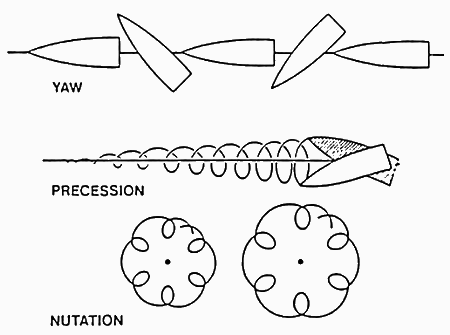
Bullets do not follow a laser beam-like, perfectly straight line to the target, nor does the nose of the bullet always point exactly at the point of aim. Multiple forces are in effect that may cause the bullet to yaw (rotate side to side around its axis), tilt nose-up (pitch), or precess (like a spinning top) in flight. These effects (in exaggerated form) are shown below:
bulletspin02.gif

Yaw refers to movement of the nose of the bullet away from the line of flight. Precession is a change in the orientation of the rotational axis of a rotating body. It can be defined as a change in direction of the rotation axis in which the second Euler angle (nutation) is constant. In physics, there are two types of precession: torque-free and torque-induced. Nutation refers to small circular movement at the bullet tip.

Twist rate, bullet length and uniformity can all affect this.
 
The so called epicyclic swerve rears its ugly head again. I'm still not sold on it. A bad gun is a bad gun, no matter who made it. The reason people hand load is to tune their ammo to the gun if that is the case to correct the problem. I'm leaning towards what Jerry says in that if it is there, it isn't sufficient to cause a 9 MOA gun to magically begin to shoot well at 1000 meters. More research into the topic is needed though. Is Brian Litz the only guy who has an explanation?
 
As far as I know Bryan Litz has posted a challenge on multiple websites (SH, LRH, etc...) for people to demonstrate this effect by shooting through a target at 100 yards so it also impacts a hidden target behind further out to see the group size shrink, including offering a paid trip to his ballistics lab in Michigan, and no one has volunteered so far. Not sure of the current status of it, I don't think I've seen the threads pop up lately, but with all the people who claim to experience this on the internet it should be an easy thing to reproduce. Personally I think it is more to do with parallax issues and the fact that it's easy to see your holes at 100 yards - especially with the bigger calibers where this is most often attributed to, so it is easy to psychologically try and chase the group.
 
I think a better test would be a target at 40 and 100. The folly in this test is that there is no way accuracy would be unaffected after impacting a target regardless of density.
The simulation has to be an MOA (total angle) based simulation and not true inches. If a bullet truly started an entire inch of line at 25 yards it would not come back. Plus the simulation showed the nose of the bullet not the base of the bullet or Axis and the direction of travel was still very centered on the target. I would agree that once the bullet leaves the barrel it will not steer itself back on target and a 1 moa gun at 100 will not magically be a .5 at 1000 unless the shooter got lucky and missed a wind call or yanked a couple into the group. Most of the time we start off with a .250" gun and it grows to 1 moa at 500 and 1.5 at 1000 due to wind.
 
I think a better test would be a target at 40 and 100. The folly in this test is that there is no way accuracy would be unaffected after impacting a target regardless of density.

That was exactly my thought when I read mnr's post directly above yours. If the bullet strikes paper, all results beyond are corrupted.
The answer is no paper. Use acoustic targets instead. (Uses several microphones to triangulate the exact position of the passing bullet.)
https://www.google.ca/search?q=soni...=0CAYQ_AUoAA&dpr=0.9#q=acoustic+target+system
 
Last edited:
http://forum.accurateshooter.com/index.php?board=21.0
The debate rages on but in general, the consensus is bullets wobble is very slight and will damp down fast - if the right twist is provided and there are no real issues in the bullet design.

Will you see a dramatic change in MOA size from 100 to say 300? Not likely based solely on the bullet. There can be alot of error created by the optic AND the shooter and the conditions on the range.

Bullet design has a lot to do with it, I expect. The Brits notoriously loaded their .303 Mk VI and Mk VII as base heavy with lighter fill in the nose... it has variously been suggested that this led to bullet yaw on impact, deformation, and this particular effect.
 
A thin piece of paper isn't going to do anything with 338, 375, etc bullets that this test has been done with. If that was the case then you would expect the group size (in angular measurement) would change after passing through the first target, instead of staying linear within a small margin of error. Unless anyone believes the paper only effects bullets that "go to sleep", making them behave like regular bullets, like some sort of quantum physics wave/particle duality.

There has been extensive discussion about this on multiple websites. I won't post direct links to other sites, but if you google "Applied Ballistics 'Shoot Thru Target' Challenge" you will have hours of interesting reading.
 
There has been extensive discussion about this on multiple websites. I won't post direct links to other sites, but if you google "Applied Ballistics 'Shoot Thru Target' Challenge" you will have hours of interesting reading.

Thanks for the source, definitely interesting.
 
What would make an interesting test would be to have acoustic targets at every 100 Yards, all the way out to 1000 Y.
By using acoustic targets (or laser screens now.), the path could be tracked all the way, without disturbing the true path with paper.
 
I like the idea of the accustic targets. He is another concept I would like to through out there on this. How would BC be affected with a bullet that is wasting energy spinning off center?
 
When sighting in long range rifles for the first time I bore sight (with an empty cartridge) through the flash hole at 25 meters. Since I have the equipment (shooting pedestal and bags) already set up at that distance I take a couple shots to confirm scope settings. At 25 meters most scopes are under range of parallax adjustment so trying a couple rounds doesn't prove much. Sometimes at 25 meters bullet holes are not perfectly round, showing signs of instability. The 25 meter scope settings will get bullet on paper, a bit low, at 300 meters, with perfectly round bullet holes.

Boat tails have to travel through some turbulent propellant gas, deflected by the bullets rear-end angles, to target. I can see that causing yaw. Flat base bullets will stay in front of propellant gas, making them a better short range choice.
 
I did see this issue with my 7mm RUM, best 100 yard group was 3/4" no matter what I tried. However it would hold that 3/4" group at 300 yards when I finally backed it up.

I was so frustrated with my 100 yard groups I just decided to move it out and see what happened, and I was not so angry after that, actually I was, since I told a friend I would sell it to him before I discovered this phenominon!
 
You can see the bullet yaw in this video at 0:26 and at 1:06.

Initial yaw was well documented in Mann's book "The Bullet's Flight", published (as I recall) in the 20's.

I have not read it for 50 years, but I don't recall him saying that yaw had any effect on accuracy.

 
Great video of the AK-74 cycling!

The reason for my initial question was a conversation with another member.
He said that a 50BMG takes a while to stabilize, and that a 2 or 3 inch group at 100Y was not a concern, as it will tighten up.
And it will eventually becoming a tackdriver at long range.
I dont see that happening...
 
Back
Top Bottom