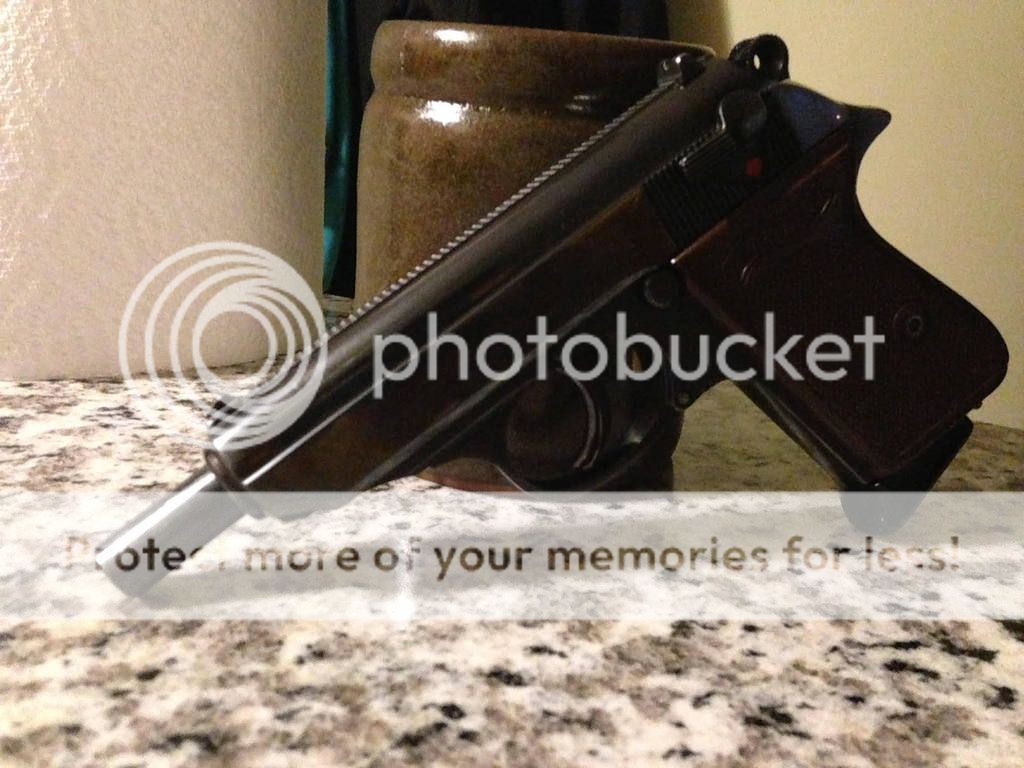
Re-Barrelled PPK Break in period?

Rating - 100%
9   0   0
Location
Montreal
Hello All,

I recently got through the painful 9 month wait to buy a re-barrelled 7.65mm PPK and have it machined by Bits of Pieces. It looks to be a good conversion in that it locks back on empty and has a proper 20lb factory spring.

Problems: (Keep in mind i've only fired 100 rounds down the pipe)

- If i load more than 3 bullets it has a failure to chamber about halfway down the mag lip.
- Occasionally (when dirty) the bullet will run into the ejector and the slide will stay locked back.

I've heard stories about 200-300 rounds is a break in period for one of these beasts? Can anyone confirm??

Thanks,

-Tony

unnamed%201_zpsktai8w20.jpg
 
Last edited:
It needs some tuning up - from here, I couldn't say what, but trying a different clip might tell you something. A little 1000 and then 2000 grit polishing might add to the reliability, but of course there are places to polish and places not to polish. The feed lips on the clip can be polished where they contact the case as it chambers. Make sure that the recoil spring is not wrong-end-forward - the big end goes to the front.

Slowly chamber a round - and notice if it gets tight at some point and slows. Now take the slide off and feed a cartridge by hand - following the same path of motion and see what binds. Sometimes a case will bind on the sides of the chamber while it is still on an angle. A slight crimp or taper crimp might improve that - or a little chamber polishing might help - but be careful - there is no way to put it back.
 
Thanks all for the replies, i clean/ re-lube it before i go to the range for each of my firearms. I have a feeling the bullet "usually" gets caught halfway out of the clip..
 
This is sometimes caused by a roughness on the bolt face that prevents the case head from sliding up past the firing pin hole.

Another catch can happen as the casehead needs to slide up behind the extractor.

If the clip does not latch as high up as it should, the lips can be too low for feeding nice.

If the lips are too tight, the feeding cartridge will be held too low to feed.
 
Break in period; no.
Might be the magazine.
Might be cleanliness/lube.
Might be your ammo.
Reloads or factory?
At any rate if it's factory ammo, clean and lubed then who ever did the conversion isn't done with it...
 
That's a tuning issue, not a breaking in deal. Something is amiss with the magazine or how the round is not slipping correctly into place on the face of the slide. Bottom line is that it sounds like your cartridges are not being correctly controlled during the feed.
 
The reason that Epps and others advocate the .30 Reid conversion vs. .380 for a PP/PPK in .32 is this very problem. Getting the larger .380 ammunition past the ejector / slide lock lever is a big problem. I ruined 3 ejectors before I gave up trying to grind something "just right". There is also the mag release you can run the .380 ammunition into, dropping the mag and making your PPK a single shot. I guess a 2 shot pistol if you start with one up the spout.

After WWII, Walther cut a groove into the grip frame on the ejector / slide lock side, with a matching bump on the magazine and follower. This allows the ejector to be ground almost completely away, and allows the .380 ammunition to pass without jamming or unloading the magazine.

Pre-war and wartime PP/PPK pistols in .380 had a bottom magazine release for this very reason.

Sounds like an imperfect conversion. If you can tell us what caliber you wound up with, and I'm assuming from the problem you're describing that it's a .380, there are a laundry list of potential problems, most of which have been explained here by others. The ejector geometry which allows the .380 bullet to pass, but still has enough sticking out to catch the magazine follower and lock the pistol open when empty, is pretty darned difficult to achieve. I'm not saying it can't be done, but it sure as heck can't be done by me, Epps threw in the towel, and it sounds like Barry may have missed this time. I don't think any amount of smoothing and shooting will help.

I have experienced the burr on the firing pin hole, this is a real problem and can create similar results to those you are experiencing. For a .380 conversion, the breech face needs to be opened up with a milling cutter, and usually the cutter is piloted, using the firing pin hole as a guide. Rough insertion of that cutter could create a burr, and the burr would create jams of the type you describe, as Anchor has already said.

My vote is for the ejector being the jamming point.

If you know how to take these pistols apart, pull out the safety and remove the firing pin and loaded chamber indicator. Then put the safety back, and you can safely test the loading, cycling and jamming of live ammunition. Cycling a pistol you know will jam, with live ammunition and the firing pin / indicator (also sticks out and can jam and hit the primer) in place, is irresponsible to say the least. If you have snap caps, you may or may not be able to recreate the problem. Most snap caps are slightly undersized, which may result in feeding those successfully but not real ammo.

Let us know which caliber you (now) have, but your description screams .380 conversion with ejector geometry issues.
 
.380 conversions are notoriously fiddly. On some guns they work just great, on others no amount of tuning seems to get them to work
 
Hi all,

I slowly fed many rounds into the chamber and it seems that the round hangs on the ejector. Also, sometimes it doesn't slide all the way up past the firing pin hole.

I hear that machining away too much of the ejector will help with reliability, but I will lose the 'lock back on empty' function.

Would it be smart to buy a spare ejector from tradex for 25 bucks and have that one machined to a better fit? I don't really want to start DIY messing around with a firearm...

I find it incredibly difficult to un-jam a ppk since I bought the proper .380 20lb recoil spring. It's tough to hold back while trying to poke around and un-jam a round....
 
I spoiled 3 (three) .32 ejectors before I gave up on trying to regrind .32 ejectors to allow .380 to pass, but still lock open the pistol on empty.

By all means try Tradex, but don't just buy one ejector. You may find a much smarter guy than me, which shouldn't be that hard, but I doubt he'll get it right on the first try.

Barry Jensen claimed (to me) that he could re-grind the ejectors to work. Most of his conversions don't lock open on empty, and again, Epps gave up on this idea too. It is remotely possible that someone with CNC grinding equipment, or maybe just a CNC mill, could adjust these ejectors consistently, and have them work. I couldn't get a prototype working, and again, Barry's pistols usually don't lock open, or if they do, they have your problem. It doesn't sound like he figured out anything, and he is a pretty clever guy who has been doing this for a long time. He didn't have a CNC grinder or mill the last we spoke.

Walther cut a channel in the frame, flattened the ejector, and used a tab in the magazine to lock open the pistol. Pre-war, they used bottom magazine release for .380 pistols, since the bigger round would hit the standard side magazine release on feeding and result in a single shot pistol.

The .380 conversion requires the breech face on the slide to be opened for the larger cartridge with a special milling cutter, the slide barrel opening to be opened up for the thicker barrel, a heavier recoil spring, and then there is the issue of the ejector / slide lock. I have a broach cutter and a guide block in a box somewhere, the same thing that's used to cut keystock slots in pulleys (except my guide is Walther magazine shaped). You don't have to remove a lot of metal, and it's all the same frame -- Walther didn't make a lot of changes in the 50 plus years they made these pistols. A 1930's barrel will fit a 1980's frame. They are wonderful pistols to work on.

If you want the pistol to lock open, you will need to have the frame cut and can then have the existing ejector ground to work, or simply buy a .380 ejector. You will need modern magazines (with the rib). Otherwise, the existing ejector needs to be ground to allow the cartridge to pass, and you will have to give up on the "lock open on empty" feature.

Please let me know if you find someone who can do industrial magic and regrind an ejector that works in your pistol as is. Cutting the frame is ugly, even with tools.

It's a shame that no commercial reloader is interested in the .30 Reid cartridge. That is a simple barrel replacement, and would make a lot of people happy for a lot less money. I have a few different ideas that I hope to make real this summer, but there will no doubt be interesting new problems.

One of the very few people in the USA who owns a PSM pistol, converted one of his .32 PPK pistols to the Soviet-era PSM 5.45 x 18 pistol ammunition with a simple barrel change. The 5.45 x 18 is a hopped-up center fire .22 with a lot of snap, and apparently cycles and ejects reliably. The ammunition is even worse than .30 Reid though -- Tula still makes it, but Russian goods are embargoed and, until that changes, we're S.O.L. on the "easy conversion with factory ammo" for PPK pistols.

I didn't believe it, so I tested the fit of the 5.45 x 18 in a PPK magazine. It fits nicely:

qz4vmr.jpg


The 5.45 PSM ammo is quite snappy and accurate, from my preliminary 3 shots.

.30 Reid or 5.45 x 18 (PSM) are simple conversions, barrel only. Either requires a custom chamber reamer, and at this point, either requires that you reload. .30 Reid is easier and cheaper to make. When we make peace with the Russians, the Tula 5.45 x 18 PSM ammo will eventually find its way here, if Tula Canada manages to survive.

 
Back
Top Bottom