Reloading for a semi auto

patriot87

Member
Rating - 100%
20   0   0
Location
Northern Alberta
Hey guys, just curious about previous experience with reloading for a semi. I'm getting obvious pressure signs in my brass, or at least what I thought was pressure signs. (rings around brass by primer pocket, primer flattening and in some cases ejector marks).

I normally thought this was a slam dunk pressure signs, but where I am having a problem deciphering is that the this loaded ammo is super accurate(sub moa) and I'm getting the EXACT same pressure signs on factory ammo/brass. I'm wondering if my XCR is just hard on the brass... ... Also food for thought my powder charge is way lower than the max specified by the powder manufacturer(IMR) and only .8 gr higher than recommended by the hornady manual(which is still lower than some other manuals)

Thoughts?
 
Brass hardness and excessive shoulder bump can effect your problem along with being over gassed. If you have a adjustable gas block try turning the gas down.
Military brass is harder and less likely to show any pressure signs that the softer commercial cases will show at lower pressures.

When you compare the 5.56 to the 7.62 the larger diameter case will exert more rearward bolt thrust and can cause CHS. My Lyman manual for a AR10 shows a max load of 44.5 of IMR-4064 with a 168 Hornady A-Max.

Case-Head Swipe
https://www.shootingillustrated.com/articles/2011/4/12/case-head-swipe/
 
Last edited:
That's probably it. I'm gonna play with the gas settings on the XCR and try my varget powder...

Thanks!

Varget is slower burning than IMR-4064 and your port pressure will be higher. Fix your problem with IMR-4064 first and if you can't try a faster powder. AR-Comp is listed as potentially the most accurate load and the fastest powder listed for the AR-10. (Lyman AR reloading handbook)
 
If you are getting the same issue with factory ammo, it sounds like a rifle problem to me, not your reloads.
I would try a different brand of factory, and if you still get the pressure signs, take it to a smith.
 
If you are getting the same issue with factory ammo, it sounds like a rifle problem to me, not your reloads.
I would try a different brand of factory, and if you still get the pressure signs, take it to a smith.

The rifle should have a adjustable gas block to turn the port pressure down and stop the problem. Many semi-autos are over gassed to ensure it functions with any ammo.

The fact it does it with factory ammo can mean the gas block is wide open and simply needs turned down to a lower gas setting.

Below a adjustable gas block.

8592d1428006097-xcr-m-range-img_2823.jpg
 
Last edited:
Haven't had a slam fire yet and I got about 1000 rounds through it...

The first time my SKS went full auto I paid more attention to what other people in forums said

CHOOSING THE RIGHT PRIMER - A PRIMER ON PRIMERS
http://www.sksboards.com/smf/?topic=56422.0

It is recommended when loading the AR15 to use primers with a cup thickness of .025.

Most slam fires happen when a cartridge is chambered without the magazine in position to slow down bolt velocity and the floating firing pin has more inertia.
 
And mil-spec 5.56 and 7.62 brass is harder in the base than commercial cases and the 7.62 is also thicker. I buy bulk once fired Lake City once fired 5.56 brass for my AR15 rifles because the cases are tougher and much cheaper.

The problem with buying once fired 7.62 brass is most of it is fired in much larger diameter machine gun chambers. This brass must be resized in a small base die to bring it back to minimum dimentions. And some times you need to size it first with a standard and size again with a small base die because the case is thicker and the brass is harder. Meaning its good brass but requires a lot more work and effort to make it usable.

A load in my Lake City brass will show no signs of over pressure or case head swipes. "BUT" the same load in .223 Federal brass will leave ejector marks and slight case head swipes.
 
The rifle should have a adjustable gas block to turn the port pressure down and stop the problem. Many semi-autos are over gassed to ensure it functions with any ammo.

The fact it does it with factory ammo can mean the gas block is wide open and simply needs turned down to a lower gas setting.

Below a adjustable gas block.

Not an expert on semi autos, but how can the gas setting cause high pressure signs in the brass? Peak pressure is reached when the bullet is only a couple of inches down the barrel, how does adjusting a port at the end of the barrel affect pressure?
 
Not an expert on semi autos, but how can the gas setting cause high pressure signs in the brass? Peak pressure is reached when the bullet is only a couple of inches down the barrel, how does adjusting a port at the end of the barrel affect pressure?

The rotational swipe on the base of the case is caused by the bolt rotating while the case is still gripping the chamber walls. The amount of pressure is governed by the location of the gas port and the diameter of the hole in the barrel. By adjusting the gas port you lower the amount of gas trying to open the bolt. Many reloaders adjust the gas port so the empty case falls at a given clock position on the ground. The amount of gas will determine if the case is thrown forward or to the rear from the 3:00 position on the ground.

On the M1 Garand the gas port is located at the end of the barrel and the bullet has left the barrel before the op and bolt even begins to moves.

If the case is over resized with too much air space between the rear of the case (head clearance) the case is slammed back into the bolt face and leave a imprint of the ejector.

If the brass is softer it can flow into the ejector hole creating a even bigger swipe mark.

Below is a Lapua case fired in a bolt action and the brass flowed into the ejector. This is a very clear sign the load is to hot causing brass flow into the ejector and over 70,000 psi. The only brass harder than Lapua is military brass and if the case was as soft as Federal brass the brass flow would been far more.


index_zpsaiocbozg.jpeg
 
Last edited:
The rotational swipe on the base of the case is caused by the bolt rotating while the case is still gripping the chamber walls. The amount of pressure is governed by the location of the gas port and the diameter of the hole in the barrel.

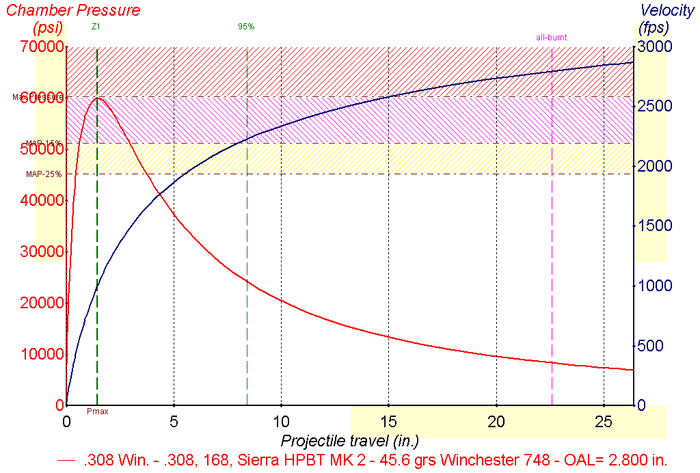
The peak pressure is reached well before the gas reaches the port in the barrel.

For example:
308-168.gif


I'm assume he has an XCR-M, so the pressure at the gas port by the time the bullet gets there is what, 15k psi?
How is adjusting the gas setting down going to change the peak pressure?
Don't forget he's also getting flattened primers.
I'm thinking the OP needs to check the headspace.
 
Back
Top Bottom