












































You are using an out of date browser. It may not display this or other websites correctly.
You should upgrade or use an alternative browser.
You should upgrade or use an alternative browser.
Hornady Brass?
- Thread starter track
- Start date

The internet hearsay is that Hornady brass is too soft and the primer pocket enlarges to the point it will not hold a primer, especially with overloads. I have a little trouble with that conclusion and largely discount it. There is no doubt that the consensus is that Lapua is the best, and my experience with it is certainly good. But, I've also had reasonably good experience with Winchester, Federal and others. I was recently in the market for some new brass for my .264 WM as I have gotten tired of using wrong headstamped 7mm. So I did some research on brass. Here are a couple of things I found.
This is some information on brass uniformity in .223 Rem cartridges. Lapua was best, and Hornady second. Norma was not included in the comparison.
Brass Uniformity Comparison

The other information I found was a survey of the top Precision Rifle shooters and what they use.
Again top is Lapua, and second is Hornady. There is a bit of a story to this though. Clearly Lapua is top choice, but the majority of those shooting Hornady are also using a 6.5 Creedmoor and Lapua currently does not make brass for it. But, regardless shooters are choosing it over the other choices.

P&D actually had a choice of three different kinds of brass for my .264; Norma, Hornady, and Winchester. I selected the mid priced Hornady, but have not used it yet other than checking the flash holes. They needed deburring. Again internet hearsay, but Norma brass potentially is made by RWS, and the Nosler brass is weight sorted Norma. It is probably very good, but also very expensive! And I am not planning to overload my 264, so I'm not too concerned about the "soft brass" story.
This is some information on brass uniformity in .223 Rem cartridges. Lapua was best, and Hornady second. Norma was not included in the comparison.
Brass Uniformity Comparison
The other information I found was a survey of the top Precision Rifle shooters and what they use.
Again top is Lapua, and second is Hornady. There is a bit of a story to this though. Clearly Lapua is top choice, but the majority of those shooting Hornady are also using a 6.5 Creedmoor and Lapua currently does not make brass for it. But, regardless shooters are choosing it over the other choices.
P&D actually had a choice of three different kinds of brass for my .264; Norma, Hornady, and Winchester. I selected the mid priced Hornady, but have not used it yet other than checking the flash holes. They needed deburring. Again internet hearsay, but Norma brass potentially is made by RWS, and the Nosler brass is weight sorted Norma. It is probably very good, but also very expensive! And I am not planning to overload my 264, so I'm not too concerned about the "soft brass" story.

prairie lover
CGN Regular
- Location
- southern MB
actually hornady brass is more money than lapua brass.......
I would take Hornady over anything except lapua. I reloaded Hornady brass 10 times in my .223 before I got worried about case separation
My view is that case head separation should never happen. To get it, you have to over resize the case and push the shoulder back too far creating excessive headspace.

The brass that I avoid whenever possible is Federal. Most Federal brass is considerably softer than others that are available.
I have seen Federal brass with loose primer pockets from factory loads. [My 300 WSM]
I have some Winchester 6mm brass that has been fired 20x with fairly stiff loads, and the primer pockets are still decent.
Using Federal brass, with 2 grains less powder, after 2x firings, I can barely feel the resistance of a primer being seated.
I just toss it in the scrap brass bucket. I do have some Hornady brass, which seems OK. Did have a lot # of Hornady 300 Win Mag
that was a bit soft, but the newer 30-06 brass I have takes the same loads as my Winchester brass, for similar results.
Regards, Dave.
I have seen Federal brass with loose primer pockets from factory loads. [My 300 WSM]
I have some Winchester 6mm brass that has been fired 20x with fairly stiff loads, and the primer pockets are still decent.
Using Federal brass, with 2 grains less powder, after 2x firings, I can barely feel the resistance of a primer being seated.
I just toss it in the scrap brass bucket. I do have some Hornady brass, which seems OK. Did have a lot # of Hornady 300 Win Mag
that was a bit soft, but the newer 30-06 brass I have takes the same loads as my Winchester brass, for similar results.
Regards, Dave.

The internet hearsay is that Hornady brass is too soft and the primer pocket enlarges to the point it will not hold a primer, especially with overloads. I have a little trouble with that conclusion and largely discount it. There is no doubt that the consensus is that Lapua is the best, and my experience with it is certainly good. But, I've also had reasonably good experience with Winchester, Federal and others. I was recently in the market for some new brass for my .264 WM as I have gotten tired of using wrong headstamped 7mm. So I did some research on brass. Here are a couple of things I found.
This is some information on brass uniformity in .223 Rem cartridges. Lapua was best, and Hornady second. Norma was not included in the comparison.
Brass Uniformity Comparison
The other information I found was a survey of the top Precision Rifle shooters and what they use.
Again top is Lapua, and second is Hornady. There is a bit of a story to this though. Clearly Lapua is top choice, but the majority of those shooting Hornady are also using a 6.5 Creedmoor and Lapua currently does not make brass for it. But, regardless shooters are choosing it over the other choices.
P&D actually had a choice of three different kinds of brass for my .264; Norma, Hornady, and Winchester. I selected the mid priced Hornady, but have not used it yet other than checking the flash holes. They needed deburring. Again internet hearsay, but Norma brass potentially is made by RWS, and the Nosler brass is weight sorted Norma. It is probably very good, but also very expensive! And I am not planning to overload my 264, so I'm not too concerned about the "soft brass" story.
I've heard Nosler is just rebranded Norma, never heard it was RWS. Easy way to tell would be to cut the head off one, Norma has a dome shaped primer pocket on the interior like this one on the right.

I don't know if Hornady even makes their own brass or outsources it to the other brass sellers (like Nosler does). Some has been good for me like 257wby, 7x64, and 9.3x62.
I did get some bad 270 from the range that was once fired and would have separated had it been reloaded. It was 30gr lighter then the average Fed/Win/Rem I had on hand.
Last edited:

The information below I think came from reloader magazine and is "ball park" information on .308 Winchester cases. As far as I know no American company makes their brass anymore and buys the brass to make their cases. Meaning they buy the brass from the cheapest vendor to make the cases.
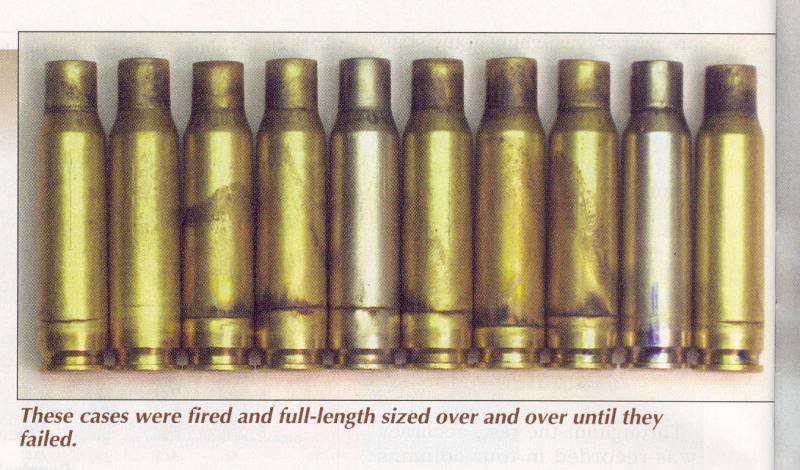
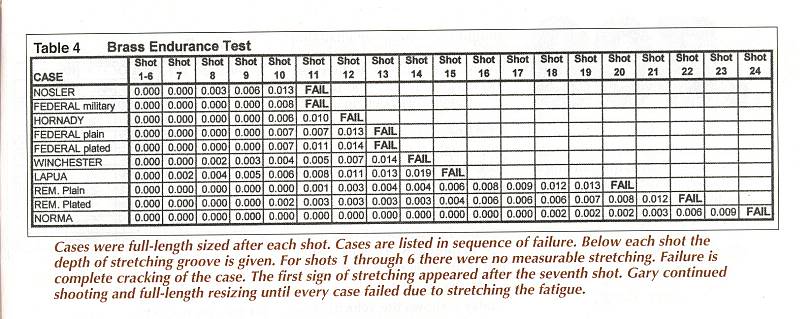
X-Ray Spectrometry of Cartridge Brass
X-Ray Spectrometers Reveal Metal Content of Major Cartridge Brass Brands
http://www.accurateshooter.com/technical-articles/x-ray-spectrometry-of-cartridge-brass/
Below is a good method, it doesn't tell you the chamber pressure, it tells how much pressure that a given brand of case can take. Meaning the strength and construction of the case in the base.
Simple Trick for Monitoring Pressure of Your Rifle Reloads
http://www.hodgdonreloading.com/reloading-education/tips-and-tricks/simple-trick-monitoring-pressure-your-rifle-reloads
Below as Eagleye stated above Federal is known for soft brass and some say they fixed the problem. "BUT" I have a scrap brass bucket half full of factory loaded Federal cases that had over sized primer pockets after the first firing. And this was due to these cases having a thinner flash hole web that adds radial strength to the base of the case.
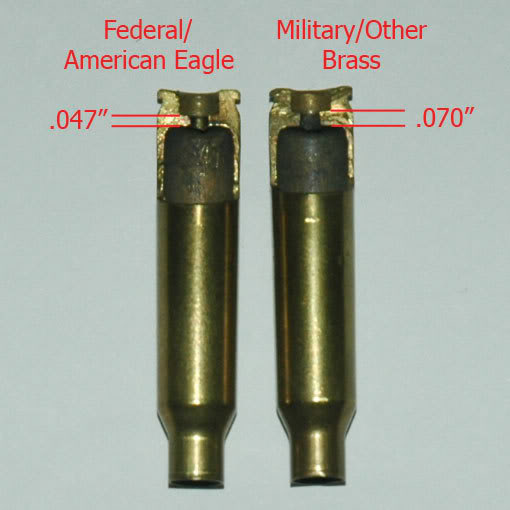
So you can see above why measuring just above the extractor groove before and after firing the case will tell you a good deal about the quality of the case. (and if you are loading too hot)
X-Ray Spectrometry of Cartridge Brass
X-Ray Spectrometers Reveal Metal Content of Major Cartridge Brass Brands
http://www.accurateshooter.com/technical-articles/x-ray-spectrometry-of-cartridge-brass/
Below is a good method, it doesn't tell you the chamber pressure, it tells how much pressure that a given brand of case can take. Meaning the strength and construction of the case in the base.
Simple Trick for Monitoring Pressure of Your Rifle Reloads
http://www.hodgdonreloading.com/reloading-education/tips-and-tricks/simple-trick-monitoring-pressure-your-rifle-reloads
Below as Eagleye stated above Federal is known for soft brass and some say they fixed the problem. "BUT" I have a scrap brass bucket half full of factory loaded Federal cases that had over sized primer pockets after the first firing. And this was due to these cases having a thinner flash hole web that adds radial strength to the base of the case.
So you can see above why measuring just above the extractor groove before and after firing the case will tell you a good deal about the quality of the case. (and if you are loading too hot)

- Location
- Whitehorse, YT
i doubt rws is doing norma brass ... norma has a factory for brass: they are even producing brass for nosler and weatherby ammunition.
i had some issues with hornady brass for my 9.3x62 but seems i am the only having problem with their bullets too ...
i had some issues with hornady brass for my 9.3x62 but seems i am the only having problem with their bullets too ...

I'm searching for input from experienced reloaders who utilized Hornady brass. Is it of good quality? How consistent is it? Pro's and con's? I plan on trying it in my 300 H&H this winter.
Rumour is that Winchester manufactures Hornady brass... How do I know? Well, my buddy found Hornady stamped brass in a package of purchased Winchester brass!
I don't know if Hornady even makes their own brass or outsources it to the other brass sellers (like Nosler does). Some has been good for me like 257wby, 7x64, and 9.3x62.
I did get some bad 270 from the range that was once fired and would have separated had it been reloaded. It was 30gr lighter then the average Fed/Win/Rem I had on hand.
Hornady started making their own brass in about 1984. They should know how to do it right by now!
Ruag Ammotec is the mother company for RWS, GECO, Norma, and others. It is hard to figure out what each sub-company makes, or where they make it. If you go to their site, you can click on each and get a bit of info, but nothing definitive.
Last edited:
Correction, all American ammunition manufactures buy the brass they make cartridge cases from.
After Winchester lost the contract at Lake City Army Ammunition Plant they fell on hard times and sold their brass manufacturing plant. And they were the Last American company to make their own brass for the manufacture of cartridge cases.
Meaning they all now buy the brass from the cheapest vendor to make their cases, and quality is governed by the shock holders.
I'm prepping 100 Winchester .243 cases and found six rejects I would not think of firing due to case forming problems. And these cases should have been found before being bagged up, they had cracked necks and malformed shoulders that stuck out like a sore thumb.
After Winchester lost the contract at Lake City Army Ammunition Plant they fell on hard times and sold their brass manufacturing plant. And they were the Last American company to make their own brass for the manufacture of cartridge cases.
Meaning they all now buy the brass from the cheapest vendor to make their cases, and quality is governed by the shock holders.
I'm prepping 100 Winchester .243 cases and found six rejects I would not think of firing due to case forming problems. And these cases should have been found before being bagged up, they had cracked necks and malformed shoulders that stuck out like a sore thumb.
Rumour is that Winchester manufactures Hornady brass... How do I know? Well, my buddy found Hornady stamped brass in a package of purchased Winchester brass!
Might be Winchester is having Hornady make their brass cases now rather then the other way around.
I bought 2 bags of the newish "red & black" bagged Win brass in .243 and culled about 10% they were such garbage. Big folds in the shoulders, body's, necks from their forming process.
I liked the blue and white Win brass, it was always good stuff.

hunters home
CGN Regular
The information below I think came from reloader magazine and is "ball park" information on .308 Winchester cases. As far as I know no American company makes their brass anymore and buys the brass to make their cases. Meaning they buy the brass from the cheapest vendor to make the cases.
X-Ray Spectrometry of Cartridge Brass
X-Ray Spectrometers Reveal Metal Content of Major Cartridge Brass Brands
http://www.accurateshooter.com/technical-articles/x-ray-spectrometry-of-cartridge-brass/
Below is a good method, it doesn't tell you the chamber pressure, it tells how much pressure that a given brand of case can take. Meaning the strength and construction of the case in the base.
Simple Trick for Monitoring Pressure of Your Rifle Reloads
http://www.hodgdonreloading.com/reloading-education/tips-and-tricks/simple-trick-monitoring-pressure-your-rifle-reloads
Below as Eagleye stated above Federal is known for soft brass and some say they fixed the problem. "BUT" I have a scrap brass bucket half full of factory loaded Federal cases that had over sized primer pockets after the first firing. And this was due to these cases having a thinner flash hole web that adds radial strength to the base of the case.
So you can see above why measuring just above the extractor groove before and after firing the case will tell you a good deal about the quality of the case. (and if you are loading too hot)
Great info. Thanks

- Location
- komoka ontario
I got a couple bags of remmington 22 hornet brass,
All the brass was stamped hornady...
All the brass was stamped hornady...
Hornady started making their own brass in about 1984. They should know how to do it right by now!
Ruag Ammotec is the mother company for RWS, GECO, Norma, and others. It is hard to figure out what each sub-company makes, or where they make it. If you go to their site, you can click on each and get a bit of info, but nothing definitive.
Interesting... maybe there is some that is still out-sourced as in-house (or made to specification)... marketing is a wonderful thing!





















