fulll length resizing

Mr. Jeffery

Regular
EE Expired
Rating - 100%
10   0   0
Gentlemen,
The other day I was at the range and like the cheapskate that I am I had a look in the brass scraps bucket. I noticed that someone tossed out some 50 308 cartridges and well... I dug 'em out and brought'em home. (shortly after I rooted through, another fellow did the very same. He found the 2 308's i missed and a bunch of 38's I had no use for.. LoL!! I feel better now! Im not the only one out there!)


This brass will not chamber into my rifle. I'd like it to, but it doesnt, The once fired brass that come out of my rifle "rechambers" without issue.. Have I wasted my time, soiled my hands and looked like a fool for no reason or can I make this brass "fit" my rifles' chamber?

This range brass goes in nearly all the way, but stops just short of being able to push the bolt handle down.. and the cartridge is a biach to extract afterwards.. So, something in the first gun has allowed the cartridge to expand near the base/primer end. i suspect.

Im looking at the LE Wilson full length case sizer as well as the hornady. Do both of these items require to be mounted into a reloader or can they be used with an arbor press? Am I even on the right path???
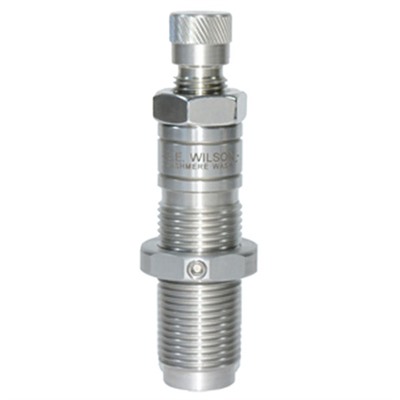
p_749016624_3.jpg
LE Wilson
p_749005670_1.jpg
HORNADY

there's also something avail from Forster... im sure Lyman has an offering also.. etc etc...

With that all said... what are your thoughts? is this doable? or am I just a scrounge (and the other guy) ?

Any knowledge shared regarding what I have in mind will be very much appreciated as well as readily absorbed.

Cheers!

Oh yeah.. and Im using a 0.334 necking bush. I had one round of cartridges that I had to switch to 0.331.

Whats your go to bush size (for most occasions and on avg...)?
 
Last edited:
Full length resizing dies are common by all reloading die manufacturers. Dies go in a press. Brands of dies and presses are interchangeable. There are some proprietary adapters, easy to find generally. It is required to full length resize brass fired in another rifle. Also recommended if reloading for a semi-auto, pump, or lever action. I found 21 30-06 brass in the range garbage last week. Already f/l resized them and added to my stash.
 
Thanks Emerson.

Your comments have made me feel much better! I am on the right path! The 25bucks worth of brass as well as any future finds will ultimately pay for the resizer. Seems like a win win situation.

How do these things work? I have a wilson neck die and decapper. I can use this with an arbor press and I chose this in case I wanted to take it all to the range or the fields and do some on the spot load tests... I am building a kit that I can drag everything I need with me... scale, dies, propellants, primers and projectiles, press as well as measuring and resizing & seating tools.. It should all fit in a box the size of a carry on. So.. having something that fits in my kit would be great! If that's not an option, I would consider making some parts on the mill/lathe so that I can use a portable arbor press
 
Thanks Emerson.

Your comments have made me feel much better! I am on the right path! The 25bucks worth of brass as well as any future finds will ultimately pay for the resizer. Seems like a win win situation.

How do these things work? I have a wilson neck die and decapper. I can use this with an arbor press and I chose this in case I wanted to take it all to the range or the fields and do some on the spot load tests... I am building a kit that I can drag everything I need with me... scale, dies, propellants, primers and projectiles, press as well as measuring and resizing & seating tools.. It should all fit in a box the size of a carry on. So.. having something that fits in my kit would be great! If that's not an option, I would consider making some parts on the mill/lathe so that I can use a portable arbor press

I am a beginner compared to many here. The hardcore precision guys sometimes reload at the range to make everything as similar as possible shot to shot, it most do it at home. I'm not familiar with an arbor press, but if the threads are common to most dies they will all fit. There are a lot of small details to reloading safely. Easy to get into deep unsafe water fast. Like teaching yourself to be a pilot. Google reloading books for a start. Much of the info can be found online although there are misleading crusaders out there too. Unless you are a pro machinist with tools to match its usually much simpler to buy off the shelf reloading dies and tools. An experienced local mentor is the easiest way to go. Post your location and ask.
 
I don't personally have an arbor press but for full length sizing I don't know if they are capable. Perhaps a lee hand press is better suited for the added force needed to full length size. Should be easy to pack to the range.

On a side note, the dies shown require a standard press, the lee would work with those. Also, it is unrealistic to think you can reload forever without the need to full length size. At some point the shoulders will need to be set back after they have stretched. I believe there are dies that will size the neck with a bushing and bump the shoulder back.

Are you a new reloader?
 
Last edited:

Forget about full length resizing in the arbor press, you will need a full size bench mounted press able to do serious sizing operations
even a full length resizing might not let you load the cases into your rifle, range brass is like that, sometime we pick up brass that is
slightly beyond our dies abilities to bring back to factory specs but mostly there are no problems.
bb
 
Perhaps a lee hand press is better suited for the added force needed to full length size. Should be easy to pack to the range.

I believe there are dies that will size the neck with a bushing and bump the shoulder back.

Are you a new reloader?


Ive been "dabbling with reloading for about 4 years now. Nothing "serious" up until about a year ago. Ive mostly reloaded 223 and all the brass was fired from my own rifles so "it fits" on the second go around. I am aware of the issues surrounding reloading multiple times but I am no expert on the same hand either..
Since purchasiing the 308, the draw of precision shooting is on the forefront of my mind. so.. here we go.. This discipline really appeals to some inner demon or trait of mine.

The reason I had asked my question about arbor pressed was to find out whether it was possible to resize with it or if I would need something with a little more snot... From the replies, It seems my press may be far too small and I have no intention of doing that sort of procedure at the range.. All case prep is a home job to me... Necking and decapping can be done at the range when developing a load. I really didnt want to have to buy a press.

Both of the dies pictured about supposedly bump the neck. I have no more information than that. Most of my equipment is LEWilson and I was hoping to stick with it.

As for machining stuff. I know very little about how the pictured items work. Something has to push the cartridge in, something has to de cap it and someting has to spit it out to make room for the next piece of brass. My next die is a flip flop deal. Put the cartridge in. press it into the die and size the neck, flip it over, decap and eject.. Next! repeat. i can effectively decap and resize about 200 cartridges in a night in front of the tube (while watching a sniper movie of course!!)

Anyway....
I'd mentioned about about necking bush size... What the flavour(s) of the day for the most part? Im squeezing the neck down to 0.303 ID. For me that means a 0.334 for federal and 0.331 for Winchstr brass. If I use 0334 on winch... the bullet falls out! LoL!!! Got a story about that.... Good thing my buddy checked.. could have been REALLY nasty.
 
Forget about full length resizing in the arbor press, you will need a full size bench mounted press able to do serious sizing operations
even a full length resizing might not let you load the cases into your rifle, range brass is like that, sometime we pick up brass that is
slightly beyond our dies abilities to bring back to factory specs but mostly there are no problems.
bb

My rifle expands the butt of the cartridge to 0.469" the range brass (from two seperate pick ups are both 0.471" Who knew 2 thou would cause an issue... ?
 
at some point in time your going to need a small base shoulder/body bump die and a bench mounted reloading press, I can get 4-5 firings with neck sizing only and then the bolt gets stiff to close, that's a sign it's either time to use the bump die or a full length sizing die, however I don't like how much the full length dies squeeze the neck down in diameter before the expander mandrel opens them back up. The other flip side of of the shoulder/body bump die is the ability to run loaded ammo into the die it it gets hard to chamber
 
Thanks Dave,
Got any recommendations? I figured 4-5 reloads then it would be time...

BTW, your name came up in conversation a few days ago at the range.. we were talking about triggers..... It was mentioned that I should talk with you about it.

Cheers
 
get a redding small base shoulder body bump die, but make sure it's the small base, the regular one will not size the web of the case near what it requires for a tight bolt action rifle chamber.
I am just south of you and travel through to shoot every month.........
 
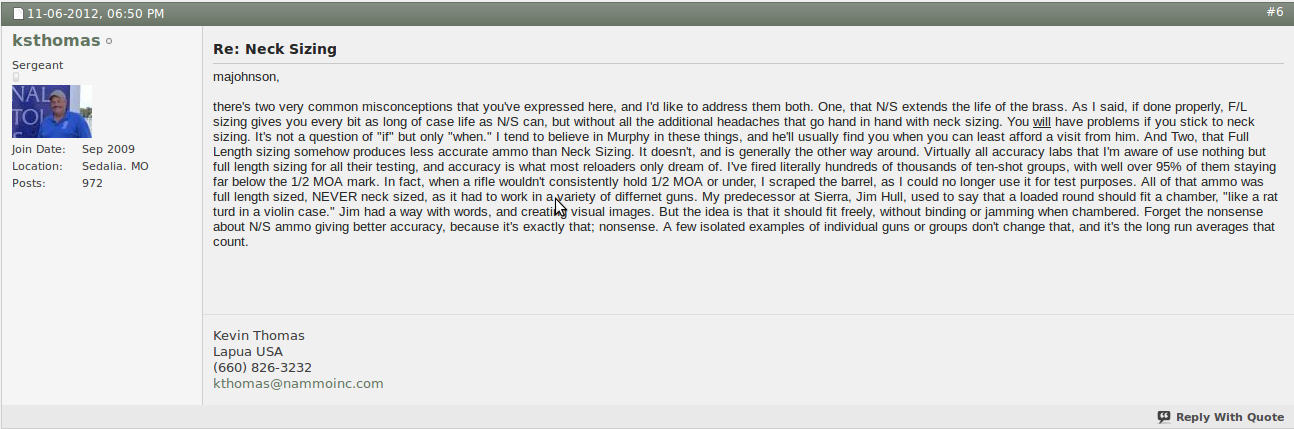
Below Kevin Thomas who worked in the Sierra ballistics test lab, and now shoots for "Team Lapua USA".

Y3IiYL5.jpg


Bottom line buy a Forster full length benchrest die with the high mounted floating expander and forget neck sizing and bushing dies.
At the Whidden custom die website they tell you they get the most concentric ammunition when using non-bushing full length dies.

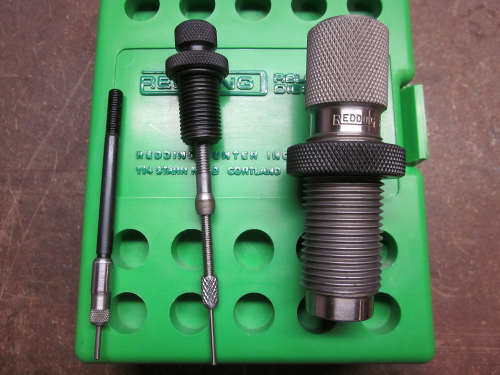
Below a Redding .243 full length die with a Forster spindle and expander assembly installed to reduce neck runout.

kWbieba.jpg
 
Last edited:

BigEd, Kevin Thomas is well respected and knows his stuff.

I won't say he's wrong but for shooters with commercial rifles there are just to many variables for what he says to be true of most commercial, off the shelf rifles.

I have a couple of those "real gems" that love full length resized cases and shoot them as well or better than NS cases. On the other hand, like most others, I have rifles that will only shoot accurately with ammo that has been shot out of their chambers and neck sized only. Neck sizing only is a disaster waiting to happen if the cartridges are going to be used in different chambers.

The OP just didn't realize that chambers will have minimum and maximum specifications and anything in between is acceptable as a commercial product. Way to many variables to take into account.

The cartridges he scrounged could have been fired in a milsurp chamber or in a rifle with a larger chamber than his rifle. I usually will FL scrounged brass. Not worth taking a chance with. I also have an anal habit of dedicating brass to a certain rifle. Scrounging brass from the scrap can at the range only makes good sense to me.

OP. NS only is a trick used by bench rest shooters whose rifles usually have minimum spec chambers and under spec neck diameters which require the necks to be turned to allow the bolts to close on the cartridge in the chamber. The reasoning behind this is to keep everything as concentric to the axis of the chamber/bore as possible. IMHO this will also work in some commercial/off shelf rifles as long as they have been chambered with a piloted reamer or you've managed to get lucky and their equipment fed the reamer true. With the advent of CNC machining chambers are much more consistent and true than they used to be.

Another thing I have found with scrounged brass is that it has been discarded because it's gotten hard from repeated firings and needs to be reannealed. I have some 30-06 and 6.5x55 cases with over 60 reloads on them. Yes, they have been trimmed when they get to long.

Keep scrounging that brass, I have saved literally thousands of dollars by following that practice myself.

If you have a rifle with a true chamber that will handle FL resized cartridges in an accurate manner then by all means go for it. It may cause a bit of extra stretching but not enough to be noticeable. One thing to be careful for though is to make sure you aren't setting back the shoulder more than a few thou. That's where the stretching occurs.
 
No, I didn't. Kevin Thomas is used to shooting either custom rifles or special test rifles. That's where his expertise is. In such rifles I agree with him completely.

One of the reasons we NS only is to try to make up for imperfections in our chambers and their concentricity to the axis of the bores. Many BR shooters load their bullets into necks with almost no tension and load them out so far they come into contact with the lands and are actually set back into case when the bolt cams closed. This is done to pre seat the bullet so it enters the leade true and no deviation is created during the jump to enter the leade.

You need a very tight chamber with a cartridge case already formed for that chamber to do this safely.
 
It's not uncommon to have difficulty chambering once fired brass from another rifle, especially if you haven't fire formed it in your chamber or full length resized it. Any FL resizer should fit your press. Then you can use a collet or neck sizer from there. Can't answer anything regards bushings.
 
No, I didn't. Kevin Thomas is used to shooting either custom rifles or special test rifles. That's where his expertise is. In such rifles I agree with him completely.

Kevin Thomas worked in the Sierra test lab where the reloading data for the Sierra manual comes from. And if you look in the Sierra reloading manual stock off the shelf factory rifles with SAAMI chambers are used for testing.

The rifles Kevin Thomas uses with Team Lapua USA have custom tight neck chambers, "BUT" Kevin Thomas uses full length bushing dies with these rifles.

The rat t u r d in the violin case humor does mean something, the body and neck of the case do not touch the chamber walls. The cartridge is supported in the rear by the bolt face and by the bullet in the throat. The only part of the cartridge that touches the chamber is the shoulder of the case as it it is pushed forward by the ejector or firing pin.

Bottom line a full length resized case has "wiggle room" to let the bullet be self aligning with the axis of the bore. And if you bother to look the vast majority of competitive shooters full length resize their cases.

Below the competitive shooter German Salazar and friends with Kevin Thomas and the late Jim Hull is answering a question about "partial full length resizing" and why complete full length resizing is the best option.

Reloading: Partial Neck Sizing
by German A. Salazar
http://riflemansjournal.########.com/2010/06/reloading-partial-neck-sizing.html

"Now the last scenario, a full-length sized case in which the neck is also fully sized. There is clearance at the neck and in the body of the case, the closest fit anywhere is the bullet in the throat. If the neck to bullet concentricity is good (although it needn't be perfect), then the bullet will find good alignment in the throat and the case body and neck will have minimal influence. Let's not forget that the base of the case is supported by the bolt face or the extractor to a certain degree as well; this is yet another influence on alignment. As you can see, there are several points from base to bullet that can have an effect. My procedure is to minimize the influence of those that I can control, namely the case body and neck, and let the alignment be dictated by the fit of the bullet in the throat and to some extent by the bolt's support of the base. Barring a seriously out of square case head, I don't think the bolt can have a negative effect on alignment, only a slightly positive effect from minimizing "case droop" in the chamber. Given that a resized case will usually have a maximum of 0.001" diametrical clearance at the web, this isn't much of a factor anyway."


What this means is if the case has any thickness variations the thin side of the case will expand more and the case can warp. And by full length resizing you reduce the guiding effect of the case body with the axis of the bore. And above it mentioned "out of square" case heads which has the greatest effect on causing the cartridge to be tipped in the chamber. Meaning the .001 to .002 shoulder bump leaves this much clearance between the bolt face and the rear of the case and some "wiggle room" for warped cases.

And if you neck size only the cartridge is a snug fit in the chamber and the out of square case head can push the bullet out of alignment with the axis of the bore. So a lot of this boils down to the quality of the cartridge case, and full length resizing reduces the effects of the imperfect case that stretches and warps when fired. And this is where the "wiggle room" of full length resizing aids with bullet alignment with the axis of the bore and accuracy.
 
Last edited:

Over the years I've picked up and reloaded range brass with success. . After lubricating the cases full length resize by running the shell holder all the way up, in the press, and turning the resizing die down till it touches the shell holder and then a tad more so you feel a slight cam action. . Also the shell holder and die should be of the same maker. . Set your case length trimmer, to the correct length, and run each case through the trimmer so every case is exactly the correct length so bullet seating and crimping is equivalent to each cartridge. . Visually check each case thoroughly for case head separation, split necks etc.

It's important not to over crimp the bullet seating or the you may bulge the case shoulder that may prevent chambering the cartridge with ease.
 
Great replies guys. Thank you muchly. I almost lost this thread...

So.... Sounds like my L.E.Wilson dies may not have been my wisest choice. good for the range and that's about it.

The brass I picked up the other day doesn't chamber in my rifle. (I suspect that my fired brass would chamber in the other rifle though....) I did find some that fit and I will reload that and shoot it. I suspect that I will get 3-5 reloading cycles before I have to bump the neck on the brass I currently have. I will looking into a FL die. The redding die that BigEd posted above looks acceptable. I just didnt want to have to go out and pick up that rig quite yet. I had thought about making a die of my own and infact I did try something out in the shop the other day, but it was more sketch than anything. I was able to reduce the diameter of the head so that I could chamber the cartridge and it worked but it wasnt made from harden-able steel. The first (and only) cartridge worked quite well, but all subsequent cartridges were scored from the sides of the bore hole coming away. If I had been able to make it from better steel and actually has a 308 reamer, I could have resized the head to fit my rifle and then fireformed those cases to my rifles chamber. Again.. sketchy as all get go.. so I will have to look into a FL die.
 
Ive been "dabbling with reloading for about 4 years now. Nothing "serious" up until about a year ago. Ive mostly reloaded 223 and all the brass was fired from my own rifles so "it fits" on the second go around. I am aware of the issues surrounding reloading multiple times but I am no expert on the same hand either..
Since purchasiing the 308, the draw of precision shooting is on the forefront of my mind. so.. here we go.. This discipline really appeals to some inner demon or trait of mine.

The reason I had asked my question about arbor pressed was to find out whether it was possible to resize with it or if I would need something with a little more snot... From the replies, It seems my press may be far too small and I have no intention of doing that sort of procedure at the range.. All case prep is a home job to me... Necking and decapping can be done at the range when developing a load. I really didnt want to have to buy a press.

Both of the dies pictured about supposedly bump the neck. I have no more information than that. Most of my equipment is LEWilson and I was hoping to stick with it.

As for machining stuff. I know very little about how the pictured items work. Something has to push the cartridge in, something has to de cap it and someting has to spit it out to make room for the next piece of brass. My next die is a flip flop deal. Put the cartridge in. press it into the die and size the neck, flip it over, decap and eject.. Next! repeat. i can effectively decap and resize about 200 cartridges in a night in front of the tube (while watching a sniper movie of course!!)

Anyway....
I'd mentioned about about necking bush size... What the flavour(s) of the day for the most part? Im squeezing the neck down to 0.303 ID. For me that means a 0.334 for federal and 0.331 for Winchstr brass. If I use 0334 on winch... the bullet falls out! LoL!!! Got a story about that.... Good thing my buddy checked.. could have been REALLY nasty.

You don't have to full length size every time. Once you've got them back to factory spec then fired in your rifle you can use your neck sizer at the range for a few loads. You would still have to buy a press to use the f/l die unless you have a friend that would let you use theirs. As others have said you should get four or so loads before needing to f/l size again, watch the trim length too. I don't use bushings so can't help with that question
 
Back
Top Bottom