












































You are using an out of date browser. It may not display this or other websites correctly.
You should upgrade or use an alternative browser.
You should upgrade or use an alternative browser.
reloading magnum caliber brass
- Thread starter rhino519
- Start date


- Location
- Prince Albert, Sk
Power of load has a great deal to do with it, which relates to stresses/fatigue on the cases as well as sizing on the case creating wear and fatigue.Primer pockets stretch over time and is related to load as well.Necks get brittle if not annealed.
The hotter the load the less one gets out of them for use.
I won't say one chambering will have brass last longer than the next because the loads one settles on can vary greatly and the pressure created can be a very wide range.
Some literature on brass prep in one of the manuals is a very good start or google if you have very specific questions , or here.
The hotter the load the less one gets out of them for use.
I won't say one chambering will have brass last longer than the next because the loads one settles on can vary greatly and the pressure created can be a very wide range.
Some literature on brass prep in one of the manuals is a very good start or google if you have very specific questions , or here.

with no anealing?I've got seven loadings on some of my 7mm rem mag brass and will keep going until it looks like it will seperate. I only load 61 grs of 4831 behind a 140 gr bullet so its by no means hot.

Attilathecanuk
CGN Regular
- Location
- On the way to Onoway
I am on 4 reloads with 7 mm remmag, brass is fine. I don't load the max charge and I do not anneal.
with no anealing?
In the past I never kept records and got brass mixed up , and I never annealed , when I noticed the necks splitting I would cull , often loose primer pockets would show before the necks split and/or signs of case head seperation . I now keep track and have better luck but I don't shoot enough to know how many firings the brass is good for , I have just used new brass after problems started to show .I have went up to and over 5 with small batches sized properly (5-10) that I used for testing then I culled them .

Not to hijack the thread but to clarify....
I bought around 400 rounds of 300wm brass, half once fired and half has been reloaded not sure how many times. Should i skip keeping track and just look for signs of failure or color the once fired red and the others blue for tracking??
FYI I will be using 200gr and above bullets.
I bought around 400 rounds of 300wm brass, half once fired and half has been reloaded not sure how many times. Should i skip keeping track and just look for signs of failure or color the once fired red and the others blue for tracking??
FYI I will be using 200gr and above bullets.

don't know if this question been asked before but how many times is it safe, if any at all, to reload casings in magnum rifle calibers? i'm specifcly lookin at 300WM
There is no set limit, and case life involves many factors, brand and quality of the brass, how much the case stretches on the first firing and how far you push the shoulder back during resizing.
I have been reloading for over 47 years, I do not anneal and the majority of my cases fail due to split necks. I also have 30-30 cases over 25 years old and I had one split neck.
Bottom line your case life will depend on you and how well you take care of your brass.
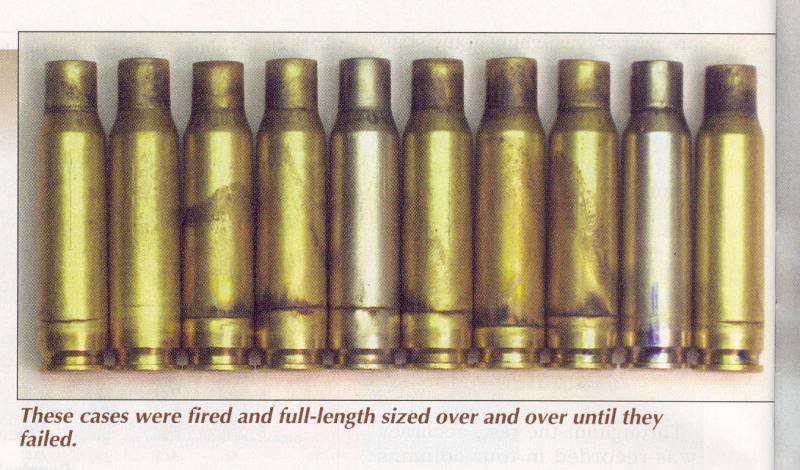
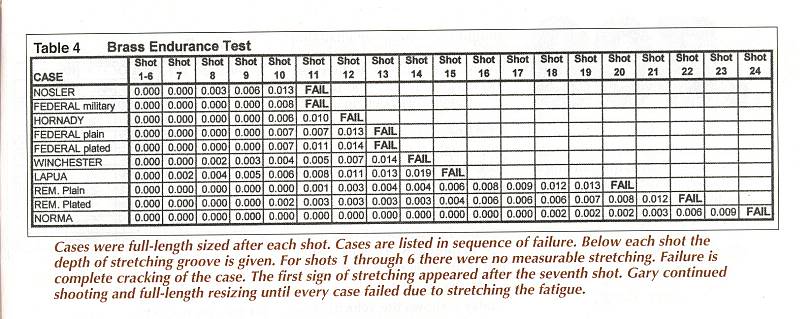
Below .308 Winchester cases tested until they separated and a "ball park" idea on case life. Just remember that rifle chambers and resizing dies vary in size and some dies "might" work your brass more. Example I have a Lee .223 full length die that will reduce the case diameter "MORE" than my small base dies do. So having gauges to measure your cases are good to have.

I have several 308 Norma Magnum rifles, and of course, I keep the brass fired in each rifle sorted to be fired in that rifle only.
I also have a die set for each rifle, to avoid adjusting the die for every rifle. I am very careful not to push the shoulder back too much.
Norma brass is very good quality, as the post from bigedp51 shows. [quote: "Bottom line your case life will depend on you and how well you take care of your brass".]
I do not load these rifles "light" They are hunting rifles and get stiff loads [180 at 3100+, 200 at 2975] I start losing brass
due to neck splits if I do not anneal about every 6-7 firings. That being said, I have some 308NM brass that has been loaded 12 times,
and still works fine. Primer pockets are noticeably looser, but not to the point of discard.
I have not had a case separation yet with any of these rifles. AAMOF, I have not had a case separation in any of my rifles in the last
8 years or so. Must be doing something correctly. Dave.
Dave.
I also have a die set for each rifle, to avoid adjusting the die for every rifle. I am very careful not to push the shoulder back too much.
Norma brass is very good quality, as the post from bigedp51 shows. [quote: "Bottom line your case life will depend on you and how well you take care of your brass".]
I do not load these rifles "light" They are hunting rifles and get stiff loads [180 at 3100+, 200 at 2975] I start losing brass
due to neck splits if I do not anneal about every 6-7 firings. That being said, I have some 308NM brass that has been loaded 12 times,
and still works fine. Primer pockets are noticeably looser, but not to the point of discard.
I have not had a case separation yet with any of these rifles. AAMOF, I have not had a case separation in any of my rifles in the last
8 years or so. Must be doing something correctly.
Dave.The only time I anneal is when I'm forming to some caliber that is a big jump from the case I'm using. When I'm prepping my brass for reloading everyone gets looked at really well and what ever looks like it will give trouble gets tossed.

Below .308 Winchester cases tested until they separated and a "ball park" idea on case life. Just remember that rifle chambers and resizing dies vary in size and some dies "might" work your brass more. Example I have a Lee .223 full length die that will reduce the case diameter "MORE" than my small base dies do. So having gauges to measure your cases are good to have.
Was this test a one-off for each make or were multiple casings used to average out the data. Just wondering as in everything else, I have casings from the same make and the same lot which show quite a bit of variability over the same number of firings with the same loadings. If the above test was just one case from a make, it might just indicate a worst or best case scenario within a make too. While none of mine have failed yet, it will be just be a matter of time until one does. I have noticed a few with lightened primer seating and wall thickness thinning at the neck after 5 reloadings, but it is far from consistent across the entire lot. Some stretch more than others and required trimming. Usually if I get some bolt sticking or extraction stickiness, then the entire lot gets full length resized and trimmed for consistency. I have some brand new Lapua .223 and .308 brass. If a lot test has not been done, I should set aside 10 random casings and do the above test. Could be a nice project over the next year or so.

It largely depends on how hot your loads are. If you load hot, primer pockets will loosen in only a few shootings. Like 3 or 4. If you load mid-range loads or less, you can get 10-20 firings if you anneal and don't over work the brass. If you load low velocity plinking rounds, like using pistol bullets in a rifle or slow cast loads, cases can last forever practically.
I have 4 firings out of my brass , I could tell the primer pockets were a little looser on the last loading, also the neck tension was a little light. I want to aneal before next loading.
I would never use the brass you are referring to with any Max Magnum loads. Personally I would discard any Magnum case that exhibits any deficiencies in the brass.
Not to hijack the thread but to clarify....
I bought around 400 rounds of 300wm brass, half once fired and half has been reloaded not sure how many times. Should i skip keeping track and just look for signs of failure or color the once fired red and the others blue for tracking??
FYI I will be using 200gr and above bullets.
I would keep track on any case that you use for serious magnum load shooting or Hunting. You wouldn't want that once in a life time Moose to get away due to a case failure would you?
Carefully inspect each case for signs and skip the count for general plinking is fine.

BigUglyMan
CGN Ultra frequent flyer
- Location
- New Scotland
Not to hijack the thread but to clarify....
I bought around 400 rounds of 300wm brass, half once fired and half has been reloaded not sure how many times. Should i skip keeping track and just look for signs of failure or color the once fired red and the others blue for tracking??
FYI I will be using 200gr and above bullets.
Shoot them until you start seeing the primer pockets getting loose then ####can the lot of them and buy new virgin brass.
I've never annealed brass and, so far, so good. I would do it if I was making brass for the 219 Donaldson Wasp or something else that requires a lot of sizing to get to where I'm going. Even necking up 1F brass from 30-06 to 9.3mm I only lost 3 or 4 cases though they could probably stand being annealed.





















