to heck with load development

Longwalker

CGN Ultra frequent flyer
Super GunNutz
Rating - 100%
216   0   2
Location
Saskatchewan
I'm an incurable gun trader, and obsessive- compulsive reloader. I have always tried to come up with the ultimate load for each rifle, tweaking this and that, trying different bullets, powders, seating depths, etc etc. But then I sell that particular rifle and have a whole bunch of specialized ammo on hand. I tend to just shoot that ammo in the next rifle that comes along that can use it. I have come to the conclusion that specialized ammo is seldom necessary, and that with reasonable care and attention a good load in one rifle will almost never be unsafe in another firearm if staying within published maximums, and will usually shoot good in others too. If it were otherwise, factory loads would not be practical.
So now I want to load "good enough" ammo for all the various rifles that will possibly fire it. Any one else take that approach? Will I be voted out of the club?
 
Yup...
Good enough for me and my purposes. There's no point in me developing a load that will hold sub-MOA at 1000 yds, since I don't have the skills, equipment, or the range to make use of it!

That being said, I do like to know that my hunting ammo is reasonably accurate and consistent.
 
n

Due to the variations in reloading components and firearms it is best to make workup loads.

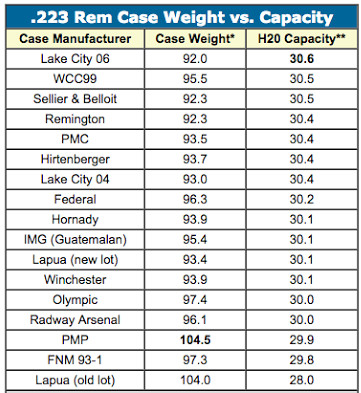
Example below and changes in case capacity, the top case at .223/5.56 case at 30.6 grains of H2O capacity and the bottom case at 28.0 H2O capacity.
This difference in case capacity with the same load of 25 grains of H335 and a 55 grain Hornady FMJBT will cause a 6,000 psi difference in chamber pressure. (using Quickload)

LjAQ7L9.jpg


And this is just the difference in cases, rifles have different throat lengths, bore diameters and then the variations in other reloading components.

When you see a pressure test barrel used in the reloading data the chamber and bore are at SAAMI minimum dimensions to create the highest possible chamber pressure.

If you see a specific firearm listed then a strain gauge is glued to the barrel and the chamber pressure measured. And this is why the data varies between reloading manuals.

So go ahead and just pick a load at random, its your face next to the rifle when you pull the trigger.

PijdpgS.jpg


cKCA1re.jpg


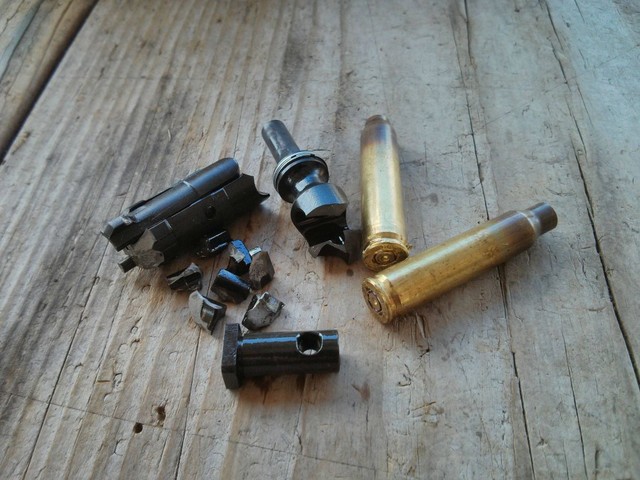
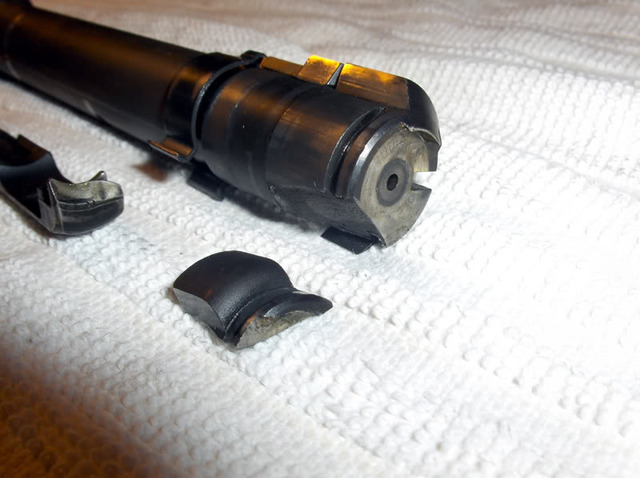
Oversize Bullets, Reduced Powder Charges and other Blowup Stories
http://www.leverguns.com/articles/taylor/blowups.htm
 
No need for scary pictures - I don't just pick a load at random. Yes, i agree that all those variables are important, and to ignore them can be dangerous. I do account for things like case capacity when choosing a load. I have been reloading for more than 30 years and have developed loads for more than 50 rifles so have a bit of experience. I no longer try for the maximum speed possible at the maximum pressure allowed in a particular firearm. And I just don't care any more if my load is 50 or 100 fps slower than the maximum possible, or 1/4" less accurate than the ultimate a rifle is capable of. I want a good load that works very well in any rifle I put it in. Like a decent factory load. For example, I have three 30-06 rifles at present. I shoot the same load in all three that was developed in the one with the shortest throat and tightest chamber. Developed the original load in the heaviest brand cases. No big surprise, that load in my tightest chambered rifle also produces the highest speeds, and I assume pressures. But all three shoot that load quite well. Why have three loads for three rifles? Same with my four .222 rifles, my two 7x64's and four 7x57's, two .308's and four .375 H&H's etc.
 
There is no doubt that you can load moderate loads to use in more than one rifle of the same caliber without any ill effects assuming proper OAL's and full length resizing and sturdy cases.
In the end of the day loading for the sake of saving money or for ultimate performance will dictate how deeply you get involved and how much you are willing to spend to find that magic load for each gun.
Personally scary pictures are all good. A reminder that there are rules and procedures to follow that can be fatal if not adhered to.
bb
 
I'm an incurable gun trader, and obsessive- compulsive reloader. I have always tried to come up with the ultimate load for each rifle, tweaking this and that, trying different bullets, powders, seating depths, etc etc. But then I sell that particular rifle and have a whole bunch of specialized ammo on hand. I tend to just shoot that ammo in the next rifle that comes along that can use it. I have come to the conclusion that specialized ammo is seldom necessary, and that with reasonable care and attention a good load in one rifle will almost never be unsafe in another firearm if staying within published maximums, and will usually shoot good in others too. If it were otherwise, factory loads would not be practical.
So now I want to load "good enough" ammo for all the various rifles that will possibly fire it. Any one else take that approach? Will I be voted out of the club?

Factory ammo works because the manf doesn't need to reload the brass again.... you will.

Chambers vary and there can be enough to cause undersized brass to break and separate... not good for rifle or you.

I would not mix ammo with reloaded brass into rifles without confirming that the headspace and dimensions are really close.

Then there are throat lengths which can now vary more then the chamber... how do you load for a min/under min spec throat vs one that is huge?

Err on the side of safety AND accuracy. Work up a load for each rifle... keep the brass separated and maybe even have a set of dies for each rifle.

That is how I do it...

Jerry
 
I'm an incurable gun trader, and obsessive- compulsive reloader. I have always tried to come up with the ultimate load for each rifle, tweaking this and that, trying different bullets, powders, seating depths, etc etc. But then I sell that particular rifle and have a whole bunch of specialized ammo on hand. I tend to just shoot that ammo in the next rifle that comes along that can use it. I have come to the conclusion that specialized ammo is seldom necessary, and that with reasonable care and attention a good load in one rifle will almost never be unsafe in another firearm if staying within published maximums, and will usually shoot good in others too. If it were otherwise, factory loads would not be practical.
So now I want to load "good enough" ammo for all the various rifles that will possibly fire it. Any one else take that approach? Will I be voted out of the club?
I do load development to get best accuracy loads for some rifles, but I load "good enough" for most firearms. Some of the old guns don't need to be subjected to hundreds of rounds of additional firings every time I change a component. Some circumstances don't require moa accuracy. But I do work up from a starting load for a new-to-me firearm, even if I don't develop it past "good enough". A few extra starting loads in 1-2 gr steps doesn't take much extra effort and you usually learn something from it.
 
I usually do specific load development for each "new to me" rifle that comes home to me.
However, I at times take shortcuts, with safety in mind. I'll give an example:
I recently acquired a Winchester M70 FWT chambered in 7x57 Mauser. I already own a
Remington 700 "Classic: so chambered, and have owned at least 10 other 7x57 rifles over the years.
My pet load in the 700 is the 140 Accubond, chased by 50 grains of Reloder 17. Stellar accuracy, and
very decent speeds. For my M70, I simply took the same components, adjusted the seating depth
to suit the Winchester, and started at 48 grains of RL 17. In 1 grain increments, I worked up to 50 grains.
Guess what? It shoots sub-moa for 3 shots, and clocks 2865 avg. No excess pressure signs.
This will be fine for any hunting I will do, and I doubt I will bother to work up another load with this rifle/
bullet combination. I later plan to do load development with the 150 Scirocco II, but until then, all is OK.
D.
 
I have to chime in on this one because I recently bought a Tikka T3X in 223 with my other 223 (Weatherby) I spent lots of time load developing tweaking trying to make the most accurate ammo I could - I did achieve accuracy under MOA at 200 yards (4 shots) but it took time and money to do so. Back to the Tikka broke in the barrel today at the range had 40 rounds of Sako 55g that I bought - once the scope was zeroed - at 50 yards I had a 1/4 inch four shot group (Damn!! it I said to me self) ain't going to waste time trying to improve this - bought another 60 rounds. Once, I have it zeroed at 1.25 inches high at 100 yards it will be more than enough for my Coyote hunting and will be good for 200-250 yards. Will keep the 1f brass separate from my other brass just in case I decide to sell the entire lot of Sako brass.

I will reload for the weatherby since I have a good load data for it and do not consider the time I spent loading developing a waste of time - I did learn how to make accurate ammo and its this skill set I will use when I reload for my 6.5 creed.
 
Whenever there is a scope power, or hunting range thread there will always be those who swear that the average range is under 100 and practically nothing is over 200 yards. That might even be true, or at least I believe the people posting it think it is.

If that is indeed the truth; I don't know why they would ever develope a load for accuracy,
or handload, or mount a scope, or shoot anything that wasn't among the very cheapest cartridges in the blue box Federal pile. Why bother with smokeless powder at all?
 
Aw c'mon Dogleg, where's your sense of humour? I wrote the original post as a way of getting a discussion going. Seemed to achieve that, in a limited sense anyway. i actually do pay attention to things like throat length and tight vs. loose chambers, and case weight ( capacity) but despite that, when loading for instance for my current 4 .222 rem varmint rifles, all seem to like a load that I have settled on, using IMR4198, Nosler BT 40 gr, and Rem 7-1/2 primers. No need to test further to get 1/8" better accuracy.
I have found that all my 3 current 30-06 rifles like H4350 and 180 grain cup and core bullets of almost any flat base design and Rem or Win LR primers loads to produce 2700 fps MV. The accuracy doesn't vary by more than 1/2" at 100 yds. compared with other loads tailored for specific rifles.
All my 4 various 7x57's like H4350 and 160's at 2600fps.
My 4 .357H&H rifles like RL15 and 270 gr, Hornady or almost any other bullet of that weight at with any case I have tried and a magnum primer at 2700 fps. I'm still working on a a good generic 300 gr. .375 load.
My several .308 Win. rifles like Varget and 165's ,etc, etc.
 
All I know is that for 50 yard fun plinking I am not going to invest a lot of time and energy developing loads. I started doing some but then found I was having more fun blasting lead down range with my kids than I would have sitting at a bench by myself.
 
It would be very interesting to see data on the percentage of reloaders that actually find the most accurate load at say <75% of max published charge.
Its definitely a good idea to work up in a new rifle. But I used to waste too much time and components testing low and mid range powder charges.

I generally seem to end up loading closer to (one side or the other) the max end of the published data.
 
All I know is that for 50 yard fun plinking I am not going to invest a lot of time and energy developing loads. I started doing some but then found I was having more fun blasting lead down range with my kids than I would have sitting at a bench by myself.

I too enjoy shooting with my friends far more than reloading. I have to load up some 9mm, and 45acp soon though.
 
I'm going to side with longwalker on this one. Unless the rifle I have chosen to develop a load for has been purchased for ultimate accuracy it gets fed a moderate pressure load from a previous rifle and if the accuracy is where I'm happy with then both rifles get fed the same thing. If any load is hight speed or high pressure then it is worked up to confirm that I won't have any unexpected explosive surprises.
I want to spend my shooting time doing what the rifle was made for not spending hours and a hundred rounds trying to squeeze that last bit of speed and accuracy out of my deer rifle or my 357 plinking gun.
 
I am a fairly novice reloader, but i have always had "good enough" results (for me) with loads that lean towards the starting charges. So once i find one that is good enough for me, i stay with it. I dont shoot in competitions so its not a big deal for me if its not the perfect load.
 
Back
Top Bottom