Powder Went Bad

Ganderite

CGN Ultra frequent flyer
Rating - 99.7%
355   1   0
From time to time someone asks on this forum if their powder is still ok.

Those of us who have had powder go bad say something like "If it is bad you will know."

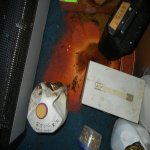
I just found that a jug of powder went bad. It gassed up, ate a pin hole in the jug and blew the typical red residue out of the jug. It stinks like ammonia. The powder in the jug is a solid lump.

This powder is only 20 years old.
DSCN1093.jpg
 

Attachments

  • DSCN1093.jpg
    DSCN1093.jpg
    80.7 KB · Views: 942
I have had powder go bad usually 30 or 40 years old. I have powder from the 60's that is still very good. Good storage conditions help but sometimes the powder just doesn't last. I have bought large lots of powder from some older people and most of is still in excellent condition. The two part fans that went bad where under 20 years old,one IMR and one alliant. Both excellent powders which I have bought new and will continue to use.

 
4895?...probably best not to use anyway if unsure...lol

My powder comes in 45 and 60 pound drums. I decant it into jugs and label the jugs with something to help me note the lot or batch for record keeping of loads. They are not canister grade powders.

In this case the drum was 4895 but I did not know anything else about it. Hence the ? My other jugs of 4895 are 4895LC because it came from Lake City. The ? lot is 2 grains faster than the LC.

The bad powder is 8506 made by Expro in the 80s. It is similar to slow Varget or fast 4350.
 
Ganderite, I noticed that you had the powder in a white plastic jug. I was told that white plastic jugs were not good to store powder in as they allow light through which is suppose to be bad for powder. Is there any truth in this or just an old wives tale. All of the major powder manafactures ship their's in black plastic ones.
 
Thanx for the heads up.

I have a couple of full containers of 8506 from Expro as well from the eighties. A 40 pound, laminated paper keg, which was a gift from my old friend Tom Higginson. It arrived by special courier one day after my birthday.

Tom was good people. I liked him a lot and when I think about him, I miss our conversations. I first met Tom back in the late sixties. He was always a gentleman, even if sometimes outspoken. A tome of inormation.


I don't like laminated paper containers. They can and do absorb moisture out of the air IMHO and because I can't explain discoloration on such containers when the bags inside are fine as is the powder. I just repackage it into old liquid detergent jugs as they seem to be impervious to everything, including acid and are very sturdy to take up the rigors of surge pressure when they're dropped while full of liquid.


I really like that powder, especially in my 338-06 where I use it almost exclusively to get an honest 2700+fps with 225 grain bullets, without pressure issues. I find it to be as consistent as the old Nobel 47N which was in the same burn range. I liked 47N but it turned as well.

time lapse::::::

I just checked the containers. They're fine but I think this may be a sign it needs to be used up while I still can.

Thanx John.
 
I would take a close look at the type of container and if you have similar containers being used for bulk storage of powder, their contents. The type of plastic and or residual chemicals from a previously used container may have reacted with the powder.
I have experienced very old powder getting a rusty / brown color and a strong ether smell , but never eating through the container ( plastic or metal).
The clumping into a solid mass may indicate moisture ingress more than age deterioration of the powder.
Is it possible the container had a pinhole before it was used for powder storage? As dissolving plastic to form a hole seems odd.
An inspection of the inside of the container near the hole , should show thinning or additional pitting if corrosion is the culprit.
 
I have hundreds of pounds of powder in the magazine in milk jugs, juice jugs and window washer fluid jugs. I am looking at some juice jugs that are about 40 years old, here in my shop.

This is only the third time in 50 years a jug has gone bad. The other 2 were both CR17 - which went bad for a number of others, too.

If it is the jug that caused the problem, so be it.

I first met Tom Higginson in about 1966. he was moving into his new house in Hawksbury. Over the years we had many dealings. I supplied him some of the Expro powders he sold. I had a R & D relationship with Expro.
 
Ganderite, I noticed that you had the powder in a white plastic jug. I was told that white plastic jugs were not good to store powder in as they allow light through which is suppose to be bad for powder. Is there any truth in this or just an old wives tale. All of the major powder manafactures ship their's in black plastic ones.

I have an older 8 lb round keg of H110 that is white plastic (not solid white but sort of semi transparent)
It has the original label on it so i'm sure it's original. Looks like back in the day that was probably normal.
 
Last edited:
I am not a powder expert (chemically) but know a bit about using it.

I worked with a PhD chemist who knew everything there was to know about powder - except what it was used for. We made a good team.

I asked a lot of questions and remember a few of the answers. One was that powder has solvents and water in it. If you let it dry out (leave it in the powder hopper) it speeds up. This is why you hear that a new lot of powder is "slow".

The important thing about packaging is a tight lid.

I asked about throwing old scraps of powder on the lawn for fertiliser. He said it would take about 20 years for the powder kernels to break down. Slow release fertiliser....

The powder from EXpro (IMR) and Bofors (e.g. RL15) came in 20 and 30 kg fibre drums. The powder was inside in a heavy duty garbage bag. It had to be decanted into jugs for storage. It came in 1300 pound shipments, because that is all my little truck would hold.
 
I just dumped a one pound H4831 on the garden a week ago. It's probably 30 years old, but that's a guess. I check with the old sniffer when I open a jug. This one had no aroma at all. might have gone bang, but, I was going to use it for load development. If it doesn't burn right, you might just add more, that could result in developing a load that could be dangerous with fresh powder. I opened a fresh jug, and enjoyed that wonderful aroma.
Some manuals say to rework a load when you switch lot numbers, same could be said for opening a fresh can.

Was actually thinking about H4831 when I dumped it. R.I.P Bruce.
 
I just dumped a one pound H4831 on the garden a week ago. It's probably 30 years old, but that's a guess. I check with the old sniffer when I open a jug. This one had no aroma at all. might have gone bang, but, I was going to use it for load development. If it doesn't burn right, you might just add more, that could result in developing a load that could be dangerous with fresh powder. I opened a fresh jug, and enjoyed that wonderful aroma.
Some manuals say to rework a load when you switch lot numbers, same could be said for opening a fresh can.

Was actually thinking about H4831 when I dumped it. R.I.P Bruce.

I posted this to show what "bad" powder looks like. Catastphic break-down. Yellow gunk.

The old pound of 4831 was still usable, but would be a bit different than a fresh one.

My powder is mostly in 8 pound jugs. I would have taken that 1 pound and added it to an 8 pounder and shaken. (not stirred)
 
Back
Top Bottom