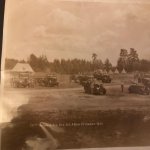
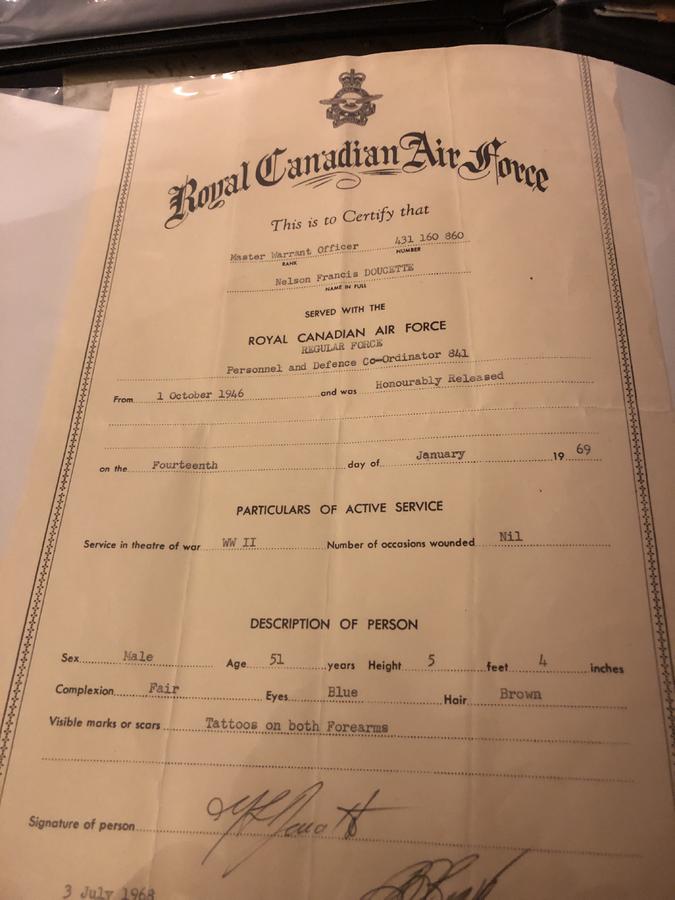
Some pictures from our Canadian military history...

louthepou

Snow-White Le Mod<br>Moderator
Moderator
Rating - 100%
792   0   0
Location
Aylmer, QC
A friend of mine was kind enough to share some of his family's military history souvernirs.

His grandfather:

" Nelson Francis Doucette. Fourth Light Anti-Aircraft Battery, Royal Canadian Artillery.

Participated in D-Day. My Grandfather was overseas for the entire 5 year war. Billeted in England. D-Day, continental Europe."

Then in 1946 he joined the RCAF until 1969. Quite a career I think.

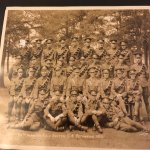
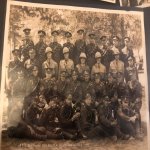
My friend has little information about the pictures posted here, thankfully there are some written info on some of them. Please feel free to help us figure out some of the stories about them...
5.jpg

6.jpg

4.jpg
 

Attachments

  • 5.jpg
    5.jpg
    133.6 KB · Views: 466
  • 6.jpg
    6.jpg
    96.7 KB · Views: 467
  • 4.jpg
    4.jpg
    46.6 KB · Views: 466
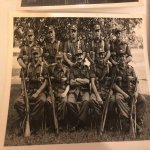
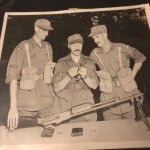
Front row, in the middle - Nelson Francis Doucette

3.jpg

2.jpg

No idea about this one:
7.jpg

Look at that mustache. Awesome.
8.jpg

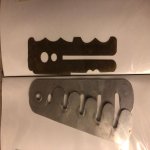
And, on that last picture, he's using these tools - anyone knows what these were used for?
9.jpg
 

Attachments

  • 3.jpg
    3.jpg
    104.1 KB · Views: 460
  • 2.jpg
    2.jpg
    58.3 KB · Views: 456
  • 7.jpg
    7.jpg
    80.6 KB · Views: 462
  • 8.jpg
    8.jpg
    71 KB · Views: 457
  • 9.jpg
    9.jpg
    38.4 KB · Views: 459
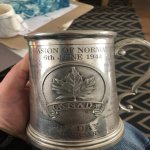
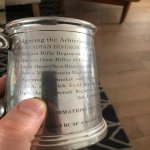
I figure these guys certainly qualified as "Do Deserve a Drink", right?

IMG-1263.jpg

IMG-1264.jpg
 

Attachments

  • IMG-1263.jpg
    IMG-1263.jpg
    90.4 KB · Views: 455
  • IMG-1264.jpg
    IMG-1264.jpg
    65.3 KB · Views: 454
Front row, in the middle - Nelson Francis Doucette

View attachment 243347

View attachment 243348

No idea about this one:
View attachment 243349

Look at that mustache. Awesome.
View attachment 243350

And, on that last picture, he's using these tools - anyone knows what these were used for?
View attachment 243351


They are called button sticks - you put them underneath or around your brass buttons on a jacket and polish them without marking the cloth. The slit takes the brass parts of the webbing belt.
 
I remember those cotton Bush uniforms for summer wear. They must have spent an hour with an iron just before this pic was taken. Nice boots too.


I remember being issued Bush uniforms when I joined the Milita in 1971 , never wore it though , we had Combats for field , but wore Battledress for parade , and of course the Puttees with ankle weights
 
These are shields to polish your brass buttons and your regt crest, etc. So you don't get brasso on your uniform.

attachment.php
 
Bush pants were turned into a thing of beauty and a joy to behold. Beaucoup spray starch, and even sewn in creases, made them look very spiffy with customized ankle boots and well wrapped puttees.:eek:
 
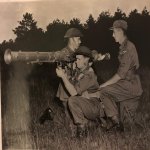
3.5" Anti-Armour Rocket Launcher in Canadian service from the 1950s to the early 1980s. My Army Reserve unit in 1980 still had these in the weapons vault. They were notoriously unreliable as electronic leads had to be clipped onto corresponding wires at the back of the rocket in order to fire it. The Trigger was an electrical generator that sent a charge to ignite the rocket motor. The Launcher breaks down into two parts for ease of transport.

What I can't figure out is what Canadian Air force members are doing with predominantly Infantry weapons in this photo and the other showing the stripped US M1918 Browning Automatic Rifle. Very curious....

 
I don't recall having to clip any leads to anything on the circular tail fin assembly of the 3.5", but there was a paper clip serving as a 'safety' device we had to remove as we loaded. You always gave the tail fin a few turns after inserting to ensure a good contact.

Fun watching the rocket wobble in flight as it arced it's way to the target! Archaic, but it worked.
 
3.5" Anti-Armour Rocket Launcher in Canadian service from the 1950s to the early 1980s. My Army Reserve unit in 1980 still had these in the weapons vault. They were notoriously unreliable as electronic leads had to be clipped onto corresponding wires at the back of the rocket in order to fire it. The Trigger was an electrical generator that sent a charge to ignite the rocket motor. The Launcher breaks down into two parts for ease of transport.

What I can't figure out is what Canadian Air force members are doing with predominantly Infantry weapons in this photo and the other showing the stripped US M1918 Browning Automatic Rifle. Very curious....

I had read somewhere , that the M1 Garand was issued to some Canadian units in Europe, with the NATO force , also the Browning Auto Rifle too, there was several Canadian printed training manuals for these weapons , also prior to the Korean War , there was a plan to change over to US Infantry weapons , but this plan was dumped with the out break of the Korean War and our Canadian brigade been part of the British Commonwealth Division, staying with our Lee Enfields, and Bren gun made ammo supply and maintenance much simpler,
 
RCAF base defence personnel were armed with BARs and M1 Garands in the early NATO years. Told to me by a friend who served as an RCAF MP during that time. Yes, we used the 3.5 inch RCL as well. I had the opportunity to lug one of those around.

 
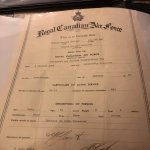
Just wondering. He was member of RCAF 1946-1969 Document says he served in WW2.???? While WW2 ended in 1945...was the RCAF informed? Did the RCAF classify him as a WW2 vet by error or was there some reason to this?


KW8eHDh.jpg
 
Back
Top Bottom