












































You are using an out of date browser. It may not display this or other websites correctly.
You should upgrade or use an alternative browser.
You should upgrade or use an alternative browser.
Salt bath annealing
- Thread starter TrxR
- Start date


what they are saying does not make sense.
I thought the article was pretty clear
I thought the article was pretty clear
If the brass reached the right temp how does it matter if it was induction , gas flame or flame or salt bath

But it doesn't reach the ideal hardness using the salt bath method
Since this "test" was not done by an actual accredited lab I suggest we take the findings "with a grain of salt" Had they paid an independant lab to do the testing, i would not dispute the findings.
why not?temperature is temperature...why should it matter if salt or flame or magnetic fieldBut it doesn't reach the ideal hardness using the salt bath method


ChewyChewbacca
CGN Regular
- Location
- Port Edward BC
I guess AMP has to try and justify there $2000 price tag when comparing it to the $125 price tag of salt annealing.
My thoughts exactly. 500C is 932F and if I recall 700F is the max you want to go. So it’s comes down to how long you leave it in the salt.
I’m sure AMP is a good product but way out of my price range.


What I don't get is how the body and shoulder gets too soft,( "softer than virgin brass") but the neck which is in the liquid does not.
I can think of at least one major reason. The brass is plunged into the hot salt to somewhat past the shoulder body junction. The neck brass is significantly thicker than the body brass so it will take more heat/time to get up to temp. If you apply more time in the salt to heat the thicker brass of the neck, the thinner wall of the body/shoulder area will get even more heat so it will anneal quicker. I can understand fully how they get the results they get from the measured hardness profile. On the other hand, while this heating profile isn't exactly what is desired, it does provide some annealing of the neck area, just not what they feel is 'perfect'. Best effect would be to heat for long enough to minimize the over-annealing of the shoulder/body region. This would result in under annealing the neck but would not over anneal the shoulder/body area.


The AMP annealing test article reminds me of what NECO did going all over the web saying that posting Quickload results was a copyright violation when it was not.
Reminds me of our President that keeps saying "no collusion no obstruction".
Reminds me of our President that keeps saying "no collusion no obstruction".
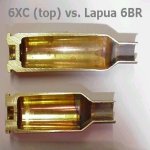

Just looked at some more articles on the AMP site and they showed both a Norma and a Lapua case sectioned and measured. Interesting. Since forming the brass requires several cycles of stretching and annealing it thins the wall from the web to the mouth as the brass is lengthened. Once sufficiently lengthened it is trimmed to length and then several cycles of neck forming by die tapering and annealing occur. Stretching the brass thins the wall from the thickest at web to the thinnest at the mouth and the tapering process to form the shoulder and neck squeezes the brass down which thickens it in this area. Bottom line is that the thinnest point in the brass generally occurs near the interface of the shoulder to body where the brass has been thinned relatively the most by stretching without receiving any of the thickening by the tapering process. Still, in well made brass, the wall thickness is quite consistent throughout the entire region based upon the examples and measurements they show. I have always thought that the brass thickness at the shoulder/body interface was close to 10 thou, the shoulder would increase thickness by around 3 thou to the neck thickness in the order of 13 thou. This does not look to be the case.
Thanks for the pics of the Lapua brass above. Even without measurements it can be seen that the thinnest portion of the brass does occur in the shoulder right near the interface with the body, but neck thickness and shoulder thickness while different, do not appear to be sufficiently different to change heating due to the salt bath. What else can cause the results they measured? Why does salt bath annealing not sufficiently anneal the neck reqion? Is this something that can be overcome by a timed slowing of the immersion process so that the neck region gets the most heating time and the body the least?
I don't believe AMP is skewing their results for some indefinable tin foil hat reason or to beat their own drum louder than everyone else. They are measuring something here and there must be a reason they are seeing these results. There are all sorts of flame style annealing machines out there and they actually say that they tend to work so, what could be going on with the salt bath not working as well as other methods and is there something that can be changed to improve the results?
Thanks for the pics of the Lapua brass above. Even without measurements it can be seen that the thinnest portion of the brass does occur in the shoulder right near the interface with the body, but neck thickness and shoulder thickness while different, do not appear to be sufficiently different to change heating due to the salt bath. What else can cause the results they measured? Why does salt bath annealing not sufficiently anneal the neck reqion? Is this something that can be overcome by a timed slowing of the immersion process so that the neck region gets the most heating time and the body the least?
I don't believe AMP is skewing their results for some indefinable tin foil hat reason or to beat their own drum louder than everyone else. They are measuring something here and there must be a reason they are seeing these results. There are all sorts of flame style annealing machines out there and they actually say that they tend to work so, what could be going on with the salt bath not working as well as other methods and is there something that can be changed to improve the results?
Last edited:





















