












































1917 Remington P14 Mk1 refurb - salvageable or junk?

Wallaback

CGN Regular
Rating - 100%
18   0   0
Location
Ontario
Good day wise wizards!

I come to you with a tale of woe involving my first tentative foray into the world of milsurps. A little while ago, I was at a gun show and picked up what, to me, looked like a lovely example of a restored Remington-made Pattern 1914 Mk1* Enfield, with all matching metal but a newly made, reproduction stock, for an agreeable price.

ioxGUEq.jpg


Lacking any serious gunsmithing experience, but with no lack of ignorance/naivety, a quick initial look down the barrel seemed to show what to me looked like a par for the course milsurp barrel. Not shiny, but clear, well defined grooves.

9FtTdFg.jpg

NnWVT3q.jpg


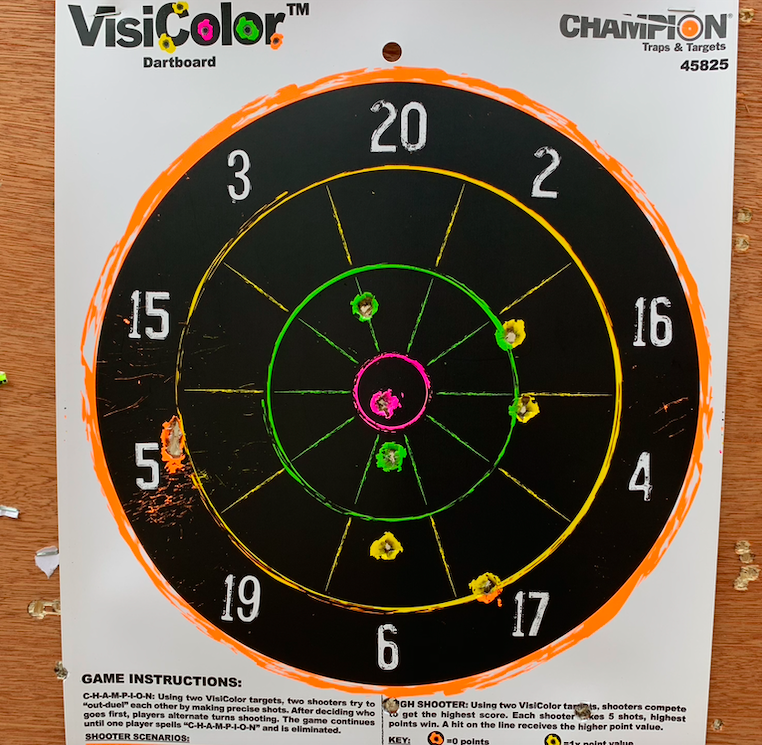
Having heard about the supposedly above average accuracy of Pattern 14s, I was excited to take it to the range and see what it had to offer. Alas, consider my surprise when the rifle, shot supported from a bench, produced somewhere around Minute of Barndoor at 100 yards. A switch from 180gr Winchester .303 SP to 180gr Remington Core-Lokt lead to similar results. Unfortunately I did not have any period-correct 174gr ammo lying around to give that a try.
zyjsGMa.png


Can you spot all 12 rounds? Yeah, me neither.

What particularly concerned me was the little fella right by the #5 on this highly professional sight-in target. That is one heck of a mighty tumble at only 100 yards!

So I started to take a closer look at the rifle. The Upper Barrel Band is fairly loose, allowing the barrel to move almost freely about. That probably doesn't help, but nothing a quick shim can't fix. A little bit of online research seems to suggest that throat wear on P14s can sometimes lead to stability issues using boat tail projectiles. Both ammo types I shot were boat tails, so that could be the culprit as well. It is exceedingly difficult to find flat-based .303 projectiles, making this perhaps a long-term deal breaker.

But then came the kicker: Taking a closer look at the crown, the light happened to fall in just the right way for me to discover something that (to me at least) looks seriously disturbing: A series of roughly 6 gashes in the barrel, all but invisible when the bore is inspected from any regular angle. I must have inspected the barrel and crown at least a dozen times, both normally and before/after cleaning, and I had never noticed it before. It took a good bit of trickery with additional lighting and camera angle to bring you the photo below:

jo9biyz.jpg


Could this be the culprit? I have never seen this kind of damage on a barrel before! Frankly, I'm not even sure what could have caused this. The damage extends roughly 1 1/2 inches into the barrel. Am I naive to think a simple counterbore might resolve the issue?

I'm not too worried about preserving the rifle's collectability. The stock is already a refurb, and the metal, while all matching in terms of serial number, had a large parts of the proof marks, etc, seemingly ground off at some point. The desired end-state is a well functioning, reasonably accurate range gun with milsurp legacy and appearance, not a collectors item.

Cheers, and I look forward to hearing what you guys have to say!

Wallaback
 
Looks like you need a barrel. Don't know where youcould get a new one.
Look for a bubba'd rifle with an intact barreled action with a decent bore. Should be able to find something for $150-$200. Cobble together a rifle using the best parts.
 
Some things I see in your pictures - that floor plate / bottom of magazine looks like it is sticking out of the stock?? The trigger guard should be laying into an inlet right even with the bottom of the stock, so only the floor plate protrudes below the bottom stock line. Almost as if your stock was inlet for a converted "straight" floor plate, and then a correct military "goose necked" one is installed??
Just recently went through with a similar looking bore in P14 here - shiny on top of rifling, dark in the grooves - with a bore scope, I discovered that "dark" was a whole series of little pits - and that was after multiple soaks with WipeOut to remove copper and powder fouling. Very, very do much want to be using flat base bullets, I would think?
Those old long stocked military rifles - the barrel should be mostly free floating in that lower stock - often want stock support right under the chamber, but then free of contact with the stock all the way to last inch or so of the fore-end - at that point, you want the stock pressing up on the barrel. The hand guards on top should not touch the barrel at all, in any place. Bands should be tight enough that the wood pieces do not "wiggle" against each other.
So, just from your pictures, I think you have a number of things to investigate. These are 100+ year old rifles. 3" five shot groups at 100 yards is pretty realistic expectation - was "good enough for government work"...
 
Strange damage given that the crown looks nice. I wonder how that could have happened? Personally I would probably counterbore it before giving up on it but that may just mean I've got too much time on my hands. You'd have to decide if the balance of the bore is good enough to justify the work. I have had success counterboring a few rifles (Lee Enfield and Mosin) that had very serious problems at the muzzle but very good bores up to that point. Your photos of the bore are pretty good and it does look rough but I'll mention I have an Eddystone P14 with similar appearance that shoots so well I put a Parker Hale target sight on it and routinely get surprising groups from it. It's big problem was another thing you have to consider- it was in a replacement stock and did not initially sit on the wood correctly (as brought up by Potashminer while I was typing).

milsurpo
 
Some things I see in your pictures - that floor plate / bottom of magazine looks like it is sticking out of the stock?? The trigger guard should be laying into an inlet right even with the bottom of the stock, so only the floor plate protrudes below the bottom stock line. Almost as if your stock was inlet for a converted "straight" floor plate, and then a correct military "goose necked" one is installed??

You're correct Potashminer. The magazine floor plate sticks out more than it should with an authentic stock. My understanding is that the stock on this rifle was made from a blank by a gentleman in Alberta. I suspect he did his best to approximate the correct shape, but got it a little wrong at the bottom. Or maybe it was an aesthetic choice, I'm not quite sure.

Very, very do much want to be using flat base bullets, I would think?

Yeah, flat based seems to be the way to go with these from what a lot of forums say. But do you (or someone else on this forum) have any recommendations for good projectiles that fit the bill? Almost all I can find are boat tails, and the only one that isn't is a round-nose soft point that seems more suitable (and priced) for hunting than range use.


So, just from your pictures, I think you have a number of things to investigate. These are 100+ year old rifles. 3" five shot groups at 100 yards is pretty realistic expectation - was "good enough for government work"...

She'll be a project for sure!
 
Some P-14 rifles have generous bore diameters (WWI, WWII). I had one that would only shoot .314" did bullets. That ruled out any modern ammo that was made to a .311" dia. If I shot .311" dia bullets I would get keyholing and sloppy groups.
Most modern .303 is .311" or .312" depending on who made it.

Two things to do..

1) Measure your bore dia. slug your bore or see a gunsmith. If you have a .311 dia bullet you can see if it drops through the bore. Don't be surprised if it does.

2)Don't rule out counterboring (common for a P-14) the muzzle as deep as the marks in the bore. I had a p-14 with the end of the bore slightly bent down. I had it counterbored slightly past the bend and it grouped within 2"@100 yards.

Also, ss mentioned above, it also looks like the stock has been sanded too much at the mag well. Barrel bands are to support the barrel and hold the stock together with the handguards, they should not be dead tight nor loose.

Pete
 
It's big problem was another thing you have to consider- it was in a replacement stock and did not initially sit on the wood correctly (as brought up by Potashminer while I was typing).

It's definitely something I'll take a closer look at, and it might help tighten up the groups eventually - but for me right now a lack of bullet stability (as indicated by the tumble) is the primary symptom of concern with regards to whatever is affecting the accuracy of the rifle - and I don't believe a poorly fitted stock could cause that?
 
Some P-14 rifles have generous bore diameters (WWI, WWII). I had one that would only shoot .314" did bullets. That ruled out any modern ammo that was made to a .311" dia. If I shot .311" dia bullets I would get keyholing and sloppy groups.
Most modern .303 is .311" or .312" depending on who made it.

1) Measure your bore dia. slug your bore or see a gunsmith. If you have a .311 dia bullet you can see if it drops through the bore. Don't be surprised if it does.

I don't have a caliper (or loose .311 projectile) on hand, but I was able to easily put a round of .303 into the barrel up to the start of the casing neck, with some wiggle room. I think you might be on to something! How available are .314 projectiles? (I am a complete rookie when it comes to the world of reloading - it's a rabbit hole that I've only glanced at with interest, but not delved into just yet)

2)Don't rule out counterboring (common for a P-14) the muzzle as deep as the marks in the bore. I had a p-14 with the end of the bore slightly bent down. I had it counterbored slightly past the bend and it grouped within 2"@100 yards.

That's encouraging to hear!
 
I do not know of any source for jacketed bullets larger than .312. I have some Hornady #3130 here - they are .312" 174 grain flat base, but round nose, Interlocks, so "hunting" bullets. I do have a mould that casts a bit larger than .314" from wheel weights, and a .314" sizer, that I use for a couple Lee Enfields in 303 British.

Just a comment - as you increase bullet diameter, the neck of your re-loaded cartridge gets bigger. Sometimes you end up that the oversize bullet has made the neck too fat to fit into the neck area of your chamber. My Lee Enfield's take the .314" without problem - no idea about your P14.

Slugging the bore, and having a cerro-safe chamber cast will tell you what you have to deal with. I have no experience with counterbores, but certainly has been done many times - I suspect a "good job" results in good results - somebody with a hand drill and an un-piloted twist drill bit probably gets predictable results.
 
Slugging the bore - might consider a slug into the chamber end of the rifling for an inch or so, then back out. Do the same at the muzzle - maybe in an inch and back out. Lets you get an idea of the changes, if any, in bore diameter. A slug run all the way through from one end to the other will only tell you what the smallest diameter was. And your pictures show 5 groove rifling - probably going to need a machinist's help to measure actual diameter of 5 grooves - does not have opposing grooves, so difficult to do without proper V-block...
 
Hornady

.303 British .312" dia

150 gr interlok SP & 174gr RN SP

Woodleigh bullets 303 British .312" dia

PP SN 174gr & 215gr RN SN

Here's an article about a lee speed rifle restoration, but most interesting is dealing with an oversized bore and accuracy.

ht tp://www.rathcoombe.net/sci-tech/classics/lee-speed/lee-speed.html
 
I have several Finn Mosin Nagant rifles with some hefty counterbores. I realize that they were usually hard up for rifles, but they worked. You're not going to war, so give the old rifle a chance.
 
Two things to consider.
I have firelapped barrels in the past with good results, with LBT's paste, and more recently with diamond paste.

Also, with the use of cordite, chambers became eroded rather quickly, so a larger bullet may do the trick. The chap at 303British.com feels that .312 bullets are really too small and that .314 is proper for the .303.
Also, NOE makes their mould 314299 available in .316 and in a worn chamber this may do the trick. If you're using a soft lead bullet, it will size down nicely upon shooting to fill the bore.

If you're not too far from Sudbury, we could have fun trying to improve things.
 
The crown looks to need a bit of a touch-up, but I don't think that is the issue.

Before doing anything like counterboring, I'd do a bit more testing.

Ku25DKum.jpg


That's the bore on a 300 Win Mag that shot less than moa at 300 yards. Not from a clean bore, but after a few fouling shots, it was OK.

First: I'd test using some ammunition that is known to be accurate. 2 bullets that I know work are the Speer and Sierra 150's. I'd not worry about them being 311, after a bit of fouling they should work fine.

Or try cast. Start from a cleaned bore, then let the lead and grease smooth out the anomalies. After it starts shooting, clean with a bore snake, with a bit of oil on it as per instructions, one pass and that's it. 2 moa should be a realistic goal. Use a gas checked bullet. Most of mine worked OK with the 150's, never resorted to cast.

Mil-Surp is not bench rest or hunting. It's about enjoying the shooting.

Nitro
 
I just had the same issue with a gun I bought off of the EE. My remedy was to buy a sporter and swap the barreled action into the stock. I got the sporter for $265 and sold the bad barrel in the sporter stock for $50. Mind you, my bore was awful and I wanted a quick sale. You could probably sell yours for more.

Biggest challenge was the front sight wouldn't come off so I had to buy a tool from the states.

Now i have a sub $700 p14 that shoots ~3 moa with ww2 surplus ammo.

Not sure if you can use a p17 barreled action but I was looking at that too.
 
Back
Top Bottom






















