













































You are using an out of date browser. It may not display this or other websites correctly.
You should upgrade or use an alternative browser.
You should upgrade or use an alternative browser.
Your opinion on pressure
- Thread starter Boltcarrier
- Start date



WereWeasel
CGN Regular
- Location
- Albert County, N.B
Were they hard to extract? Not sure on the context of your question what reasons do you have that cause you to believe they may not be?

Are you refering to the stretching near the case head? If you full length size you may run into case head separation problems. Just neck size if they are going to be used in the same rifle. As for pressure, the primers look A OK.
Auggie D.
Auggie D.
The 303 is a relatively low pressure round. The issue with 303's is that they are a rimmed case, with oversize chambers. The brass swells upon firing, in some rifles more than others. If you fully resize those cases, then they will swell again upon firing. Ultimately, this will lead to case failure. How many reloads you get depends on the type of brass, and the magnitude of the size/swell cycle. Knowledgeable 303 shooters will only partially resize their brass by screwing down the sizing die until there is a loonie gap between the die and shell holder. Alternatively, you can neck size your brass.
The brass shown is fine for your first reloads, although Winchester brass is not the best for longevity. From what I gather the brass was not fired in your rifle. If the fired brass chambers in your rifle, then you can opt to neck size. If the brass doesnt chamber, or you dont have a neck sizing die, then you have to partially resize with your sizing die. Welcome to the world of 303's..
The brass shown is fine for your first reloads, although Winchester brass is not the best for longevity. From what I gather the brass was not fired in your rifle. If the fired brass chambers in your rifle, then you can opt to neck size. If the brass doesnt chamber, or you dont have a neck sizing die, then you have to partially resize with your sizing die. Welcome to the world of 303's..

- Location
- Somewhere on the Hudson Bay Coast
When a rimmed bottle neck cartridge is new, typically it headspaces on the rim. The pressure of firing causes the casing to become a mirror image of the chamber. Each subsequent loading should allow the cartridge to headspace on the shoulder the way a rimless bottleneck cartridge would. The best way to ensure this is to adjust the sizing die to neck size, and bump the shoulder just enough to allow easy chambering, usually .002"-.004" is enough. If you don't have the means to measuring the shoulder set back, this can be achieved by marking the case neck with a marker or dip the neck in dry neck lube, and incrementally adjust the die so that the resizing of the neck stops just short of the junction of the neck and the shoulder. This will ensure reasonable case life from cartridge which often exhibits extraordinarily short case life.
Boltcarrier
CGN Regular
The 303 is a relatively low pressure round. The issue with 303's is that they are a rimmed case, with oversize chambers. The brass swells upon firing, in some rifles more than others. If you fully resize those cases, then they will swell again upon firing. Ultimately, this will lead to case failure. How many reloads you get depends on the type of brass, and the magnitude of the size/swell cycle. Knowledgeable 303 shooters will only partially resize their brass by screwing down the sizing die until there is a loonie gap between the die and shell holder. Alternatively, you can neck size your brass.
The brass shown is fine for your first reloads, although Winchester brass is not the best for longevity. From what I gather the brass was not fired in your rifle. If the fired brass chambers in your rifle, then you can opt to neck size. If the brass doesnt chamber, or you dont have a neck sizing die, then you have to partially resize with your sizing die. Welcome to the world of 303's..
i have a Lee hand loading kit, the resizing die requires that i hammer the case into the die, is there a way for me to just resize the neck with the hand loading die
- Location
- Somewhere on the Hudson Bay Coast
i have a Lee hand loading kit, the resizing die requires that i hammer the case into the die, is there a way for me to just resize the neck with the hand loading die
The Lee hand loading tool neck sizes only, sounds like you're good to go.
Leatherstocking
CGN Regular
- Location
- BC Rockies
Yes, Boomer is correct!
It is worthwhile checking .303 cases fired in a Lee Enfield for incipient separations. A little wire probe (reworked paper clip will do the job) with a sharp right angled end can be used to feel for the groove that forms inside the case in the expansion area about 5/16" - 3/8" above the rim.
Sometimes there is enough stretching that a case cannot be reloaded even once.
As discussed above, this has nothing to do with pressure.
Sometimes there is enough stretching that a case cannot be reloaded even once.
As discussed above, this has nothing to do with pressure.
The Lee hand loading tool neck sizes only, sounds like you're good to go.
OP - If your cases were fired in another rifle that has a larger chamber than yours, then you wont be able to reduce the case size sufficiently to fit your gun, using the Lee hand loader.
- Location
- Somewhere on the Hudson Bay Coast
OP - If your cases were fired in another rifle that has a larger chamber than yours, then you wont be able to reduce the case size sufficiently to fit your gun, using the Lee hand loader.
Another problem that might occur, depending how hot your loads are, is that over several cycles the brass will become difficult to chamber as the base to shoulder length increases slightly with subsequent firings. This is not a problem that can be addressed with the Lee Loader. If you are using the single powder measure that comes with the Lee Loader, the problem might never come up since the powder charge volume is modest, being intended to be used with a broad range of both ball and extruded powders and different bullet weights. If and when you have difficulty chambering a resized round, don't discard the brass, simply separate it, and keep it until you get a press and can partially full length resize as I described in my first post.
While there are advantages to cartridge reloading with a press, you don't need to be in a big rush to get one. The Lee Loader is quite capable of producing uniform accurate, ammunition. Each time you have some cash to spend on equipment, consider what your system needs to make your loads better, and to enable you to load better, faster. If I were you, my next expenditure would be to acquire a powder scale and/or a Lee Powder Measure kit and a copy of Modern Reloading by Richard Lee. If you ever want to shoot reduced loads, or shoot a variety of charges, with a variety of bullet weights, the manual enables you to check which powder is best, how much is appropriate, and which powder measure you should use. For now you might be content to load a single bullet weight with the corresponding load you get with the single powder measure in the kit, but sooner or later you'll be unable to find the bullets, or more likely, unable to find the powder you've used thus far, and you'll need to load with a significantly different powder charge.
I was frankly surprised how uniform charges from the powder measures could be, and I actually prefer them to my powder measure when using long extruded powders. I weighed the powder from a midsize 2.8 cc measure with IMR 3031 powder to see how uniform these measures could be. IMR 3031 is sort of a worst scenario powder for volume measure. Low density extruded powder like 3031 are less likely to provide uniform volume measures than short extruded powders like H100V or H4831 SC, and will certainly be less uniform than ball powders. I weighed 10 consecutive charges heaped and 10 consecutive charges struck flat with a plastic card. The heaped charges average was 37.9 grs with an extreme spread of .9 grs, while then struck charges averaged 34.7, with an extreme spread of .7 grs.
The Lee Safety Scale is the least expensive, and the potentially most accurate balance beam scale available. The accuracy is due to the fact that the beam is only slightly shorter than its competitors, but only weighs 50 grs rather than 100, and it does not have magnetic damping. The lack of magnetic damping also makes it one off the most frustrating scales to use since it takes so long to settle down, then, because its prudent to get two identical consecutive readings, you have to tap the pan and wait for it to settle down all over again.
A hand priming tool should be high on your list as well. Primers can be quickly and uniformly seated with a hand priming tool, where as tapping the primer into place with the Lee Loader and a hammer is neither quick or uniform, and household members may get upset with the occasional pop when a primer is struck a bit too enthusiastically. Lee has a new bench mounted priming tool that looks pretty good, and I do prefer a bench mounted priming tool myself, where you may not, or you might not have room for a dedicated loading bench.
Last edited:
Leatherstocking
CGN Regular
- Location
- BC Rockies
Boomer, the Lee scale is magnetically damped.
https://leeprecision.com/powder-handling/lee-safety-powder-scale/
https://leeprecision.com/powder-handling/lee-safety-powder-scale/
- Location
- Somewhere on the Hudson Bay Coast
Boomer, the Lee scale is magnetically damped.
https://leeprecision.com/powder-handling/lee-safety-powder-scale/
If so this must be a new "improvement" the one I had was back when they were first introduced and it was not magnetically dampened. Further, Nathan Fosters reloading book also states that the Lee scale is a more accurate scale relative to Ohaus products, which he claims now are of questionable quality, and he asserts that one reason for Lee's accuracy is the lack of magnetic dampening. In a recent Lee flyer I got with my order from Higginson, there is no mention to magnetic damping as there is in the link you posted.
Last edited:

Isn’t there also some risk with very low pressure loads pushing the primer out a bit before the case moves backward and squishes the primer out, looking like high pressure when the opposite is the case?
My 30-30 at the max pressure of 42,000 psi always has the primers protruding. This is because the chamber pressure is not great enough to make the brass stretch back and contact the bolt face.
If you make a workup load and start at the suggested start load with any rifle cartridge the primers will protrude. Then as the load is increased and the pressure increases the primers will start to become flush with the base of the case.
And in most reloading manuals you are warned to never use reduced load cases with full pressure loads. This is because the case shoulder is pushed back with each firing increasing the case headspace and making it shorter than the chamber. Then if the case is fired again with a full pressure load you could have a case head separation.
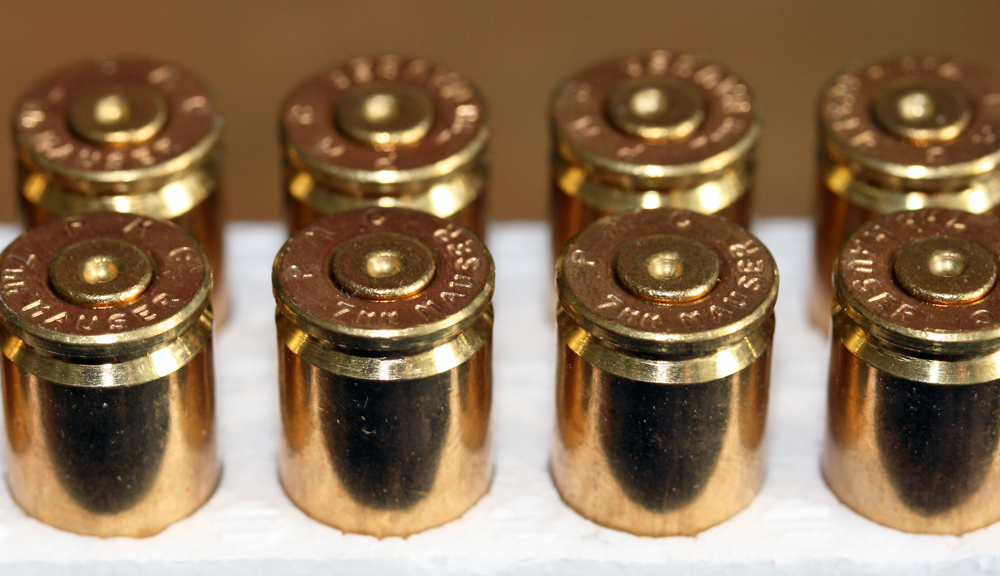
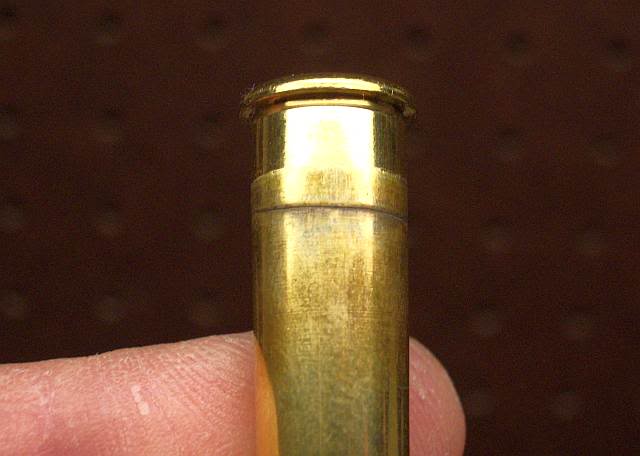
Below these factory loaded 7mm Mauser cases have the primers protruding and were fired in a old military mauser. The primers backed out and were not seated again and also lost their rounded outside edges. So to answer your question this can even make the top of the primer mushroom shaped and bulge over the oridginal outside diameter of the primer.
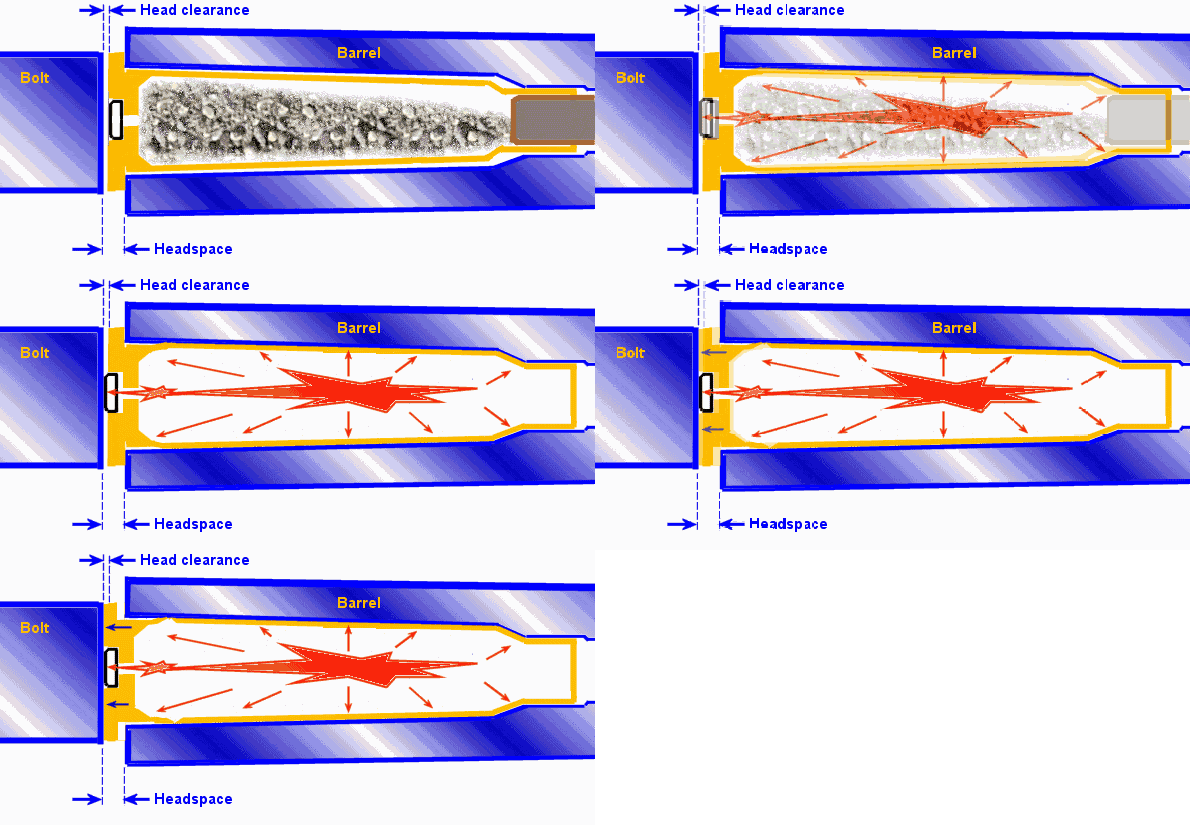
The "air gap" between the rear of the case and the bolt face is called head clearance. And with a full length resized case the head clearance corresponds with the amount the shoulder was pushed back during sizing. And on the .303 British cartridge fired in a Enfield rifle at max military headspace of .074 and a rim thickness of .058 you would have .016 head clearance.
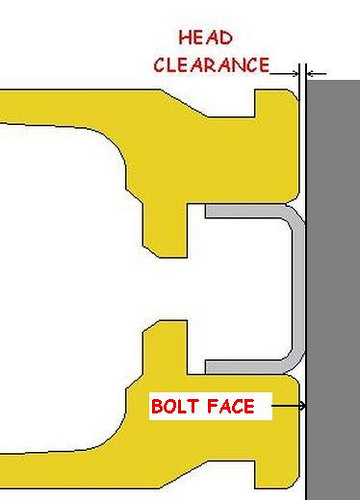
This is why full length resizing the .303 British can cause case head separations because the case has so far to stretch to contact the bolt face.
- Location
- Somewhere on the Hudson Bay Coast
Bigedp51, this is where its nice to have a Lee Loader to decap the brass, or reseat the extruded primer, when its difficult to slide the brass into a shell holder. Your explanation and illustrations are excellent as always.
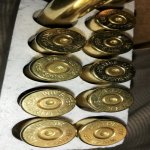
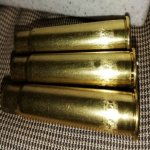
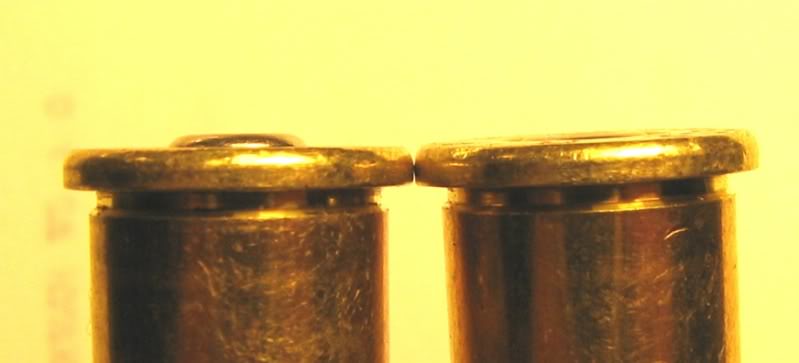
first time fired from factory Winchester 130 gr 303 british power point cartridges.
what's your assessment on the pressure on the brass. would these be good for reloads.
View attachment 438824View attachment 438825
The SAAMI sets the chamber pressure for the oldest and weakest action the cartridge will be fired in. And factory loaded ammunition can be loaded very conservatively and even lower than the rated chamber pressure.
In your photos the cases show signs of expanding near the base to contact the chamber walls and this is normal.
Below is a factory loaded Winchester .303 British case that was fired in my No.4 Enfield rifle and the headspace a smidgen below .067. This Winchester case stretched and thinned .009 when fired and I was told that Winchester cases will not last long if full length resized.
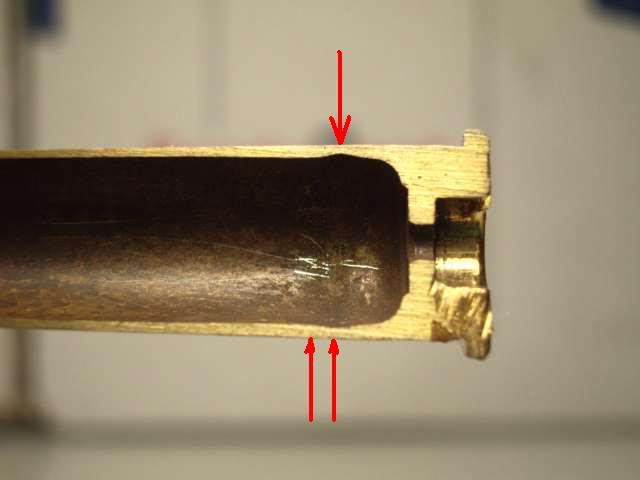
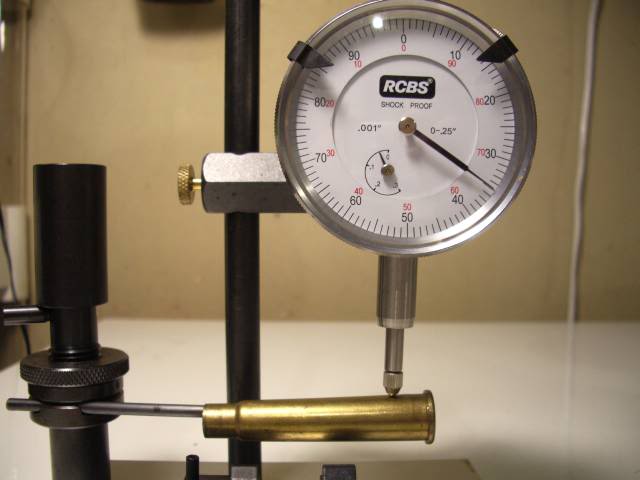
I used my RCBS Case Mastering Gauge to measure case wall thickness and case stretching and thinning. It does the same thing as using a bent paper clip but reads in thousandths of an inch.
Bigedp51, this is where its nice to have a Lee Loader to decap the brass, or reseat the extruded primer, when its difficult to slide the brass into a shell holder. Your explanation and illustrations are excellent as always.
Below on the left is a backed out primer fired in a old worn No.1 Enfield rifle way over max headspace with low pressure reduced load. With a reduced loads and cast bullets this old rifle could still be fired when its over max headspace. And all that happens id the primer backs out.
Ever wonder why a shell holder has a groove cut down the center?

i have a Lee hand loading kit, the resizing die requires that i hammer the case into the die, is there a way for me to just resize the neck with the hand loading die
Not to be flippant as I have no knowledge of your financial circumstances, but the least expensive used press out there and moving beyond The Campfire Kit will pay off in many ways, including your current situation. They are excellent for dirt cheap entry into reloading, and for those thinking of reloading on the run in a future SHTF situation. Beyond that, they have lots of limitations, one of which you're now running into.
The posts to date put up here by others offer you several roads that provide answers to your questions, and several of the roads that lead to Rome - or more accurately, a happy Lee Enfield reloader.
Sooner or later somebody will stickie a post on all the "issues" with brass in Lee Enfields, what can dramatically shorten case life, and how various adjustments/techniques can address that. I'm pretty sure I've seen a stickie on this over at Milsurps, or maybe I remember the little action GIF biged51 included in his explanation from a similar discussion over there.
Anyways:
First, Lee Enfields DON'T have "excess headspace" (as long as the chambers are within military go/no go standards). Nor do they have "oversize chambers". That's simply urban legend, initially created by people who didn't understand what they were trying to explain to others.
What Lee Enfields have is a chamber and accompanying ball ammunition that was INTENTIONALLY designed to specifications that would feed even the most groddy, possibly covered in verdigris cartridges that had sat for decades in some steamy military bunker in some far flung corner of the Empire. And after WWI with the advent of the No. 4 Mk1, chamber cartridges possibly covered with bits of mud and water from a slimy trench.
The designers of the .303 British chamber and the ammunition for it did not design it to provide competition accuracy, and they certainly didn't design it out of concern for reloaders wanting to reload the brass. They designed the chamber/cartridge specs to provide the most reliable feeding that soldiers armed with that rifle would face in wartime conditions on the battlefield. They didn't care about what happened or was done with the cases once they were ejected from the chamber onto the battlefield.
So three things (at least) are at play here when you intend to reload cases from factory/arsenal ammunition.
First, you have various arsenals around the world who produced Lee Enfields and their chambers intended for wartime use, under wartime conditions. Lots of variation between chambers there. Presumably, ALL left the factory only after passing a go/no go test.
Second, as Ed mentioned earlier, Lee Enfields headspace on the rim, not the shoulder. So not only can it be completely normal for intended-for-one-firing-only ammunition to have a gap between the face of the bolt and the base of the cartridge when chambered for firing, but the manufacturers of that ammunition did not make the rims the same dimensions - particularly North American manufacturers supplying the civilian trade.
If you have assorted .303 British cases laying about - better yet some new in the box commercial ammunition and some military ball like the old Greek HXP or Radway Green (kind of unlikely for most now)... take a micrometer to the rims and do some comparative measuring. The commercial stuff is generally thinner - more "excess headspace" there. I suggest saying a lot of civilian .303 ammunition is undersized is a statement that is more accurate than saying Lee Enfields have excess headspace?
And a third: some Lee Enfields either just before escaping from the hands of the military into the wilds of the civilian world either were at the point of failing a no-go test by the gun plumbers, or were used sufficiently after entering civilian life to get to the point where they would now fail (or almost fail) a no-go test.
And so to your current situation:
Factory ammo out of the box is what it is, as far as fit in the chamber goes. Unless you value the cases more than having ready to go ammunition out of the box, the stretching of the cases on first firing cannot be avoided.
But it can be - if you have the right tools on your reloading bench or the right selection of O-rings. The techniques to do that were just explained in a recent thread. The Coles Notes version is that by a couple of methods, you can eliminate the gap between bolt face and base of the case prior to first firing. Lacking equipment, you can use the O-ring method described elsewhere for future first firing of commercial ammunition if you wish. Cheap like borscht.
But the cases you have were just fired without anything being done to them. To some degree, depending on the ammunition and your chamber, they are already stretched. Or (if it makes you feel better) you now have cases for reloading that are perfectly fireformed to your rifle's chamber. If you have multiple Lee Enfields, ONE rifle's chamber. Those cases, after you fired the commercial ammunition in your Lee Enfield, as they sit now are headspacing on the shoulder like a 30-06, rather than on the rim is they did before firing.
Whatever damage was to be done to those cases is now done. It's what you do from this point on that determines what you get for case life from those cases in future reloads. The wrong way to do it is a total full length resize job in the resizing/depriming die after every firing - that may be the only option you have with the Lee Campfire Kit, where you can't do precise resizing.
The right way to do it to get maximum case life and enhance accuracy potential (although the rifle could easily be the determining factor) is to resize the case no more than necessary. A Lee collet die set will do that for you - but that won't work with The Campfire Kit. As will adjusting a full length die until you can feel some resistance when closing the bolt on a resized case: commonly called a "crush fit". Probably won't work with The Campfire Kit either.
So to summarize:
Yes, those cases are almost certainly safe to reload, but with The Campfire Kit, you are going to stretch them more with each resizing and loading cycle. And so you should be checking for incipient head separations as described by another poster. Oh... and maybe find a separated head extractor or some cerrosafe in case a failing case gets past you and you have a complete separation in the chamber at firing.
Coming up with the scratch to buy an inexpensive new or used reloading press, along with the very inexpensive Lee Collet resizing die kit, will get you a long ways down the road to Happy Heaven when feeding your Lee Enfield. That will allow you to precisely resize your cases no more than necessary each time, prolonging case life. Not to mention the other bennies of having an actual reloading press.
A bag or two of the very fine .303 British cases manufactured by Privi Partisan will be doing yourself a favour. They are relatively spendy in comparison to buying a similar bag of cases wearing the Winchester, etc brand, but far superior and you'll get much longer life out of them if properly preparing them for first firing and then resizing afterwards.
BTW... it appears you may be in luck if you're interested in buying some of their brass for reloading - it's on sale at one place right now. I understand they're hard to find at most sources of reloading components in Canada:
https://www.westernmetal.ca/shooting/303-british-new-prvi-brass-bags-50-prvi303b-50
Last edited:





















