












































You are using an out of date browser. It may not display this or other websites correctly.
You should upgrade or use an alternative browser.
You should upgrade or use an alternative browser.
Firing a 303 in a 280 Ross
- Thread starter the keepa
- Start date
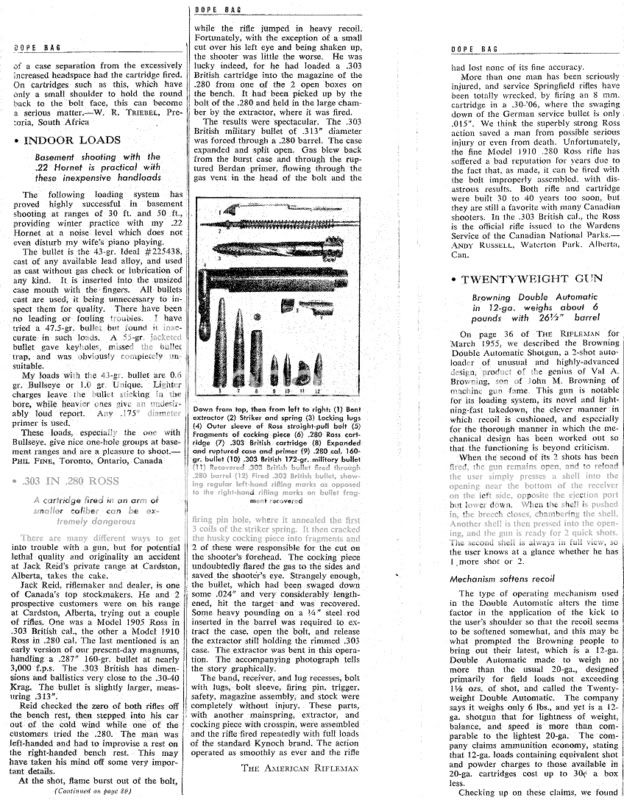


A cartridge fried in an arm of smaller caliber can be extremely dangerous.
Yep, sure can!

Always use the correct ammunition for your gun - yea that's good advice.
What we still don't have, 50 years later, are documented cases of gun blowups and injuries from using oversized bullets. I'd like to know where he got the "facts" on Springfields blowing up and injuring shooters using 8x57 in them. Gun folklore for sure.
What we still don't have, 50 years later, are documented cases of gun blowups and injuries from using oversized bullets. I'd like to know where he got the "facts" on Springfields blowing up and injuring shooters using 8x57 in them. Gun folklore for sure.
In the case of the .303 in the .280 Ross, the cartridge case was undersize, and ruptured, of course. This resulted in a substantial release of high pressure gas, and some of the observed damage and injury. It would have also limited the peak pressure. In the Springfield situation, the caseheads are essentially the same diameter, there would have been a better initial seal at the breech, and pressures could have reached higher levels. If an '03 fails, it is usually because there is a catastrophic release of gas inside the receiver ring, and the top of the ring is blown off. Experimental work by Ackley suggests that as long as there is a tapered throat in front of the chamber, the bullet will size down without mishap. He chambered and throated a M1917 .30-06 for .35 Whelen, and reported that the rifle fired normally. for American Rifleman reported an Arisaka rifle rechambered to .30-06 - a possible conversion for a 7.7 rifle, but this one was a 6.5. The rifle was fired repeatedly, excessive recoil was noted, but nothing untoward happened. There are also reports that 8mm rounds were fired in Winchester 1895 .30-06 rifles with unfortunate results.
The firing of 7.9 ammo in 30-06s is documented in the report on the blown up low number Springfields in "Hatcher's Notebook".
Would you mind providing a quote from that book on that subject? Does it go something like "It has been reported....."?
P.S. there are reports of low serial number Springfields "blowing up" using 30/06 (the correct ammo), so the same happening with 8x57 would seem meaningless in the context of this thread, no?
"...where he got the "facts" on Springfields blowing up and injuring shooters using 8x57 in them..." Hatcher's Notebook, page 213(photograph of the destroyed rifle) and the actual 'Report of Accident' dated 24 Oct., 1921, on page 458. It was a low S/N, single heat treated, 1903. Complete destruction of the receiver. The shooter, a PFC Thomas H. Appleby, lost an eye and had his face lacerated.
Using the wrong ammuniton is just stupid.
Using the wrong ammuniton is just stupid.
What we still don't have, 50 years later, are documented cases of gun blowups and injuries from using oversized bullets. I'd like to know where he got the "facts" on Springfields blowing up and injuring shooters using 8x57 in them. Gun folklore for sure.
IIRC a few years ago when he was still in rifle/handloader, seyfried wrote about and had photos of (i think) a 270 weatherby that someone had fired a 7mm weatherby round in. i can't remember all the details but i don't think the bolt let go, but escaping gas wreaked havoc and the bullet jacket only moved an inch into the barrel or something like that. maybe someone has the issue on hand and can add more (accurate) info.
Ifor American Rifleman reported an Arisaka rifle rechambered to .30-06 - a possible conversion for a 7.7 rifle, but this one was a 6.5. The rifle was fired repeatedly, excessive recoil was noted, but nothing untoward happened.
Yup, I have read, and seen a few tests on Arisaka rifles, and they are tough.
But not something I'd put one through.

I have that article also...May 1959 ...tried to post it here but Photo bucket isn't working for me to-night .American Rifleman reported an Arisaka rifle rechambered to .30-06 - a possible conversion for a 7.7 rifle, but this one was a 6.5. The rifle was fired repeatedly, excessive recoil was noted, but nothing untoward happened.
I'll try again tomorrow .
As to Hatcher, he was the Director of Accidents and every single accident with a US military rifle passed through his office, over his desk, and the investigation was done by him and his staff. I think we can regard the chapter in "Hatcher's Notebook" regarding accidents with US military rifles as about as close to absolute Gospel as we can get.
And the man must have been a wonderful lecturer. I first read the book about 45 years ago, when I was still in high school. Read it just like a novel, it was SO well written. Over the years, I have almost worn out a copy, but I learn something new every time I open it. I would regard the book as the very top of the list for anyone who really WANTS to understand what goes on when we press the trigger. And, unlike most other US writers, Hatcher is brutally honest, even when it comes to Springfields.
And the man must have been a wonderful lecturer. I first read the book about 45 years ago, when I was still in high school. Read it just like a novel, it was SO well written. Over the years, I have almost worn out a copy, but I learn something new every time I open it. I would regard the book as the very top of the list for anyone who really WANTS to understand what goes on when we press the trigger. And, unlike most other US writers, Hatcher is brutally honest, even when it comes to Springfields.
Always use the correct ammunition for your gun - yea that's good advice.
What we still don't have, 50 years later, are documented cases of gun blowups and injuries from using oversized bullets. I'd like to know where he got the "facts" on Springfields blowing up and injuring shooters using 8x57 in them. Gun folklore for sure.
We just had a fatality here in Alberta in 2006 when a hunter fired a 30-06 in a 270.
We just had a fatality here in Alberta in 2006 when a hunter fired a 30-06 in a 270.
Hmmm. Now how did he ever chamber that? Generous (0.035") neck clearance in that 270 chamber? I'd check that source.
Must have been a 308.
Last edited:

What we still don't have, 50 years later, are documented cases of gun blowups and injuries from using oversized bullets.
I know of two cases with semi opposite results. A friend fired at least 2 - 8mm military surplus rounds in his 30-06. The gun may have been a Remington (I can't remember and the gun is no longer available) and was certainly a mauser type bolt action. The gun kicked quite hard and the bolt handle lifted up partially but the gun did not fail. He bought the ammo surplus and assumed it to be the correct caliber.
A second rifle that I saw in a local gun show several years ago; bolt action with 3 lugs (each side) on the bolt head, the owner fired a .308 in a .270 rifle. He had two similar guns different calibers at the range. The pressure sheared the front lug, cracked the second. Escaping gasses shattered the stock and as I recall blew the magazine off but the shooter was uninjured.
cheers mooncoon
Just after WW1, there was a batch of US National Match ammuntion made with tinned bullets, in an attempt to reduce nickel fouling. There were rifle failures that season. Some shooters had been applying a bit of moly grease to the bullets, following British practice. Hatcher blamed the grease. Orders were issued that grease was never to be used. It appears that the problem was not the grease; the tin was bonding the bullets to the cases. The bullets weren't releasing, so pressure was spiking. If there is a catastrophic case failure, a Springfield isn't really the best rifle to have in front of your face.






















