Making Tumblers

tiriaq

Super Moderator
Moderating Team
Rating - 100%
250   0   0
It is not unusual to see hammer guns with the tumbler shanks broken. If you're lucky, the hammer will accompany the gun, but often it is lost. That was the case with these two.
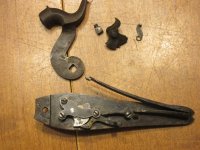
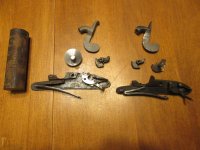
In the photo, there is a piece of 1144 steel, and two locks (both flint converted to cap). The broken tumblers are shown along with a blank turned from the 1144 bar, and on the right, a tumbler made from a similar blank which is about 80% finished. The mainspring in this lock is also a replacement. The link must be made as well. I'll make it from a piece of drill rod.

Incidentally, I got the 1144 steel from Metals R Us in Nova Scotia. They sell metals cut to length, priced by the inch. Rather than use whatever scrap steel I could scrounge, I wanted known quality alloy steel. 1144 is an oil hardening steel successfully used for making tumblers. It machines about as nicely as 12L14 free machining mild steel. They have a minimum order policy of $40, so I ordered some other pieces that I needed to make the order worthwhile.

IMG_1992.JPG
 
Last edited:

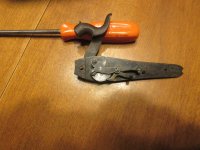
Here is another one - back action this time. Got lucky. The hammer was not lost. This hammer is retained not by a screw but by a nut on a threaded extension from the tumbler shaft. Catch is that the shank has to be squared to suit the hammer, keeping the hammer half and full cocked positions matching the left side hammer.

IMG_1993.JPG
 
Incidentally, I got the 1144 steel from Metals R Us in Nova Scotia. They sell metals cut to length, priced by the inch. Rather than use whatever scrap steel I could scrounge, I wanted known quality alloy steel. 1144 is an oil hardening steel successfully used for making tumblers. It machines about as nicely as 12L14 free machining mild steel. They have a minimum order policy of $40, so I ordered some other pieces that I needed to make the order worthwhile.

I think Metals R Us bought "Metals Plus" here in Oshawa (only 5 minutes from me) they have several offcut racks quite conveniently sorted into type and grade. Grab what you need and they sold it by weight at scrap prices! Pulled quite a bit of copper and brass out of there - they can bring in lead as well ;)
 
Looking good tiriaq. Paying close attention in order to pick up on as many tips as possible. Have not had a need to make a tumbler yet, but that day will likely come. You are no doubt aware there are also ways to replace a tumbler shaft.

Metals R Us in Halifax is my go-to source for most metals. Love going through their off-cut racks but, as I recall, they are not sold at scrap prices. Wish they were. You might also want to check out Maritime Knife supply. Both are great folks to deal with.
 
Yes, I considered repairing the tumblers by replacing the shafts. Basically the tumbler becomes a two part assembly silver brazed together.
 
Metals R Us in Halifax is my go-to source for most metals. Love going through their off-cut racks but, as I recall, they are not sold at scrap prices. Wish they were. You might also want to check out Maritime Knife supply. Both are great folks to deal with.
I think that (scrap prices) stopped for me when Metals R Us bought Metals Plus ... that was the same time the brass offcuts went back into the rack and were sold at retail (no more brass offcuts :( )
 
Lee Valley Ottawa used to sell offcuts, left over from their manufacturing operation, but that was years ago, don't know if they still do it or not.
 
Yes, I considered repairing the tumblers by replacing the shafts. Basically the tumbler becomes a two part assembly silver brazed together.
That would make it easier to index the hammer (not all that difficult anyways). While tumblers are not difficult to make (if you have a lathe), I have a Henry Gurney, 10ga percussion sxs that is in quite nice shape but needs both tumblers replaced that, perhaps some day I will take a day snd turn out a couple tumblers for it. Too many other, more pressing projects to get to first (at least that is what I tell myself).
 
I have made 3 or 4 tumblers and come to think that you should file the shaft square and fit the hammer first, then file in the sear notches and the portion where the mainspring presses. I found it pretty challenging to fit a hammer to the squared shaft after the tumbler has been completely made

cheers mooncoon
 
I have made 3 or 4 tumblers and come to think that you should file the shaft square and fit the hammer first, then file in the sear notches and the portion where the mainspring presses. I found it pretty challenging to fit a hammer to the squared shaft after the tumbler has been completely made

cheers mooncoon
The only thing to add to this is, particularly if you are making 2 matching tumblers for a sxs, but even if making just one, I found it beneficial to make a template for the notches. Turn the tumbler blank, square the shaft, then slide the template over the shaft then you can shift the template around to the right position relative to the hammer position and scribe around the notches, then file them to shape. There are a few other minor variations that can be implemented but this method worked for me.
 
I have made 3 or 4 tumblers and come to think that you should file the shaft square and fit the hammer first, then file in the sear notches and the portion where the mainspring presses. I found it pretty challenging to fit a hammer to the squared shaft after the tumbler has been completely made

cheers mooncoon
Now THAT is a great piece of advice!
Thanks mooncoon2
 
The only thing to add to this is, particularly if you are making 2 matching tumblers for a sxs, but even if making just one, I found it beneficial to make a template for the notches. Turn the tumbler blank, square the shaft, then slide the template over the shaft then you can shift the template around to the right position relative to the hammer position and scribe around the notches, then file them to shape. There are a few other minor variations that can be implemented but this method worked for me.
Another valuable piece of advice, but shouldn't the template be on the other (piloted) side of the tumbler?
 
The hammer could be fitted to the shank, and then the template applied to the bridle side of the tumbler blank.
I make templates from thin card stock. Pierce for the bridle side axle and trace the tumbler onto the card. Cut out and glue the template to the blank, then start sawing and filing. The traced line will be slightly larger than the actual tumbler, so file until the line disappears. Pretty hard to trace the notches, of course.
 
Another valuable piece of advice, but shouldn't the template be on the other (piloted) side of the tumbler?
Yes, on the “outside” axle. I just went back and EE-read my post and I did word that Im a way that suggested that the template goes on the shaft on the back side of the tumbler blank. Doesn’t do much good if it is between the tumbler and the lock plate. The tumbler blank is installed through the axle hole in the plate and the hammer installed, then, (without the bridle) put the hammer where you want it to sit at half bent, rotate the template to put the half bent notch where the sear tip will be and scribe around the template. I use sheet brass for the template but if I was doing this a fair bit, I would be tempted to make the template out of carbon steel sheet so I could harden it after shaping. That way, after hogging out the bulk, the final fitting can be done by filing right up to the template and the hardened steel will resist the file going past.
 
Here is another one - back action this time. Got lucky. The hammer was not lost. This hammer is retained not by a screw but by a nut on a threaded extension from the tumbler shaft. Catch is that the shank has to be squared to suit the hammer, keeping the hammer half and full cocked positions matching the left side hammer.

View attachment 1001341
Determined how the hammer needed to index, squared the shaft and mounted the hammer. Assembled the lock (less mainspring) in the gun. Cocked the left lock. Brought the right hand hammer back to match. Carefully removed it from the gun, and scribed the tumbler, marking where the sear nose would be to hold the hammer cocked in line with the left hand hammer. Cut the full #### notch. The hammers stand the same at full ####. Next will be to repeat this process to locate the half #### notch.
Once that is done, the next step will be to fit the fly to the mainspring.
Finish the end of the threaded shaft which secures the hammer and case harden the tumbler. This one is mild steel; the others are 1137, so heat treatment will be different.
 
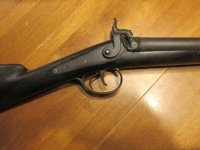
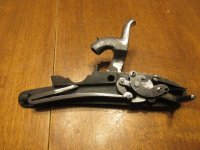
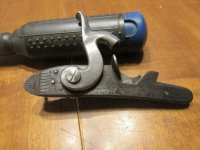
Got one just about finished. Tumbler and stirrup are yet to be heat treated, and the hammer finished. Tumbler is 1144 steel, the stirrup is drill rod. Stirrup pin is a bit of 1/16" drill shank. Hammer is one of the most common replacements (I think the same as Dixie HP1002). Had to do a bit of bending to adjust for the throw distance. The mainspring was made from Dixie's universal 2 3/4" spring (TP0306). Made the hammer screw on the lathe, 5-40. Lock cocks and clicks smoothly, pops caps reliably.
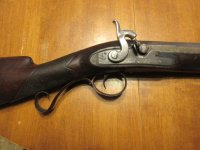
The gun is an 11ga 36" barreled shotgun, originally flint, by Whitehouse. I'd guess c1820, give or take. When I got it, the tumbler shank was broken, and the mainspring, stirrup and its screw were missing, along with the ramrod and one ramrod pipe. Hammer and hammer screw gone as well. The bore is quite respectable, has the potential to be a shooter.
Forend cap is missing. I'll make a replacement from a bit of ebony.
IMG_2004.JPGIMG_2005.JPGIMG_2006.JPG
 
Last edited:

Back
Top Bottom