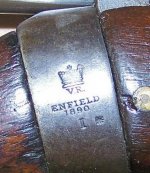
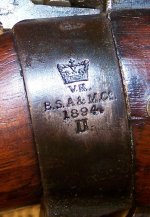
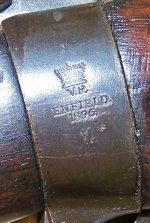
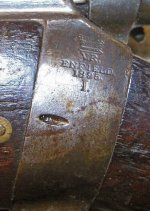
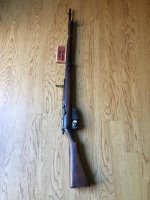
Lee Metford.

Lee-Metford's were phased out of service as obsolete infantry rifles starting in 1895 and removed fully from all front-line issue and service in 1899.

This was not a WW1 issue rifle. It did last see war service in the Boer War although.

The story about it being her Grandfather's WW1 issue rifle is just a story. Especially if is was made in 1896 which was the last year of manufacture and these were all civilian purchased target rifles.

The Lee-Metford rifle was used by Canadian forces for a very short period before being replaced by the Lee-Enfield in the late 1890s. The switch was made because the Lee-Enfield's rifling was better suited to the new cordite issue ammunition, which was more powerful but caused excessive wear on the Lee-Metford's barrel. While not the primary rifle of Canadian service, some Lee-Metford carbines may have been in circulation or privately owned.

In British service the Lee–Metford action and rifle was also upgraded to the standards of later rifle patterns (e.g. to charger loading and Short Rifle, like the SMLE pattern), though the barrel was almost always switched to one with Enfield pattern rifling to be able to use issue Cordite loaded ammunition.

The Lee–Metford was still produced commercially until 1896 and used by civilian's for target shooting until the outbreak of World War I, as it was considered to be inherently slightly more accurate than the Enfield pattern of rifling but not with Cordite ammunition as the hotter burning Cordite would completely wear the shallow Metford rifling out in as little as 3000-6000 rounds.

Civilian target shooters would still use black powder .303 ammo in their Lee-Metfords until stocks of this ammo started to run out around 1904.

It did remain as a home-guard only issue rifle in small numbers in some countries up until WW2.
 
Interesting posts so far. I would be interested to see if the OP's Lee Metford is a Lee Speed variant or one produced for the military. Given the amount of changes that was happening in the 1890s, finding an original issued Metford that wasn't upgraded to a later pattern, and is in decent shape overall, would be quite the find.
 
Interesting posts so far. I would be interested to see if the OP's Lee Metford is a Lee Speed variant or one produced for the military. Given the amount of changes that was happening in the 1890s, finding an original issued Metford that wasn't upgraded to a later pattern, and is in decent shape overall, would be quite the find.
He mentioned it was a 1896 manufacture one and by then it was already military obsolete and all made after 1894 were only for civilian target shooters and not purchased for military use.

The military had already moved fully onto the Lee Enfield in 1895 as the Lee-Metford was a black powder 1888 adoption just before smokeless powder and Cordite became the preferred ammo for military arms. The British military and Canadian militia switched to Cordite in 1891.

The original Mark I .303 British service cartridge employed black powder as a propellant, and was adopted at the same time as the Lee–Metford rifle, which had shallow rifling designed to lessen fouling from this propellant, which was adopted to replace the Martini-Henry rifle in 1888. Some Martini-Henrys were also later rebarrelled to use the new blackpowder .303 as the "Martini–Metford".

Excessive barrel wear of the shallow Metford rifling with all the smokeless powders then available and especially so with Cordite caused ordnance authorities to institute a new type of barrel rifling designed by the Royal Small Arms Factory at Enfield, to increase barrel life; the redesigned rifle which was introduced in 1895 as the Lee–Enfield replaced the Lee-Metford. Also after extensive testing, the Committee on Explosives selected Cordite for use in the Mark II .303 British service cartridge.

Back then all fullbore matches used military type rifles but many were not ever military issue but built for civilian target shooters.

I used to own a Commercial Snider-Enfield by Thomas Turner of Birmingham, it was a Snider Mk III target rifle that was a exact copy of the military issue but was made by a civilian gunmaker who used their own action/lock that was even fancy engraved unlike any army issue ones. It had no military markings on it but looked exactly like a Canadian military stamped and issue Snider Mk III with "DC" (Dominion of Canada) stamps, military proof marks, and regimental unit markings.

These civilian Target rifles made to the same pattern as military ones used to be very common back in the late 1800's and early 1900's and most were made well after the military made them obsolete and moved onto newer and better models.

Even Ross rifles in Canada did the same thing with civilian sale Ross target rifles patterned after the military models.
 
Interesting posts so far. I would be interested to see if the OP's Lee Metford is a Lee Speed variant or one produced for the military. Given the amount of changes that was happening in the 1890s, finding an original issued Metford that wasn't upgraded to a later pattern, and is in decent shape overall, would be quite the find.
Lee Metfords were sold to small family outlets as well, by the factories making them.

Many well known "makers" back in those days did their magic to the rifles they purchased, then resold to customers in various forms, some of which were indistinquisable from the military option, other than bedding and trigger work, to make them more accurate in competition, and likely some went to school shooting teams, maybe even in quantity, because at the time, shooting was a well respected sport and skillset.

" Lee Metford MkII rifles were rebarreled with Enfield rifled bores. The Lee Metford rifle was originally designed to use Lee barrels, but many of these rifles were later rebarreled to accommodate Enfield rifling, which was more durable and easier to clean. This transition occurred as the Lee barrels wore out and the need for a more reliable firearm arose.
Rifleman UK+2"

The family has provenance for the rifle, but from the post, it wasn't clear, to me, if the rifle was issued to the relative or one of the rifles issued to the unit he served with. Maybe I missed something?

Whatever, it's a lovely rifle, and no matter how much we would like to say the rifle was actually issued to the relative, it will likely not be known.

Some officers bought their own weapons, and I have a Webly Mk1, 476/455 which was purchased by an officer sent to the Boer War, only to settle on a piece of land deeded to him for his service, about 10 kliks from where I presently live. There is a record of the purchase, which I had to provide to get a letter of "antiquity verification" from the CFC, so it could be deregistered.

That's why I asked about engraving on the action dust shield.

The officers purchased firearms using "issue ammunition," because of logistical issues in the field. Some officers purchased odd ball stuff and had to supply their own ammo as well.

There may be a lot of verifiable history behind the rifle in the OP's pic. That's most of the fun in obtaining such firearms, searching out the provenance.

Good on you OP for helping out the family with this matter.
 
Also all military issue Lee-Metford's were made by The Royal Small Arms Factory (RSAF). Commercial versions were made by BSA and LSA for the civilian market.

Here is a nice condition LSA Lee-Metford Mk. II* Commercial Rifle (Lee-Speed/Patent Marked) example that sold recently on Gunsinternational.com -

LSA-Lee-Metford-Mk-II-Commercial-Volunteer-Rifle-Lee-Speed-Marked_101579168_19081_17D7D50ACF2796B7.jpeg


LSA-Lee-Metford-Mk-II-Commercial-Volunteer-Rifle-Lee-Speed-Marked_101579168_19081_F42C4E962E9469D7.jpeg


LSA-Lee-Metford-Mk-II-Commercial-Volunteer-Rifle-Lee-Speed-Marked_101579168_19081_67396AAC7F128F62.jpeg


LSA-Lee-Metford-Mk-II-Commercial-Volunteer-Rifle-Lee-Speed-Marked_101579168_19081_0905EBECCC636391.jpeg
 
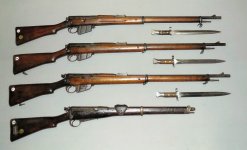
Lee Metfords: Rilfes Mks I*, II, II* & Cavalry Carbine

1.JPG
 

Attachments

  • (18) Lee Metford Mk.I Star (2).jpg
    (18) Lee Metford Mk.I Star (2).jpg
    57.1 KB · Views: 1
  • (19) Lee Metford Mk.II (2).jpg
    (19) Lee Metford Mk.II (2).jpg
    98.2 KB · Views: 1
  • (20) Lee Metford Mk.II Star(2).jpg
    (20) Lee Metford Mk.II Star(2).jpg
    122.8 KB · Views: 1
  • (21) Lee Metford Cav Carb (2).jpg
    (21) Lee Metford Cav Carb (2).jpg
    156.6 KB · Views: 1
The owner offered to bring it by my shop. If she does I can take some pics.
Let me know what areas of the rifle in particular I should get close ups of.
 
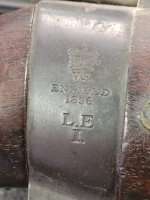
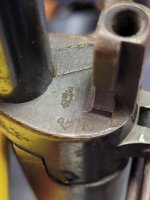
Are we, at this point, certain it is a Lee METFORD? Given the DOM, it could be either a Metford Mk II*, a Metford Mk II upgraded to Mk II*, or an Enfield Mk I. Perhaps the OP could check for an "E" stamped on the top of the knox when he has the rifle in hand. No offence intended, but not everyone is able to readily distinguish between Metford and Enfield rifling.

EDIT:
Had a bit of a brain f*#t. The obvious place to look is the butt socket and the OP has likely already done that.
 
Last edited:
The owner offered to bring it by my shop. If she does I can take some pics.
Let me know what areas of the rifle in particular I should get close ups of.

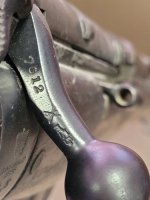
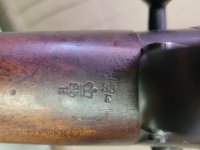
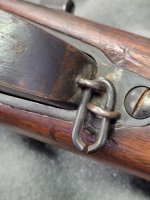
Any markings on the left and right side of the receiver socket (where the butt stock connects into to), any visible markings on the receiver and top of the barrel, and any markings on the right side of the butt stock. Removing the hand guard would also be great but can be tricky without damaging the hand guard.
 
Any markings on the left and right side of the receiver socket (where the butt stock connects into to), any visible markings on the receiver and top of the barrel, and any markings on the right side of the butt stock. Removing the hand guard would also be great but can be tricky without damaging the hand guard.
I won't touch the handguard, but if she comes down I'll try and get all that.
 
A well marked Lee Enfield Mk I in beautiful condition. Please don't do anything to disturb that wonderful patina. As-found condition is what most collectors are looking for these days.
 
Back
Top Bottom