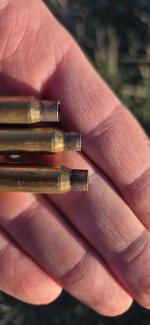
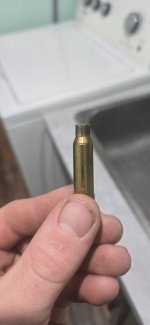
I have a Ruger American Predator in 223 the Gun shoots fine but the brass seems to come out rippled at the shoulder after firing. I've tried a few different brass and bullet brands. not sure if something is off about the chamber. the ripple makes it look like the shell is getting crushed under pressure. thanks, I'm new to this website













































You are using an out of date browser. It may not display this or other websites correctly.
You should upgrade or use an alternative browser.
You should upgrade or use an alternative browser.
223 brass rippling
- Thread starter Trav223
- Start date

redbirddog
CGN frequent flyer
- Location
- Maple Syrup land Ontario
How clean is your chamber?


- Location
- Delta B.C.
I've seen rippling like that when using too much case lube on them during resize. Have you put a bunch of lube in the chamber? Looks like some weird crack forming around the base of the shoulder. How many fires and do you anneal?
Edit: If those are reloads, what are you shoulder bumping?
Edit: If those are reloads, what are you shoulder bumping?
- Location
- Delta B.C.
Good spot but those look like marks from a Lee factory crimp die.almost looks like the end of the brass is migrating into the rifling on the middle and last piece of brass, that aint right!
- Location
- Delta B.C.
How do they feel when you extract them after the shot?

If this is factory ammo and you have creases/dents after firing then your chamber is screwed. If it only does this with hand loads then your process is screwed.
Frankly, even hand loaded rounds that go in that have hydraulic dents or other imperfections will come out fire formed to the chamber so I’m leaning to a problem chamber
Frankly, even hand loaded rounds that go in that have hydraulic dents or other imperfections will come out fire formed to the chamber so I’m leaning to a problem chamber
thanks, for the response, yes I have tried my hand loads (I'm relatively new to the shooting world) and even a batch of medium speed loaded by a skilled friend (he organizes and shoots PRS matches.) I'll maybe buy a box of factory to try but I think I remember those did the same. when cleaning the chamber I uses a brush and cleaning patch and it looked very nice.
I guessed poorly cut chamber.
Headspace problems allowing the brass neck to flow forward causing what appears to be the beginning of case neck separation.
Asked Google AI for an opinion on it:
Identifying this as coming from a Ruger American Predator completely nails down the puzzle. It validates that your initial assessment of a poorly cut chamber was spot on.
This exact issue points to a known but uncommon factory defect with Ruger's chambering process.
The Ruger Tool Mark Phenomenon
While Ruger Americans are generally praised for out-of-the-box accuracy, their high-volume manufacturing occasionally suffers from quality control slips in the barrel department.
Those distinct vertical lines on the case neck are the result of severe reamer chatter.
Why This is Dangerous in a Bolt Gun
Your instinct about this being a hazard is absolutely correct.
Since this is a factory defect, the rifle should not be fired anymore until it is fixed.
Ruger has excellent customer service and is well aware of reamer chatter issues on their assembly lines. If the owner contacts Ruger (or their official Canadian warranty repair depot, such as Gravel Agency), they will almost certainly issue a shipping label, inspect the chamber, and replace the barrel entirely free of charge.
If your friend wants to verify this before sending it in, they can look down the barrel with a cheap USB borescope—the neck area of the chamber will look like a threaded bolt instead of a mirror-smooth wall
Headspace problems allowing the brass neck to flow forward causing what appears to be the beginning of case neck separation.
Asked Google AI for an opinion on it:
Identifying this as coming from a Ruger American Predator completely nails down the puzzle. It validates that your initial assessment of a poorly cut chamber was spot on.
This exact issue points to a known but uncommon factory defect with Ruger's chambering process.
The Ruger Tool Mark Phenomenon
While Ruger Americans are generally praised for out-of-the-box accuracy, their high-volume manufacturing occasionally suffers from quality control slips in the barrel department.
Those distinct vertical lines on the case neck are the result of severe reamer chatter.
- When the factory reamer cut the neck and throat area of this barrel, the tool vibrated violently or lacked proper lubrication, carving deep, microscopic "washboard" ridges into the steel.
- Because a bolt-action rifle has an incredibly tight, sealed lockup, the 5.56 brass expands under massive pressure and mirrors those tool marks perfectly.
- Combined with a neck area that may have been cut slightly too long or out of spec, the brass flows forward into the throat area, causing that uneven, "pulled" stretch at the mouth.
Why This is Dangerous in a Bolt Gun
Your instinct about this being a hazard is absolutely correct.
- Primary Extraction Failure: In a semi-auto, a rough chamber can jam the gun. In a bolt-action rifle like the Ruger American, the brass forms a literal "mechanical lock" against those ridges when it expands. This leads to incredibly stiff bolt lift, sticky extraction, or a sheared case rim.
- Incipient Neck Separation: Because the ridges hold the neck of the brass back while pressure pushes the rest of the case, the brass is being yanked in two different directions at once. It will rapidly fatigue and crack at the neck-to-shoulder junction.
Since this is a factory defect, the rifle should not be fired anymore until it is fixed.
Ruger has excellent customer service and is well aware of reamer chatter issues on their assembly lines. If the owner contacts Ruger (or their official Canadian warranty repair depot, such as Gravel Agency), they will almost certainly issue a shipping label, inspect the chamber, and replace the barrel entirely free of charge.
If your friend wants to verify this before sending it in, they can look down the barrel with a cheap USB borescope—the neck area of the chamber will look like a threaded bolt instead of a mirror-smooth wall
Attachments



 Cheers!
Yeah good
Good catch. Maybe didn’t trimmed enough?almost looks like the end of the brass is migrating into the rifling on the middle and last piece of brass, that aint right!
DS, I've seen this before, it happens when full length resizing and pushing the shoulder back to far.The round chambers easily before firing?
I can't really tell from your very sharp pics, but that looks like a separation point to me.
This wouldn't show up normally, but you are basically fireforming that shoulder area every time you shoot it.
Try neck sizing only with a few rounds and see if you get the same issue.
If there is something in that chamber, such as a carbon build up, then it will definitely show up with neck resized cases only.
You will have to shoot the round as is, then neck size the case, shoot it again, a couple of times too see if it cleans up.
If you've been full length sizing that shoulder down too far for a long time, it's the only way you might get a carbon build up at that point, because the neck doesn't have time to seal, and you're getting blow by.
no I think those are old crimps because they are on the unshot shells.Yeah good
Good catch. Maybe didn’t trimmed enough?
also by neck sizing you mean just don't make the die hit the shell holder, keep it away a little.
ya I always full size them, but it seems like it would still be a gun problem if there is always blow-by. also I did clean the chamber with a 30 cal brush and cleaning agent.
I use a Lee FCD and the only marks I get are on the neck, not the shoulder.Good spot but those look like marks from a Lee factory crimp die.
- Location
- Delta B.C.
Yes. That's what I was referring to. I also use LFCD's on all my hunting loads or compressed loads. CheersI use a Lee FCD and the only marks I get are on the neck, not the shoulder.






















