












































You are using an out of date browser. It may not display this or other websites correctly.
You should upgrade or use an alternative browser.
You should upgrade or use an alternative browser.
Snowshoes
- Thread starter mackillan
- Start date


- Location
- Somewhere on the Hudson Bay Coast
X2 for Atlas. These are the only ones I could find that were rated up to 300 pounds. Other than some freyed fabric, they stand well up to harsh conditions, like for use on sea ice, and I have 6 winters on mine now. My only complaint is that sometimes snow collects under the ball of the foot, turns to ice, and can lead to sore feet.
Atlas
Would these make sense? I am 210 lbs
http://www.mec.ca/Products/product_...older_id=2534374302726601&bmUID=1229883021139
Would these make sense? I am 210 lbs
http://www.mec.ca/Products/product_...older_id=2534374302726601&bmUID=1229883021139

Johnn Peterson
CGN Ultra frequent flyer
- Location
- Chemainus B.C.
I did a fair amount of snow shoeing as a kid in the B.C. interior using the more traditional shoe shoes. Last year I started back into the sport again, for the exercise and hopefully some winter predator hunting in the not too distant future.
Technology has come a long ways in the equipment available and there are a number of good makes & models available. What I decided on are a brand made in Quebec GV Snowshoes and the model, mid price range, I got last year are Polar Trail, 9"x32", they work well. Their website might help you out,
www.gvsnowshoes.com
Technology has come a long ways in the equipment available and there are a number of good makes & models available. What I decided on are a brand made in Quebec GV Snowshoes and the model, mid price range, I got last year are Polar Trail, 9"x32",
they work well. Their website might help you out,www.gvsnowshoes.com

What kind of weight are you packing, and has any of it been on powder?I did a fair amount of snow shoeing as a kid in the B.C. interior using the more traditional shoe shoes. Last year I started back into the sport again, for the exercise and hopefully some winter predator hunting in the not too distant future.
Technology has come a long ways in the equipment available and there are a number of good makes & models available. What I decided on are a brand made in Quebec GV Snowshoes and the model, mid price range, I got last year are Polar Trail, 9"x32",
www.gvsnowshoes.com

Johnn Peterson
CGN Ultra frequent flyer
- Location
- Chemainus B.C.
When I ordered them I believe the selection would handle 250lbs + and most of my use to date has been on powder.What kind of weight are you packing, and has any of it been on powder?
I got mine through MEC and at that time this model was yellow & black in colour. A quick check of the MEC site, is see they are now coloured red & white, 9x32, listed as 'New' and rated for 80-190 lbs. When I got mine, I also got a pair of GV Snowshoes, Cat Trail 8x25, also listed now as 'New', still the same colour and rated for 100-220 lbs. Smaller but rated for a heavier weight??? Haven't figured that out yet. Don't know what totell you.
Last edited:

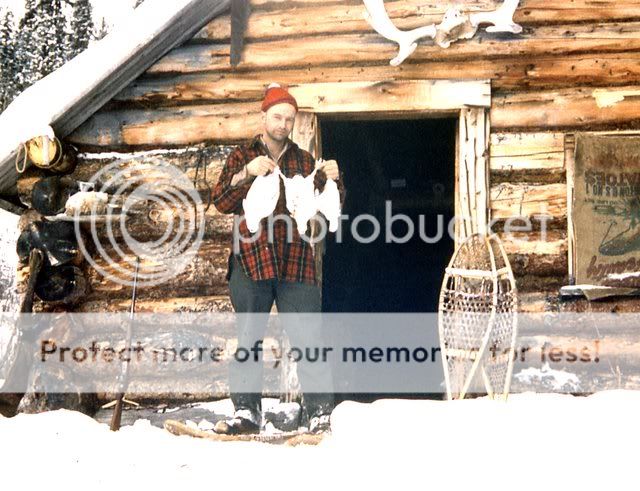
My traditionalist ways were imbedded in me a long time ago! Here I am on the old style, traditional snowshoe. The problem with the ones I have on here, is the toes were not turned up enough. When breaking trail in quite deep snow the toes would tend to load up with snow. The Ojibway made ones I have now had for forty some years, has a turned up toe and size 11 x 54. My partners shoes leaning against the cabin are probably 12 x 60, with turned up toe, good for breaking trail, which he was very good at.
For those not familiar with how to walk on snowshoes, I will give a brief explanation. When standing, with the snowshoes side by side, your legs must be spread to an, almost, uncomfortable position. When walking the length of stride corresponds with the length of the wide portion of the snowshoe. With the foot that is picked up and moving, the wide part of the snowshoe just barely clears the leg that is on the ground. The snowshoe is then set down far enough ahead to enable the wide parts of both shoes to not be side by side. That is, the wide part of the shoe will be set down ahead of most of the other shoe.
This results in a mile eating pace and the legs are never far apart. Easier to practice than tell about. One who doesn't know hw to walk on snowshoes walks with an exagerated spread of the legs, which is awkward and very tiring.
For those not familiar with how to walk on snowshoes, I will give a brief explanation. When standing, with the snowshoes side by side, your legs must be spread to an, almost, uncomfortable position. When walking the length of stride corresponds with the length of the wide portion of the snowshoe. With the foot that is picked up and moving, the wide part of the snowshoe just barely clears the leg that is on the ground. The snowshoe is then set down far enough ahead to enable the wide parts of both shoes to not be side by side. That is, the wide part of the shoe will be set down ahead of most of the other shoe.
This results in a mile eating pace and the legs are never far apart. Easier to practice than tell about. One who doesn't know hw to walk on snowshoes walks with an exagerated spread of the legs, which is awkward and very tiring.

Johnn Peterson
CGN Ultra frequent flyer
- Location
- Chemainus B.C.
Just sent you an e-mail concerning the traditional Ojibwe style and my using them in the Wells area years ago.My traditionalist ways were imbedded in me a long time ago! Here I am on the old style, traditional snowshoe. The problem with the ones I have on here, is the toes were not turned up enough. When breaking trail in quite deep snow the toes would tend to load up with snow. The Ojibway made ones I have now had for forty some years, has a turned up toe and size 11 x 54. My partners shoes leaning against the cabin are probably 12 x 60, with turned up toe, good for breaking trail, which he was very good at.
For those not familiar with how to walk on snowshoes, I will give a brief explanation. When standing, with the snowshoes side by side, your legs must be spread to an, almost, uncomfortable position. When walking the length of stride corresponds with the length of the wide portion of the snowshoe. With the foot that is picked up and moving, the wide part of the snowshoe just barely clears the leg that is on the ground. The snowshoe is then set down far enough ahead to enable the wide parts of both shoes to not be side by side. That is, the wide part of the shoe will be set down ahead of most of the other shoe.
This results in a mile eating pace and the legs are never far apart. Easier to practice than tell about. One who doesn't know hw to walk on snowshoes walks with an exagerated spread of the legs, which is awkward and very tiring.
That was something else I should've hung on to and didn't.
Last edited:
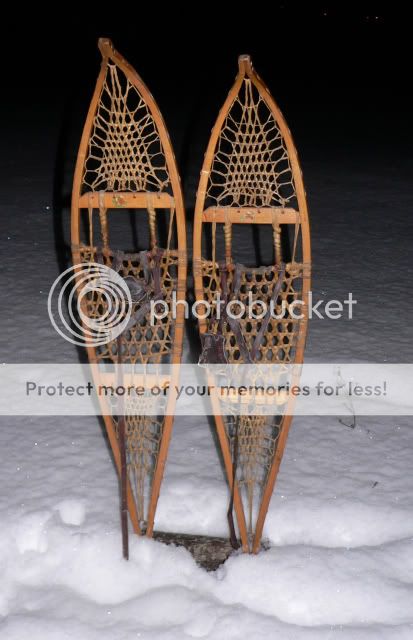
Johnn, here are my Ojibwa shoes. About identical to your picture of them. They sure were the tried and proven pattern, all over northern Canada. In north-central BC, every forest sevice worker I ever heard of, the men who used snowshoes constantly, all winter, used nothing but that pattern. So did the game department men in the bush, as well as many trappers. The only variation was size. These are 11 x 54.
Those look nice H4831. I've got aluminum ones, the same ones as I had in the army. They are O.K., but I always thought they would go better with a pointed front like your Ojibwa shoes. The army bindings beat the crap out of the junky ones at crappy tire etc. You put your toe under the front part, their is a cross strap under your foot, and the 2 main straps cross behind your ankle and fasten together in front. I bet they copied the natives, just like the mukluks. I'm sure their are all kinds of ultra light modern way better stuff out there, even the army was supposed to be getting a new snowshoe when I got out 2 years ago. Cheers.

sure, go w/ Atlas if you want snow flicked down your back. if you want the BEST performance snowshoe, then go w/ MSR. and you can always add the 'tails' should you be encountering deep powder. MSR invented the heel lift bar that Atlas has now copied. don't let people fool you into buying Atlas cause they apparently do up faster or are more secure. sure, the binding system looks visually better, but is functionally as good as MSR's. and should your Atlas break while in the field, try fixing it fast! MSR has a field kit to replace straps, etc...
my recommendation is the MSR Denali Evo Ascent w/ 6" tails (if you're in powder).
my recommendation is the MSR Denali Evo Ascent w/ 6" tails (if you're in powder).
Last edited:
get msr snowshoes. tube frame shoes are for weekend warriors - not real outdoorsmen.
Get it right- *real* outdoorsmen bend their own wood frames and string it with gut from cute fuzzy creatures they killed with their bare hands!
In the winter I wear snowshoes to work 5 days/week and both Atlas and MSR work well. Matter of fact my partner drove by the skidoo one day, hooked his Atlas snowshoes tied to the back rack with the truck bumper, and dragged the whole works down the driveway!! We unsnarled the mess, drove over the snowshoes with the truck to remove a 'taco-ish' bend and used them the rest of the winter. My current pair is 8 years old and going strong!
Go down to the local sporting goods store, find a pair that fits with a price you like and walk out a happy man.
I'm with Search and Rescue here in Prince George and we use Ursus. They have great floatation, a really agressive crampon (that doesn't get all clogged with snow), they're built like a brick you know what, and best of all they're Canadian made!
They're not cheap ($255 a pair) but worth every penny. Having tried just about every other design out there I can say that for backcountry work these are easily the best snowshoe on the market. They're probably not the best if you're into running trails, but who wants to do that?!?! Getting off trail into the powder is a better workout and it gets you away from the unwashed hordes.
They're not cheap ($255 a pair) but worth every penny. Having tried just about every other design out there I can say that for backcountry work these are easily the best snowshoe on the market. They're probably not the best if you're into running trails, but who wants to do that?!?! Getting off trail into the powder is a better workout and it gets you away from the unwashed hordes.
Johnn Peterson
CGN Ultra frequent flyer
- Location
- Chemainus B.C.
I'm with Search and Rescue here in Prince George and we use Ursus. They have great floatation, a really agressive crampon (that doesn't get all clogged with snow), they're built like a brick you know what, and best of all they're Canadian made!
They're not cheap ($255 a pair) but worth every penny. Having tried just about every other design out there I can say that for backcountry work these are easily the best snowshoe on the market. They're probably not the best if you're into running trails, but who wants to do that?!?! Getting off trail into the powder is a better workout and it gets you away from the unwashed hordes.
All around, they sound similar/comparable to my GV Polar Trail 9x32. An agressive crampon/harness set up, made in Canada and I believe the present price through MEC is $265.oo. And you're quite correct concerning the 'running trails' and the workout which is one of the reasons I got back into it recently. Helps keep the blood sugar levels down but as I mentioned earlier on in this thread I got started in this game, probably not too far from where you are now. Wells.






















