9MM + Bear

I'd say it's very likely to fail. Foster slugs are for light animals. Brenneke style slugs are a much better choice. A .375 or .45-70 would be even better. Really lame that we can't pack pistols in the bush.

Brenneke slugs are like Hen's teeth, I hear about them, but hard to find, I am down to my last 1/2 box.
 
The point of the discussion is to examine whether or not a 9mm and by extension, any .36" bore handgun, is suitable in the bear defence role. It matters not that a 12 bore or a .700 Nitro has more killing power if you don't have one with you, and you carry a handgun because you are unable to carry a long gun in the course of your duties; so the long gun is not available to you.

Whether or not any particular firearm is suitable in the defence role is determined more by the shooter than by the firearm. If you can shoot competently under stress, and if you have a knowledge of bear physiology, a typical pistol service cartridge can get the job done. If you cannot shoot competently under stress, it doesn't really matter what you carry. Having said that, a firearm that recoils within the limits of the shooter allows for a fast follow up shot. For example, I can fire 6 aimed rounds from my .357 (195 gr hard cast SWC at 1100) in the time it takes to fire 2 from my .44 (325 gr WFN hard cast at 1150). In a defensive shooting scenario this translates to having 2 shots available to me with the .357 and one with the .44. I prefer to carry the .44 because it is a smaller, shorter, tougher gun not because I have more faith in its ability to save my life. By comparison, pistol chambered in 9mm might give you 3 shots in an emergency. A 9mm loaded with heavy bullets has sufficient velocity to penetrate well, and it is penetration that will win the day, not raw power. No handgun cartridge compares well to a powerful rifle cartridge, and even powerful rifle cartridges have failed in dangerous game defensive shooting scenarios.
 
I have read that a .303 is better than buckshot for charging cats. Perhaps one of the gunnuts with African experience can say for sure what the guides use.

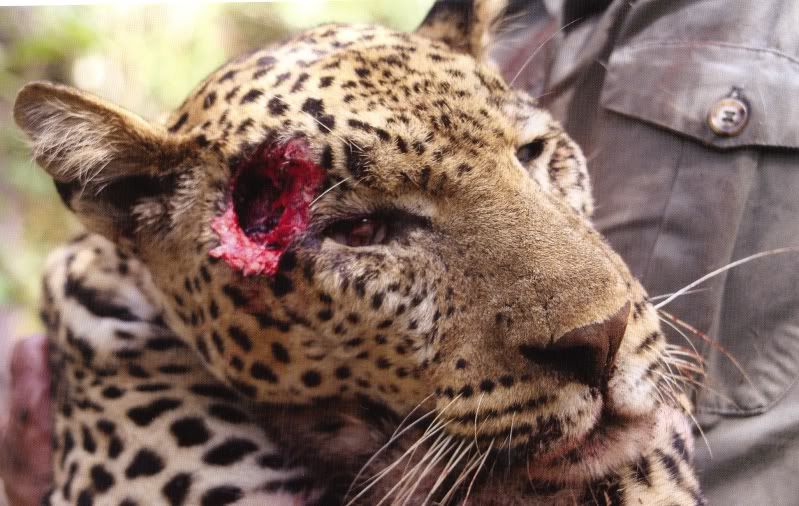
From what I have been able to digest from reading between the lines is that the PHs tell their clients that a shotgun is the best firearm for going after a wounded leopard in long grass in the dark; perhaps because you can more effectively fire a shotgun instinctively than you can a rifle. But more importantly from the point of view of the client, a close range hit with buckshot is less likely to blow up the fragile skull of your trophy leopard. The PH will warn his client over and over not to take a shot that might hit the head. These encounters are very close range, and the shot has had no opportunity to spread, so there is no advantage of the shotgun over the rifle in that respect. I've got a pic somewhere of a head shot leopard that illustrates this, I'll try to find it.
 
I've seen a medium-size blackie dispatched with a 9mm with handloaded 124FMJ's. The first shot was from about 12 yards, and although the whole mag was emptied into the bear, it wasn't going anywhere after about the third shot. This bear was not mad/charging.

No, I do not own, nor have I ever owned, a 9mm pistol.;)
 
When I was in grizzly country I used to load up with FMJ's in my 10mm's then switched over to Sierra JFP's my defense rounds are now Beartooth hard cast WFNGC's (wide flat nose gas check) bullets.

When I am in black bear country I sometimes load JHP's especially when I carry my Super Redhawk with either 45 Colt or 454 Casull loads.

and as Boomer I also am far faster when shooting top 45 Colt loads over the far heavier recoiling 454 Casull loads.

Here is a video I took that shows the difference I'm shooting a double action 4.25" Ruger Super Redhawk with 6 300gr XTP 45 Colt loads @ 1280fps first and then 6 454 Casull 300gr XTP-Mag's @ 1500fps.

http://www.youtube.com/watch?v=uJOIRP_dy9c&feature=channel_page
 
Here's that leopard pic from Mark Sullivan's book "Fear No Death". It was dispatched by a load of 00 buck from a range of 6'. As you can see the skull was not badly damaged as would have been the case with a high velocity bullet.

Untitled-Scanned-01-2.jpg
 
If anyone cares... I have some Velocity/Energy stats for the 3" Remington BuckHammer slugs from an 18.5" Gas Operated Semi-Auto Shotgun:

601.5gr projectile travels at 1349fps (avg) = 2431 ft/lbs of energy.

It hurts like hell to shoot from the semi, I would only shoot these from a pump if my life depended on it.

:D
 
I load my Marlin 1895GS 45-70 with 550gr Jae-Bok Young Crater's @ 1580fps yes I understand that 601grs is 50grs heavier but it is also a lot slower.

The recoil shouldn't be all that heavy... :)

Cool picture Boomer...
 
From what I have been able to digest from reading between the lines is that the PHs tell their clients that a shotgun is the best firearm for going after a wounded leopard in long grass in the dark; perhaps because you can more effectively fire a shotgun instinctively than you can a rifle. But more importantly from the point of view of the client, a close range hit with buckshot is less likely to blow up the fragile skull of your trophy leopard. The PH will warn his client over and over not to take a shot that might hit the head. These encounters are very close range, and the shot has had no opportunity to spread, so there is no advantage of the shotgun over the rifle in that respect. I've got a pic somewhere of a head shot leopard that illustrates this, I'll try to find it.

Don't take offense to this, but many African PH's believe Sullivan to be a fool. Judging by his videos, they're probably right. He enjoys provoking charges for the camera. I'm quite surprised he's still alive.
Any good PH/guide isn't going to give a rats ass about the trophy when it comes to protecting his life or his clients.
The buckshot's sole purpose is that you don't have to be as accurate since you've usually got 9+ projectiles hurtling toward a very fast & aggressive thin skinned predator which doesn't let you know when or from where it's going to charge.

I've never hunted leopard, but read countless old books by professional hunters and they can't all be wrong.

They generally don't go after leopard in the dark.
 
Sullivan certainly has his detractors, and they have spread lies about him far and wide across the Internet as a result of their own inadequacies. None of his detractors have hunted with him. I have. He has earned my admiration and respect.

Consider how many charges he has faced on camera. With 20 years of professional hunting, with a 120 day season each year and an average of a dozen clients per year he has well over 500 buffalo kills to his credit. Yet how many charges are on video? Maybe a dozen. All of those charges have been the result of the client being unable to anchor the game; buffalo, hippo, or cats.

Even Craig Boddington, who I don't like much, has said he dreamed of a big tom leopard on the bait at sunset. If the shot is made at sunset, chances are the follow-up will be in the dark.

With respect to the 9 pellets requiring less precision than a rifle bullet, look again at the picture I posted. If the shot takes place at close range hitting your target with the pellets requires the same precision as hitting the target with a bullet, yet the pellets produce far less damage. You will notice there is no exit wound from the pellets. You will notice that the skull remains intact. Neither would have been the case had a rifle been used. The PH knows that the leopard will be encountered at close range. He knows that his shot must be precise. The only reason not to use a rifle is to limit the damage to the client's trophy, regardless what they claim publicly.

I don't know what books you have read on leopard hunting, but when the leopard is wounded, it heads for heavy cover. Once into cover, the PH must face it at close range to finish it. All the authors I've read have opined that the follow up of a wounded leopard is the most stressful duty they have to perform. Sometimes it is in the dark, or at least in failing light, although I'm sure they would prefer it to be otherwise. Sometimes it is in daylight if the client got his shot early in the morning, but unless you have seen difficult grass conditions in Africa, you can't begin to imagine what it would be like to follow up a wounded leopard in cover that can hide an elephant.
 
Sullivan certainly has his detractors, and they have spread lies about him far and wide across the Internet as a result of their own inadequacies. None of his detractors have hunted with him. I have. He has earned my admiration and respect.

Consider how many charges he has faced on camera. With 20 years of professional hunting, with a 120 day season each year and an average of a dozen clients per year he has well over 500 buffalo kills to his credit. Yet how many charges are on video? Maybe a dozen. All of those charges have been the result of the client being unable to anchor the game; buffalo, hippo, or cats.

Even Craig Boddington, who I don't like much, has said he dreamed of a big tom leopard on the bait at sunset. If the shot is made at sunset, chances are the follow-up will be in the dark.

With respect to the 9 pellets requiring less precision than a rifle bullet, look again at the picture I posted. If the shot takes place at close range hitting your target with the pellets requires the same precision as hitting the target with a bullet, yet the pellets produce far less damage. You will notice there is no exit wound from the pellets. You will notice that the skull remains intact. Neither would have been the case had a rifle been used. The PH knows that the leopard will be encountered at close range. He knows that his shot must be precise. The only reason not to use a rifle is to limit the damage to the client's trophy, regardless what they claim publicly.

I don't know what books you have read on leopard hunting, but when the leopard is wounded, it heads for heavy cover. Once into cover, the PH must face it at close range to finish it. All the authors I've read have opined that the follow up of a wounded leopard is the most stressful duty they have to perform. Sometimes it is in the dark, or at least in failing light, although I'm sure they would prefer it to be otherwise. Sometimes it is in daylight if the client got his shot early in the morning, but unless you have seen difficult grass conditions in Africa, you can't begin to imagine what it would be like to follow up a wounded leopard in cover that can hide an elephant.

With all due respect, do you really believe that PH's are worried about damaging the skull on a charging leopard or other animal for that matter?

I realize leopards are shot over bait in dim light. However, they generally won't track what they believe to be a wounded leopard in the dark.

Perhaps Mr.Sullivan waited until the cat was 6 ft. away for the finishing shot.
Most PH's would take a shot at further range should it present itself. The buckshot/skull damaging theory is hogwash.

I have seen Sullivan's videos, and he provokes charges for the camera,which is foolish. One dud primer in his double and himself and the client are in serious danger, unless of course there's an entourage of back-up snipers off camera, which wouldn't surprise me. If he's writing books 30 years from now, I may change my outlook on him. :)

BTW, I said I hadn't hunted leopard. I didn't say I've never been to Africa.

 
With all due respect, do you really believe that PH's are worried about damaging the skull on a charging leopard or other animal for that matter?

I realize leopards are shot over bait in dim light. However, they generally won't track what they believe to be a wounded leopard in the dark.

Perhaps Mr.Sullivan waited until the cat was 6 ft. away for the finishing shot.
Most PH's would take a shot at further range should it present itself. The buckshot/skull damaging theory is hogwash.

I have seen Sullivan's videos, and he provokes charges for the camera,which is foolish. One dud primer in his double and himself and the client are in serious danger, unless of course there's an entourage of back-up snipers off camera, which wouldn't surprise me. If he's writing books 30 years from now, I may change my outlook on him. :)

BTW, I said I hadn't hunted leopard. I didn't say I've never been to Africa.

The idea that shot is a better killer than a bullet is hog wash. The idea that you stand a better chance of killing a dangerous predator due to shot dispersion, doesn't stand up in practice. If the shot has room to disperse the limited penetration is further reduced by the quick drop in velocity and the poor secional density of each individual pellet that is no longer part of a larger mass. I use shot in my bear gun if I'm in town or near a tightly populated area to prevent the over penetration of a bullet or a slug injuring someone, but beyond that very specific use, shot has no place in a gun that is to be used on predatory big game. It simply isn't up to the job. Now perhaps the old timers got a false sense of security when they loaded their back up guns with shot, I don't know what their logic was, but the only reason to use shot rather than a bullet is to minimize damage to the trophy.

I can assure you that Sullivan didn't wait until the cat was 6' away before he fired the finishing shot, he shot as soon as he had sight of it, which was at a range of 6'. There is a big difference. Perhaps the part of Africa you hunted was like the Serengeti where the grass was not terribly high or thick, but that is not the universal experience. Had you watched all of Sullivan's videos you would have seen the follow up on a wounded leopard under such conditions. He actually spends a great deal of time explaining the correct way to set up a leopard bait, the choice of the location, and the right way to set up the bait and protect it from birds, so I'm a little surprised you missed it.

Due to his hunting technique, Sullivan knows more about stopping charges than anyone else on the planet. Every professional hunter who sells videos has a gimmick, Boddington is a walking add agency, Jim Shockey is a black powder hunter, the guy from Predator Quest is about calling coyotes etc. Sullivan's gimmick is double rifles and dangerous game charges. Only about half of Sullivan's videos contain charges. Why? Because charges are relatively uncommon. Sullivan has prevailed because he understands what he must do when he is charged by an animal. He knows the difference between a charge and an animal that is just running towards him. And why not face a charge? It certainly adds to the experience, and the experience is what an African Safari is all about. One does not go to Africa for meat. Yet Sullivan's clients do not have to participate in a charge should they not wish to. All the client has to do is shoot well when he bangs his buffalo, and there is no opportunity for a charge. If he shoots poorly, but does not wish to participate in the follow up he is not required to. Sullivan will do it himself. Hippos on the other hand should not be hunted on dry land if you don't want to face a charge. They will often come unprovoked.

Sullivan is well into his 60s, so if he is still writing and making videos in 30 years I'll be impressed. In the meantime, a good friend of mine is hunting with him (I believe it is his 5th safari with Mark) in a few weeks and I look forward to a blow by blow report. It is interesting as well that so many of Sullivan's clients are repeat customers.

It is kind of interesting that Sullivan generates so much criticism due to his videos. Had his experiences been limited to written text perhaps that criticism would have been less virulent. I am amazed that so many hunters of long experience are troubled by what they may see on the television screen. The old timers seldom received criticism for what they wrote, but perhaps that would not have been the case had they put their exploits on the screen. In print, the experience can be related any way you like, but in video it is what it is. Could it be that Mark's detractors are unable to do what he has done repeatedly? Could it be that they believe that when Sullivan's name comes up they have feelings of inadaquacy? That is the only reason I can see for the mud slinging. As for the entourage of snipers backing him up, if Sullivan waits until a charging buffalo or hippo is 10' away before firing, how exactly would they help him? A truck mounted .50 couldn't save him at that point, only his coolness of character and attention to detail could.
 
I didn't insinuate buckshot was better than a rifle. If you read my post about dispatching bears earlier, you'll see that.

If you really do believe they use buckshot to save the trophy, I'm at a loss for further explanation.

Let's agree to disagree on Mr.Sullivan. :)
 
Come on guys can't you tell that the truck is one of those huge International 4X4's that dwarf's the bear...

Looks like a 6" + bear to me when you put it into perspective. :D
 
Back
Top Bottom