45-70 newbie question

alec ouellet

Regular
EE Expired
Rating - 0%
0   0   0
Location
rimouski, quebec
Hello!

Santa Claus came early this year and he gave me a beautiful Marlin 1895:D

I know , I'm lucky man!!!...... (thanks to my wife,she's Santa:p:p)


I would like to know if I can use "modern rifle" data (I saw that in Hogdon website) for doing some handloading for my Marlin?

Am I restricted to the medium load and can't use a "hot load" because my rifle is a lever action ?

Thanks!

Alec
 
Many of the books don't differentiate between new manufacture Marlins and old, and most of their lever action data is based on older manufactures. You can load a new Marlin hotter than what the book says for lever actions, but perhaps not as hot as you would load say a bolt action Ruger. Start low and work your way up...you might find it's your shoulder and not the gun that tells you when enough is enough.

There's a fellow named Bob Mitchell who publishes a missive about hot loads for the 45/70. You might want to look him up and give that a read.
 
Just because it's a lever action, doesn't mean you can load it hotter. There's a reason off the shelf 45/70 is a bit weak and that's so it doesn't blow up some of the older 45/70's out there.

The Marlin will take the hot loads but be cautious and do your research like Edward said. the marlin owners website is a good resource.
 
In the Hodgdon #27 manual, as in many of the other manuals available, there are a number of categories or load levels listed for different strength actions. From the Hodgdon manual;
  • 98a & 98b 45-70 Government, these data intended for Springfield "trapdoor", 1886, Rolling Block and antique replicas.
  • 98c 45-70 Government (Lever Actions), these data intended for the 1895 Lever Action Marlin only.
  • 98d 45-70 Government (Modern Rifles), these data are for only Ruger No.1 and Ruger No.3 single shots, Browning 1895 Single Shots and Modern bolt action rifles for the 45-70 government cartridge.
Back to your question, no, you can't use the "Modern Rifle Data" in your Marlin. The "98c Data" is more in line with your requirements.
 
I've owned quite a few .45-70's and currently own two or three. With the right powders, you can send a 405 grain bullet out the barrel at 1,400 fps at antique Trapdoor pressures. In North America, I see no reason for any more power than this. The catch is that you need to keep your shots at 200 yards or less, not because the bullet is not powerful enough for much greater yardage, but because of its trajectory beyond 200 yards. If you have a ballistics table with you, and you have proven that your load is consistent enough to fall within 4" of the table data, and you have a range finder, then you can go to 300 yards. Beyond this, use a different caliber.
 
Hello!

I would like to know if I can use "modern rifle" data (I saw that in Hogdon website) for doing some handloading for my Marlin?

Alec

Definitely not. Use the "leverguns section". The modern guns section is for the Ruger #1, #3, and I believe some converted bolt actions. You'll find the lever guns section plenty stout in the Marlin :D

Enjoy that new rifle.

edit: Those lever gun loads are pretty hot. don't deviate from the components that they specify. If you are using the website data, you might want to knowthat they use CCI 200 primers and Winchester brass. Thought I'd add that as it's mentioned in the paper manual but seems to be absent from the web site. Also they use a 24" barrel for their published velocities.

Chris.
 
Last edited:
I have the 1895 Model new Marlin , also, and have been playing around for a year or so with reloading it.
It is the only rifle I have ever loaded for where, as someone else mentioned, you load to what the shoulder can stand, and I put a LimbSaver on it!
Johnn Peterson gave me his copy of a Handloader magazine issue devoted to reloading the modern Marlins, for which I am forever grateful.
They have every powder and bullet load immaginable, divided into pressure catagories, starting at loads that, "Do not exceed 21,000 CUP," which should be in the Trapdoor Class. Even at that pressure restriction, they have 405 grain bullets going up to 1,700 FPS!
I have loaded up to where a few shots will make my head ache, and I seldom, or maybe never, got out of the, "Loads that do not exceed 28,000 CUP."
I find it about the most gratifying rifle I have ever loaded for. Load up virtually anytning, and it will likely be quite accurate.
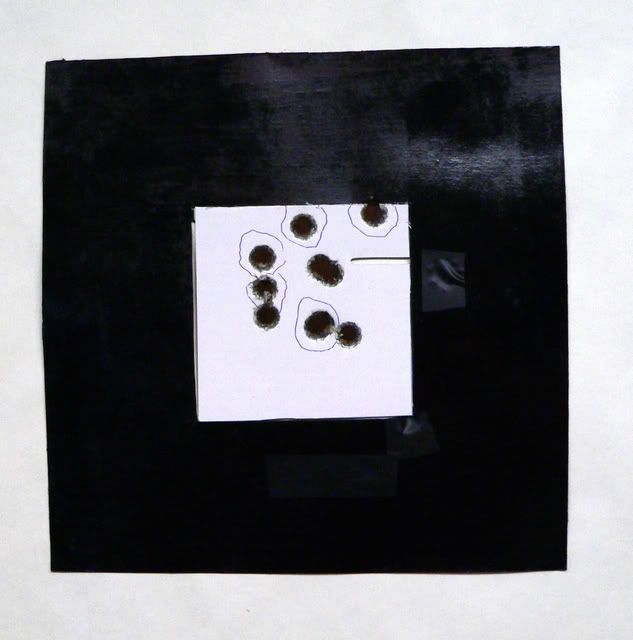
Here is a 100 metre target of five "headache variety loadings," 43 grains of 4198 and a 420 grain cast gas check. The magazine shows 44 grains of 4198 with a 400 grain bullet, as coming in the "not to exceed 28,000," catagory.
The flyer here is due to a scope that was coming unglued inside, and shortly really went to pot.
1.jpg

And here is five loaded so light with 4227, that after the report of the rifle going off, you hear the bullet hit the 100 metre target.
Unique004.jpg

And here is ten, with an intermediate, or actually light load, 420 grain bullets at about 1,600 fps. I was experimenting, five were gas checked, I circled the holes, then fire five plain base. Luck, I suppose, but the plain base made a better group.

PANASONIC002.jpg
 
I'm starting to question why I own 3 different 45-70s, each in a different "strength" category. Two is doable (I use regular blass for BP and nickle plated brass for smokeless to differentiate the two) but three might be asking for trouble.

 
I've owned quite a few .45-70's and currently own two or three. With the right powders, you can send a 405 grain bullet out the barrel at 1,400 fps at antique Trapdoor pressures. In North America, I see no reason for any more power than this. The catch is that you need to keep your shots at 200 yards or less, not because the bullet is not powerful enough for much greater yardage, but because of its trajectory beyond 200 yards. If you have a ballistics table with you, and you have proven that your load is consistent enough to fall within 4" of the table data, and you have a range finder, then you can go to 300 yards. Beyond this, use a different caliber.

Good advice.

The 405's are awesome killers, but keep in mind they are designed to work at trapdoor velocities.

Bullet selection and the mated velocity are everything in the 45/70.

IMHO hard cast bullets need careful consideration before going hunting.
 
H322 is my favorite powder for my Marlin 1895GS 45-70 with Win LR primers and a consistant crimp I load...

300gr Jacketed = max 56grs H322

350gr Jacketed = max 54grs H322

400/405gr Jacketed = max 52grs H322

420gr/430gr WLNGC cast = max 52grs H322

525gr WLNGC cast = max 45grs H322

550gr WLNGC cast = max 44grs H322

These loads are safe in my rifle if you choose to use it reduce all data by at least 10% and follow safe reloading procedures.
 
I think a few others alluded to it; your shoulder will give up before you reach max loads for your rifle. Mine has a limbsaver and I've still nicknamed it "Flinch". The expression "I've fallen and I can't get up" was written by an owner of one of these guns. That said, it is a fun gun to play with using less then max loads, then just use the stiff ones to kill stuff.
 
I install Kick-Eez recoil pads onto all of my harder recoiling rifles they are the bet recoil reducing pads on the market gving up to almost twice the recoil reduction of a limbsaver.

Don't let the comments on recoil scare you I used to listen to comments like that and fear the firearm so bad that I had a flinch built in even before I shot the thing and after the first shot I was always amazed that the recoil was nowhere near what everyone was saying it would be.
 
I install Kick-Eez recoil pads onto all of my harder recoiling rifles they are the bet recoil reducing pads on the market gving up to almost twice the recoil reduction of a limbsaver.

Don't let the comments on recoil scare you I used to listen to comments like that and fear the firearm so bad that I had a flinch built in even before I shot the thing and after the first shot I was always amazed that the recoil was nowhere near what everyone was saying it would be.

Exactly. Some may kick you but they're not going to kill you.
 
I'm starting to question why I own 3 different 45-70s, each in a different "strength" category. Two is doable (I use regular blass for BP and nickle plated brass for smokeless to differentiate the two) but three might be asking for trouble.

I've got 6 of 'em :). All a bit different. The way I see it, as long as you are very careful, which you need to be for reloading anyway, you'll get to keep all of your fingers.

I colour all of the primers on my Ruger loads with red marker. Each box of ammo has a piece of paper with all of the load data including expected pressure, as well as the specific rifle I put it together for.

I also don't really load any of them too hot. Even my ruger loads are generally slightly below the top of the lever gun ratings pressure wise.

Chris.
 
[I have the 1895 Model new Marlin ,/QUOTE]

So excuse my lack of knowledge and not wishing to hijack the thread, what is the difference between the "new" marlin and the older designs and when did the "new" version come out?

The original 1895 had a square bolt like the 1894, and was discontinued around 1916 or so. It was not very popular. The new 1895 came out around 1970, and is really a 336. It has a smaller action than the original 1895, which was long enough to handle the .45-90. The modern one is, of course, stronger.
 
Anyone here loading their No. 1's balls out? What's that like? Those No. 1 loads always intrigued me. I'm a total masochist though. Love a round that kills one end and wounds on the other.
 
Back
Top Bottom