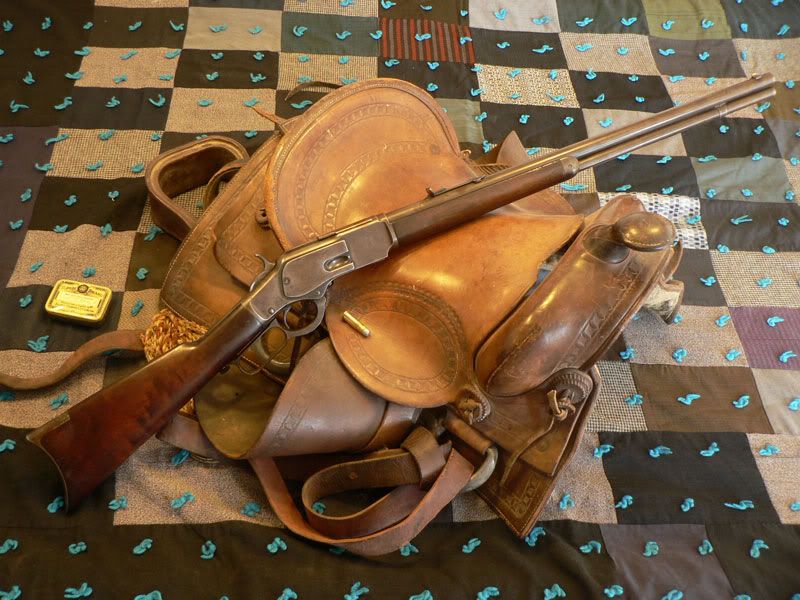
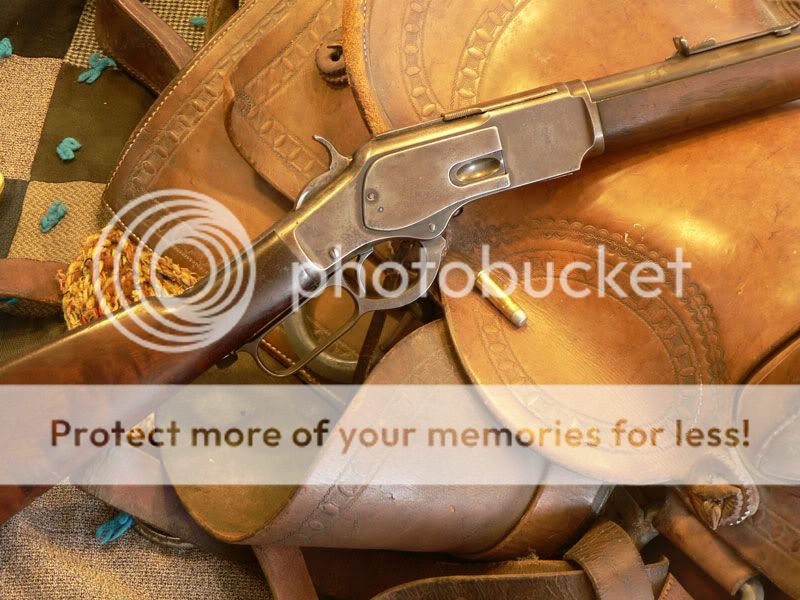
Boys, this 119 year old Winchester Model 1873 has become one of my all-time favourite rifles. This old timer earned its keep a century ago, judging from its worn, but completely original appearance. When I hold this old '73, I think of a late 1800's farm yard just a few miles north of the Vermont-Canadian border. In the valley is a ripe corn field, bounded by a cedar rail fence, nestled in the Maple-covered hills. Half the leaves have fallen. It is the end of October, late in the day, and woodsmoke curls up from the chimney of the house. At the far end of the corn field, a couple Whitetail deer cautiously feed on some cobs, but the farmer, he's already got his venison for the winter, thanks to his Winchester Model 1873 that someday, more than a century in the future, will be greatly enjoyed and cared for by myself, and add another Whitetail deer to its tally.
There was a long time when I thought little of the 38-40 cartridge, preferring its slightly bigger brother, the 44-40. But after getting my first 38-40 (originally known as the 38 W.C.F.) in the form of an old Winchester Model 1892 made in 1913, it rapidly became one of my favourite cartridges. Then I began to read of those who had taken many and large Whitetail with this classic cartridge, and I realized that I had badly underestimated it. It is coming with me this fall to make venison one more time.
I like handling this old rifle, often taking it down just to hold it in my hands and feel the history silently spoken in its appearance. Here's a photo of the old timer getting some attention ....

I wanted to develop a smokeless load for this rifle that would duplicate original black powder ballistics, but at a pressure that was less than or equal to black powder and give me decent accuracy. Of the powders I have on hand, these criteria restricted me to Alliant 2400, IMR SR4759 and Accurate 5744. My trials with 5744 ended abruptly after my first trip to the range ...... the pressure was simply too low to properly bump up the soft-cast bullet, giving five-shot groups at 100 yards that were 7 or 8 inches. I noted that the faster the burn rate, the better the accuracy. Both 2400 and 4759 gave decent five shot groups just over 3" at 100 yards, but after quite a few trips to the range as I tweaked the load to give me in the low 1,300's fps, it became evident that 2400 had a slight edge over SR4759 due to its slightly faster burn rate. Both loads, however, give decent accuracy so they will both go down in my books as final loads, but I will be loading the 38-40 using 2400 from now on.
My final 'Pet Load' for the Winchester 1873, 38 WCF (aka 38-40) is 13.5 grains of Alliant 2400 under a 188 grain RCBS cast bullet for 1,320 fps. Here's the final 100 yard, five shot group I shot at lunch time today ....

My 'back-up' load for the Winchester 1873 38-40 is 17.5 grains of IMR SR4759 under the same cast bullet for 1,328 fps. Here's the final 100 yard, five shot group I shot late last week before I tweaked the front sight to center things up a bit better ....

A word about accuracy: The groups you see above are both five-shot groups taken at 100 yards with the original open iron sights on this old gun. The 2400 load group is 3 & 1//4" and the SR4759 group is 3 & 3/4". Now I know that there are fellows who can't sleep at night if they can't put five rounds into 3/4" at 100 yards and who would consider these groups jaw-dropping bad. Well, let me say, boys, that there can be a lot more to shooting and hunting than putting bullets into 3/4" at 100 yards. If I can't hunt and shoot with a old classic gun, then it's hardly worth doing. This old '73 has rifling that is half worn away and there are several pitted areas up the bore. The bullets I shoot are plain base cast. I could use gas checks or filler to improve these groups down to probably 2", but I like to make cheap bullets and I don't know if I'll always be able to get gas checks. I also love this old rifle, so the challenge was to get the best accuracy I could with the the criteria I impose upon myself. I will be hunting at less than one hundred yards, and the shot will be most likely around 50 yards, judging from past experience where I hunt. So a five shot group of 3 & 1/4" at 100 yards will allow me to put a bullet right exactly where it is going to count. Last fall, I used an old 44-40 to put venison in the freezer, now it is the 38-40's turn.
There was a long time when I thought little of the 38-40 cartridge, preferring its slightly bigger brother, the 44-40. But after getting my first 38-40 (originally known as the 38 W.C.F.) in the form of an old Winchester Model 1892 made in 1913, it rapidly became one of my favourite cartridges. Then I began to read of those who had taken many and large Whitetail with this classic cartridge, and I realized that I had badly underestimated it. It is coming with me this fall to make venison one more time.
I like handling this old rifle, often taking it down just to hold it in my hands and feel the history silently spoken in its appearance. Here's a photo of the old timer getting some attention ....
I wanted to develop a smokeless load for this rifle that would duplicate original black powder ballistics, but at a pressure that was less than or equal to black powder and give me decent accuracy. Of the powders I have on hand, these criteria restricted me to Alliant 2400, IMR SR4759 and Accurate 5744. My trials with 5744 ended abruptly after my first trip to the range ...... the pressure was simply too low to properly bump up the soft-cast bullet, giving five-shot groups at 100 yards that were 7 or 8 inches. I noted that the faster the burn rate, the better the accuracy. Both 2400 and 4759 gave decent five shot groups just over 3" at 100 yards, but after quite a few trips to the range as I tweaked the load to give me in the low 1,300's fps, it became evident that 2400 had a slight edge over SR4759 due to its slightly faster burn rate. Both loads, however, give decent accuracy so they will both go down in my books as final loads, but I will be loading the 38-40 using 2400 from now on.
My final 'Pet Load' for the Winchester 1873, 38 WCF (aka 38-40) is 13.5 grains of Alliant 2400 under a 188 grain RCBS cast bullet for 1,320 fps. Here's the final 100 yard, five shot group I shot at lunch time today ....
My 'back-up' load for the Winchester 1873 38-40 is 17.5 grains of IMR SR4759 under the same cast bullet for 1,328 fps. Here's the final 100 yard, five shot group I shot late last week before I tweaked the front sight to center things up a bit better ....
A word about accuracy: The groups you see above are both five-shot groups taken at 100 yards with the original open iron sights on this old gun. The 2400 load group is 3 & 1//4" and the SR4759 group is 3 & 3/4". Now I know that there are fellows who can't sleep at night if they can't put five rounds into 3/4" at 100 yards and who would consider these groups jaw-dropping bad. Well, let me say, boys, that there can be a lot more to shooting and hunting than putting bullets into 3/4" at 100 yards. If I can't hunt and shoot with a old classic gun, then it's hardly worth doing. This old '73 has rifling that is half worn away and there are several pitted areas up the bore. The bullets I shoot are plain base cast. I could use gas checks or filler to improve these groups down to probably 2", but I like to make cheap bullets and I don't know if I'll always be able to get gas checks. I also love this old rifle, so the challenge was to get the best accuracy I could with the the criteria I impose upon myself. I will be hunting at less than one hundred yards, and the shot will be most likely around 50 yards, judging from past experience where I hunt. So a five shot group of 3 & 1/4" at 100 yards will allow me to put a bullet right exactly where it is going to count. Last fall, I used an old 44-40 to put venison in the freezer, now it is the 38-40's turn.