8x57 ammo experience.

brunetp

Member
EE Expired
Rating - 100%
2   0   0
I ordered some Igman from out west canada, there european correct? But there ballistics are close to the same as american ammo (winchester etc..) ???

http://www.igman.co.ba/ammunition.htm
They show it around 2300ish FPS after converting it from M/S.

Sellier and bellot shows 2500 ish FPS. http://www.sellier-bellot.cz/rifle-a...12&product=528
prvi shows about 2400FPS http://www.prvipartizan.com/rifle.php

Winchester is 2350FPS 170gr
Federal shows 2250FPS http://www.federalpremium.com/produc...fle.aspx?id=65

Anyone have hands on experience with 8x57 between Sellier and Bellot, Igman, nosler, Norma, Privi ? I've heard poeple getting 2600-2700+ fps out of the 8x57, but is that only reloading territory?

Igman and sellier and bellot are easier to find in my area. Norma and nosler are expensive, and privi doesn't seem to be around.

Just trying to get a understanding of this cartridge.

Thank You!
 
Looking at a box of normas 198gr oryx It shows almost 2600 fps. Paid 33 bucks 3 years ago from Epps and dont know the price now.Reloading is your friend
 
Last edited:
Yea but how much for the equipment?does any lebarons etc..have reloading equipent? Seems like alot of reading and alot of variables before you know enough not to blow your face off lol. loadata.com is pretty interesting, choose your bullet size, FPS, then go buy the bullets and powder and get some cartridges, then theres a primers?
 
You can get started for just over a $100 with a Lee Anniversary Kit. It has everything you need including a manual except dies and the components (bullets, powder, case, primers). I used one and then upgraded things (scale) as I got more experienced. I loaded 8mm Mauser to WW2 German specs with mine. Very accurate.
 
P1010264.jpg


Try North Sylva,
aka http://www.targetshootingproducts.com/store/index.php?cPath=21

Not listed, but they have some.
 
You can get started for just over a $100 with a Lee Anniversary Kit. It has everything you need including a manual except dies and the components (bullets, powder, case, primers). I used one and then upgraded things (scale) as I got more experienced. I loaded 8mm Mauser to WW2 German specs with mine. Very accurate.

What weight of bullet was standard german loading and what velocity? Heavy bullet like 196gr may not be the best choice for my FN and Hakim, you fire your load in bolt action only or in semi-auto too? Thx:)
 
Don't forget, the WW1 7.92x57mm Mauser bullet weight and powder load were different from the post war bullet weight and powder load.

The WW1 bullet weight was around 154 grs. Late war MG rounds set the standard for the 198 grs rounds used in the post war period.

I use a 150 gr SP bullet in my reloads to get the same or similar ballistics that they would have had back in WW1 for my Mausers.

Commercial ammo is just way too expensive for 8mm Mauser. Why pay $1 a shot when you can reload for 1/4 of that ? You also know exactly what is going into every round that you make.

European 8x57mm Mauser commercials loads are generally loaded much hotter than U.S. commercial ammo. Be very careful when using European ammo in firearms such as the Gewehr 88.
 
Anyone have hands on experience with 8x57 between Sellier and Bellot, Igman, nosler, Norma, Privi ? I've heard poeple getting 2600-2700+ fps out of the 8x57, but is that only reloading territory?

The commercial ammo (especially the north american stuff) is loaded soft in deference to the older .318 bore rifles. Reloading lets you load up to more reasonable pressures for your rifle and the .323" bore size (assuming that your rifle has the bigger bore and is a strong action). Loaded up to max pressures, the 8x57 is equivalent to the 30-06.

IMO, reloading is really the only way to go for pretty much any centerfire calibre, you will recoup your investment in equipment quite quickly if you shoot any significant amount. It also lets you customize ammo for your guns and make higher quality ammo for far less than commercial prices.

Mark
 
I have used Igman 198gr SP ammo in my K98 with very good results. Very accurate stuff, and not too bad in the recoil department either. Ordered a case of 250 rds 3 years ago, also ordered a case of 250 rds of 7.62x54R as well. I remember the delivery guy called my place to verify I was home, he said the package weighed a ton and he didn't want to lug it up the stairs for no reason.
 
8x57 I and 8x57 IS - a difference

Almost every European hunter and shooter is aware of the difference between the 8x57 cartridges, but in North America, there seems to be a lot of ignorance regarding the two.

The original 8x57 I (sometimes printed as 8x57 J, the German alphabet), was designed with a .318 bore diameter, and was used in the Model 88 Mauser. The Model 88 is not considered a strong action, compared to Mauser's later designs. This was originally loaded with a heavy round nosed bullet.

In the early 1900s, the Germans looked at the Spitzer type of bullet and a better smokeless powder. The bore diameter was changed to .323 simply by making the rifling a bit deeper, and a lighter pointed bullet was used. At this time, the Model 98 Mauser was the standard service rifle, and was a much stronger action. The designation for this cartridge was 8x57 IS (or 8x57 JS), with the "S" being added to identify the more high pressure and larger diameter loading. The larger bore helped to keep the pressures lower to obtain the velocity desired.

As stated, this is a well known fact in Europe, and MOST firearms made after 1910 are the .323 bore. HOWEVER, some of the European gunsmiths believed that the .318 bore was a bit better, and made firearms after this date with the smaller bore, but they were identified with the 8x57 I (or J) designation.

To our average North American, and 8x57 is an 8x57.....right? So, Joe Smith has this old war relic, a Model 1888 Mauser, or sporting rifle that great grandpaw brought home in 1918, and he wants to fire it. So he goes into the Gun Shop and says "Gimmie a box of that German ammo, the 8x57 calibre stuff."

This is what the Ammunition Company Lawyers stay awake nights, dreaming of, and having nightmares. So, in our now common "Sue them all" society of today, to prevent a possible blow up of an old rifle, the North American ammo manufacturers underload the 8x57 cartridge (and also the 7x57 Mauser, due to a lot of old Remington Rolling Blocks used in Mexico by Pancho Villa's mob.)

The Federal stuff marked "8x57 Mauser" is about 2260 fps. Norma, on the other hand, identifies the cartridges properly as "8x57 JS" and gets close to 2700 fps with the same weight bullet.

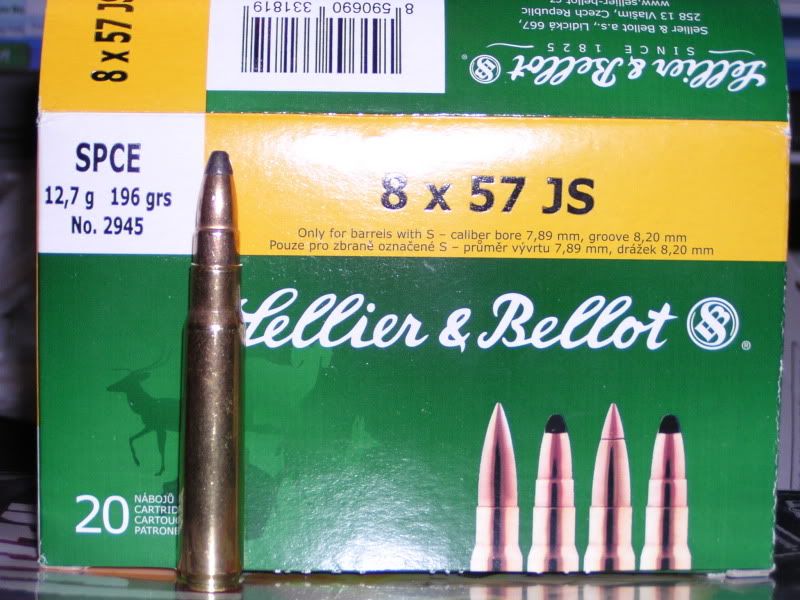
See DIOPTER's posted pictures of the Selliers and Belliot ammunition box, and you will see clearly the designation .....8x57 JS. It also says "Only for barrels with S calibre bore 7.89 mm, -- groove 8.20 mm."

Incidentally, the "I" stands for "Infantrie" also known as " Jaeger" in German, hence the "J".

Reloading the cartridge is the best way to get the best performance out of it. You can equal the 30-06 loads with the 8x57 IS. Or, you can get less than .303 British performance with the 8x57 Federal or Winchester stuff.
 
Last edited:
Ackley have long proved the bullet diameter difference point is non-existant in M/98 and other strong actions unless you are using solid bullets (but as Buffdog pointed, the m/88 is a different story).

As for the pressure ratings of the different manufacturers, PPU beyond others make two different loads for the general public; one under CIP to be sold in Europe and the rest of the world and one under SAAMI to be sold in the USA (and by rebound, to Canada).
The differences in pressure are quite great, CIP specifying 57 700 PSI while SAAMI specifies 35 000 CUP (wich translates in more or less 42 000 PSI piezo)...
Hodgdon reloading manual is a good place to start to get CIP-like pressure performances, while SAAMI pressures usually shows as starting loads.
 
Okay, I looked at the Igman chart for that weak, underpowered German cartridge. Can somebody tell me just what is so 'underpowered' about a bullet just shy of 200 grains, running down the range at 2400 ft/sec? It is GONNA flatten Mister Moose if he stands in front of it.

Yes, the Germans DID get very close to 2900 ft/sec (actually 2880 nominal) with this cartridge, but they did it with a 29.13-inch barrel and a 154-grain bullet. BIG difference between 154 and 196, especially when the 154 is ALREADY running what they considered maximum safe pressures.

What people lose sight of, always, is one simple little fact: that heavy load with the 196-grain bullet was the original ANTI-TANK load for this cartridge.

At 154 grains running at 2880 ft/sec, the 8mm is ALREADY outperforming the original 1906 load for the .30-06 by a good margin. How much MORE do you need?

US loads generally run with a 170-grain bullet with a fairly soft jacket... and they are SAFE in any old rifle which is in decent shape.

If you really want to hot things up to the 1904 specs (154 at 2880) you are going to have to (1) handload, and (2) either know your onions or else get a 29.13-inch barrel, or both.

But you simply can NOT whack a solid quarter of the length of the barrel off the rifle, then run a bullet which is 30% heavier, expect the long-barrel light-bullet velocity with the heavy bullet in a short barrel AND keep your pressures safe, especially when they were already at the considered safe maximum when things started.

There is a lot more to loading ammunition than just dreaming up a load. Get yourself a couple of modern loading manuals and then get a copy of "Hatcher's Notebook" and carefully and slowly read the chapters on ammunition loading, pressures and powders. Once you have done that, set yourself up handloading. Don't worry about POWER, either: all the power in the world is useless if you miss your target. Concentrate on turning out the most accurate ammunition you can. It's easier on you, on the rifle AND it brings home the meat because you actually hit it where the shot counted.
.
 
Just one more little burp of historical trivia here.

Apart from myself, has anybody here ever stripped down a Maxim Machine Gun and carefully analysed the guts of the thing? I had to: I wrote the CF manual on the thing.

The Maxim Models 1908 and 1908/15 have barrels which are 28 inches in length, as compared to 29.13 inches for the Gew 98 and a hair over 23 for the Kar 98aZ and Kar 98k of War Two fame.

The lockup of the Maxim weighs close to a POUND. Just the main axis pin for the crank weighs about double the weight of the lockup of a Gew 98. It is VERY strong.

The high-velocity heavy-bullet load (JsS) which was issued as anti-Tank ammunition IN THE MACHINEGUNS was NEVER issued for rifles in World War One and its use in rifles was forbidden. That the stuff saw rifle service at all is down to the fact that everybody had a buddy who had a buddy who had a friend in the machine-gun section who could get him ONE charger of the super-nasty ammo. This single charger of ammunition generally was carried in a uniform jacket pocket just in case a guy had to take on a Tank without a 77 and a TuF to back him up, so to speak.

It was NEVER general-issue for rifles. That it was issued at all during War Two is down to Herr Hitler, who was a multi-decorated War One combat veteran who wanted HIS troops to have AT capability. In actual fact, the overwhelming majority of War Two issue ammo was the 178-grain SmE loading, of which at least 99 per cent was run through machine-guns. German MG doctrine was extremely advanced: just ask anyone who was in a cross-fire from 2 or 3 dug-in `42s and they will tell you all about it. Jerry might have CARRIED the Kar 98k but the SHOOTING was done with the 34 and the 42 and even by old resurrected Maxims.

But (comparatively) very little JsS was ever run through rifles, so let`s put this myth to bed for once and for all.

I`ll run away now and let you guys fight it out.
.
 
I have had good results with S&B 8x57Js 197 gr in almost all my mauser's, K98, M48 (all of which I sold), Mauser sporter ex K98A. The only exception was my turk rifle which used that really hot turk ammo 150gr filled to the top with devil dust (don't know the powder but wow!)

winchester 180 gr dropped below the POA about 4-6 inches @ 100 yrds. S&B was bang on.

Pete
 
Pblatzz, that Turkish stuff you were shooting was made precisely to the specifications laid down in 1904 for the original JS load, which was the standard rifle loading in World War One. Shooting it through your Turk Mauser, you were getting VERY close to 2900 ft/sec with the 154-grain greased-steel-jacketed pointed bullet.

When this stuff hit the market in the States, I didn't have the money to bring in a batch. I was, however, able to beg 3 bandoleers of it from a fellow who runs a museum. I pulled down 30 rounds and put the charges and slugs into fresh Boxer-primed brass. Tested in 3 different rifles (a Gew 98, a Kar 98b and a Kar 98aZ) which had, collectively, been through 7 wars that we could prove, this ammo averaged just over 1 inch at 100 yards through the three rifles. That many people dismiss this stuff as garbage is down to one single factor: dodgy primers.

Note please that there was NO effort to re-uniform the charges: the charges were dumped directly from the Turk rounds into the newly-primed Norma commercial brass and then the bullet seated. The reason for this was simple: this was a test to see what that ammunition would do when it was fresh. It was VERY good.

The powder, by the way, was a square-flake type which could not be told from original German WW1 powder (I pulled down a German 1917 round to check).

Hope you saved some of that Turkish ammo, friend!
.
 
Back
Top Bottom