












































Is the 16 dead?

When you factor in the likely fact that unless you are hunting migratory birds the 16 will provide all the power you need with a nicer pattern than a 20 would. But you are right, the 16 was rarely made in a proper sized frame and tended to weigh the same as a 12.
The argument that a 16 will provide a superior pattern to a 20 gauge in upland hunting is the same argument used by those saying the 16 will provide an inferior pattern to a 12 guage for waterfowl hunting. I suspect any real difference on the patterning board that can't be addressed by ammunition selection is theoretical at most. And of course, the 20 gauge affectionados will argue the exact opposite - that a 20 gauge will do just about anything a 16 will do, and is available in far more trim, lighter packages.

Which leads you to other observations. If I can indeed get a 12 guage that weighs just a tad over 6 lbs, why indeed would I consider a 16 or even a 20 unless I can find one significantly lighter and value that extra weight savings? Particularly if I believe bigger gauges are going to give me meaningfully better patterns?

For me personally, I am inclined to go with shotguns much the way I have with flyrods. I use a well chosen 6 wt for most of my flyfishing, but I also have an elegant little 2 wt that comes out whenever the conditions are favourable to it.

It seems to me that the only shortcoming a 12 gauge has is weight for those who feel even a shotgun weighing 6 lbs and a few ounces is too much. So the 12 really will do anything that the smaller gauges will (better if you apply bigger bores give better patterns theory), with the exception of the desire to enjoy a feather light shotgun.

So I have sold all my 20's now and am a 12 gauge man for ease of reloading if nothing else. But I intend to apply my flyrod approach to shotgunning, and I am fairly certain the 12's are going to be joined by a 28 gauge sometime in the forseeable future. In the early parts of the upland bird season around here where it is seldom that a shot would be over 30 yards, there is definitely a time and place for a beautiful little 28 gauge.

That works for me. If I specialized in ruffies in close quarters or quail, or never had a perceived need for more than an ounce of shot, I'd probably just buy 28 gauges and never look back.

I don't think there is a new argument for or against the 16 gauge to be had, incidentally.
 
Here's a new one for ya. Was phoning around for some of this stuff in Kamloops this a.m. when I got hold of a shop that does only target rifles, which I didn't know when I called. The proprietor told me the reason I have had trouble locating ammo is that "The sixteen has had a big resurgence of interest lately and the gun shops can't keep it in stock."

That's certainly a new take on the situation eh?lol.

And just a hot stove league observation, but seems most of the talk about the various merits of the 20, 16 and 12 above discussed center around weight. But there is another consideration for me which I first read about in a book by Don Zutz years ago. That is dimensions of the whole package, taking action, barrels and stock all into consideration, can be as important as weight or anything else. With upland style doubles built on appropriate sized actions, I find the twenty a bit skimpy in my hands, the twelve a bit too fat, the 16 just right. This goes for both hands.

Just fuel for the fire.

Carry on.
 
I agree with Zutz's dimensions argument. To me a double on a true 16 ga. frame feels "just right" - the Goldilocks dimension! Some 16 ga. pumps and semi's like the Remingtons built on 12 ga. frames have no reason to exist! The Win. Model 12 is one of the few repeaters Goldilocks could like.
 
My local Canadian Tire (rural Newfoundland) carries them, as does several local Polaris dealerships (also sell guns & ammo).

I love the 16. Got a beauty Fox SXS and a nice Stevens 311 SXS. I keep my eye out for a classic Remington 870 pump. Hopefully one of these days I'll come across one when the "mad money" has not been spent for that month.

I'll be hunting with the Fox 16 this fall bunny hunting. Federal is still making 16 ga. ammo suitable for upland game. Winchester stuff seems to be harder to come by in 16 ga though...
 
There's nothing more cool than a old HVA-Lefaucheux 16 ga 2 1/2" using BP cartridges!
16gaBPHVAM20.jpg


And it still harvests games after 106 years of use....

Achasseoct2010074.jpg
 
I've read that currently 16 ga is only 3% of the North American market, but it does have its place. My wife uses a Stevens Model 5100 coach gun for cowboy Action shooting. Its the gun that fits her and she likes it. I've managed to get 3 flats of ammo in the last couple of years, 1 of Winchester #6 from Wholesale Sports in Calgary and 2 flats of Federal from a local dealer who made me wait 5 months until his shipment of trap and skeet ammo came in. I ordered Kent and I got Federal. With the price I paid, I should have at least been kissed after the fact! After all doesn't that go with a good scr**ing?
This is one gauge where you have to keep shopping around. As for the local Canadian Tire store, generally they only keep 1 or 2 boxes of #2 shot.
 
The 16ga is surly nor dead and indeed enjoyed a resurgance in popularity in North America. This can be confirmed by the fact that Browning regularly does a production run on 16's of various configurations (pumps & O/U's) and in fact just released a run of Citories in several different grades & styles. The sixteen remains popular in Europe today -- they were never overtaken with the American notion that bigger is better.
I won't get into the arguement that one gauge is superior to another -- suffice to say that I've noted that most folks I have met touting the benefits of a 12 ga over the 16 have never owned a 16. I will say this much --- I shoot all gauges and own many 28's, 20's, 16's and 12's and a couple of .410's. To me in shooting clays for example the 28ga breaks targets with more authority than the 20 and the same can be said for the 16 against the 12. Only my humble opinion --- If I've ever had a humble opinion.
Cheers.
 
Last edited:
What makes a caliber to drown is in big part the ammunition availlability (and price).
Before, most serious shooters realoaded, now, it's almost prohibitive when you compare the cost of components and equipment vs cheap commercial ammo. Reloading now only gives you an edge if you're using special stuff like my BP loads with Bismuth, but the cost of it is still quite high...
Also, everyone today seems to want a 3 1/2" shell to shoot, thinking you can get more games with it.
The lack of versatility in commercial loads can also restrict the use of the shotgun itself.
 
Personally the 16 is my favorite. Years ago 16 and 20 gauge were built on the same frame and the 16 was more effective on a greater variety of game. Obviously if it is built on a larger 12 gauge frame there is no advantage and one should choose a 12 gauge. I recently acquired a shotgun I had never seen before, it's a Fulton by Hunter Arms Co. They were the makers of the L.C. Smith doubles and though a much cheaper gun it is light, fits perfect and locks up tight. Mine was made in 1938 and is a 16 gauge, of course.
 
What makes a caliber to drown is in big part the ammunition availlability (and price).
Before, most serious shooters realoaded, now, it's almost prohibitive when you compare the cost of components and equipment vs cheap commercial ammo. Reloading now only gives you an edge if you're using special stuff like my BP loads with Bismuth, but the cost of it is still quite high...
Also, everyone today seems to want a 3 1/2" shell to shoot, thinking you can get more games with it.
The lack of versatility in commercial loads can also restrict the use of the shotgun itself.

If one intends to shoot a 16, 28 gauge or 410, then IMO handloading is almost a must. The problem with the 16 is that no decent hulls are manufactured anymore. Rem. STS and Win. HS hulls are made in all gauges but the 10 and the 16 gauge.
 
I refuse to give up on the 16 gauge; I currently own two of them, a Baikal dbl and a Browning BPS. Both are superb examples of type. I also had a Win12 and a Rem11, which have passed on to other happy owners. I have had 12s and 20s and .410s as well, but the 16 is what remains. I would buy a 28 if I could justify it, but I can't at the moment. What I can say is, owning 16s I feel no need for either 12s or 20s. Take that as you will.
 
...The problem with the 16 is that no decent hulls are manufactured anymore. Rem. STS and Win. HS hulls are made in all gauges but the 10 and the 16 gauge.

I use Kent / Gamebore shells for most of my 2 1/2" were they 12ga or 16ga. Decent stuff for the pressures I load to. They also make "Fastlead" series in 16Ga, 2 3/4" and Fiocchi also produces it, but the supply does not seems to be constant around here.
 
For those who maybe of interest,Ithaca has reintroduced their Model 37 pump in 16 gauge.The Model 37 Ithaca is now available in 12,16,20 and 28 gauge.
 
If somebody who own a 16 ga. gun gets fed up with it, they'll sell it for cheap. So this next guy buys a basically good gun for next to nothing, and because he got it so cheap he'll do a little extra legwork to find shells for it; either pay more, have them shipped or reload.

So the 16 gauge will never die as long as there are 16 ga. guns that still work.
 
There is some truth to that which is why my sxs has a 16 gauge frame and 12 gauge barrels. Best of both worlds. :)

It gets even better... this SxS has a 20 gauge frame and 12 gauge barrels. :eek: :stirthepot2: ...and weighs 6lbs. I used to have a beauty of a little Parker Bros 16. Now I have a beauty of a little 12, and I'm very happy with the transition. All that matters is the quality of the gun you're buying, not the gauge. I like 16, but it does nothing a 12 won't, with mine slinging factory loads from 7/8oz to 1 3/4oz. So while the 16 doesn't do anything more than the 12, the 12 however, does things a 16 won't. So I had to follow the logical path, and it's proved a more versatile gauge for my hunting. You just need the right gun.
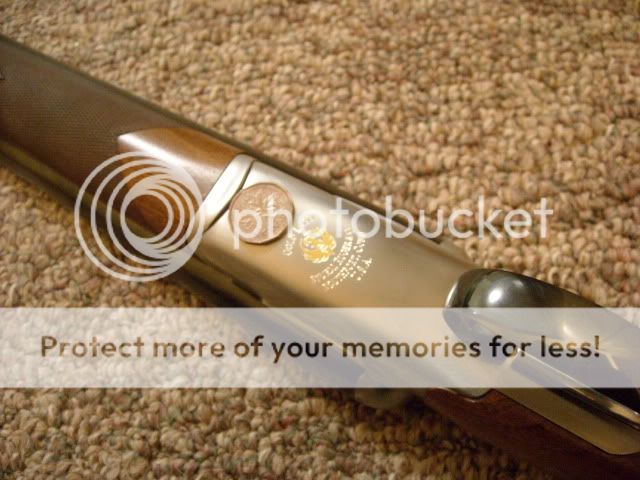


20 gauge frame, 12 gauge gun:

DSCN0005.jpg
 
Back
Top Bottom




















