












































You are using an out of date browser. It may not display this or other websites correctly.
You should upgrade or use an alternative browser.
You should upgrade or use an alternative browser.
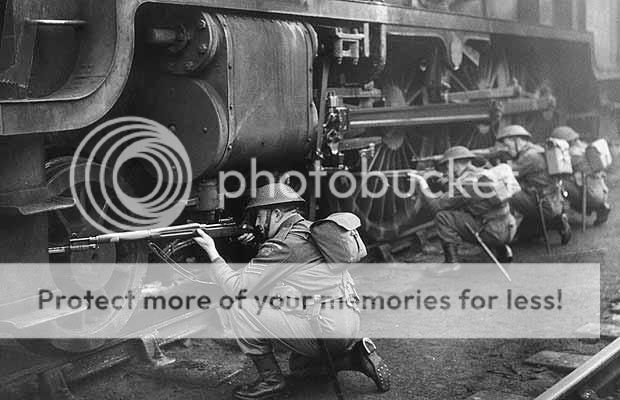
P14's in action pic
- Thread starter kjohn
- Start date



- Location
- Tucson, Arizona
Doesn't matter, those are M1917's NOT P14's. They wouldn't have painted the red band on a P14 stock even it it came from a M1917 The Home Guard were originaly issued M1917's
1. The Army needed ANYTHING that would chamber a .303 after Dunkirk
2. Ammunition supply would not be a problem as long as the rifles were in the U.K.
ONLY after production caught up were the home Guard issued P14's.
Home guard officer was asked what order he would give if the germans invaded.
He answered "don't fire until you see the whites of their eyes"
When asked why, he replied
"I have three rifles with five rounds each, and a lewis gun with a broken return spring!
1. The Army needed ANYTHING that would chamber a .303 after Dunkirk
2. Ammunition supply would not be a problem as long as the rifles were in the U.K.
ONLY after production caught up were the home Guard issued P14's.
Home guard officer was asked what order he would give if the germans invaded.
He answered "don't fire until you see the whites of their eyes"
When asked why, he replied
"I have three rifles with five rounds each, and a lewis gun with a broken return spring!

- Location
- WMU248 near Edmonton
yes and the patt 17 bayonet is a giveaway see the 2 grooves on the handle


My eye sight is failing....I only see black and white.....
 ......love the "hob nail" boots...those look like some serious sh1t kickers {aka newfie boxing gloves}....slippery on a hard stone surface I'll bet!
Rifleman1911
CGN Regular
- Location
- Leduc county AB
^ about the boots. that was the first thing I notice too. Would not want to walk 20 miles in those.!
^ about the boots. that was the first thing I notice too. Would not want to walk 20 miles in those.!
These are the standard British issue "ammunition boots" which were worn by through WW2 by the Brits, Cds, and others. They were made for durability, not for comfort.
When I joined the Army in 1964 we were issued 2 pairs. By that time the boot had been changed to have a hard rubber sole, one reason being to provide better traction when mounting tanks and other vehicles. The boots still had the rough pebble grain exterior. You kept one pair as issued for use in the field and had the second pair modified as a parade boot. This involved "spooning" or buffing off the pebble exterior, inserting a leather toe cap, adding a double leather sole and triple heel, and having a horseshoe put on the heel and a steel cleat on the front of the sole-all the better for square bashing. The durn things must have weighed 10 lbs each, incl at least 1 lb of spitshined Kiwi, when you were done, but they were a thing of beauty and a joy to behold.
In these pre-combat boot days they were topped off with cloth puttees, again a pair for the field and another for parade. The puttee was about the stupidest thing going and was a retrograde step from the canvas gaiters worn in WW2.
- Location
- Tucson, Arizona
Note also that the gaiters are leather instead of webbing.

good thing they're not in their kilts!

Scottish blackwatch training
Note the P14 or Model 1917 rifles,..im not sure but didn't the regular Brit Army use the SMLE
These are the standard British issue "ammunition boots" which were worn by through WW2 by the Brits, Cds, and others. They were made for durability, not for comfort.
When I joined the Army in 1964 we were issued 2 pairs. By that time the boot had been changed to have a hard rubber sole, one reason being to provide better traction when mounting tanks and other vehicles. The boots still had the rough pebble grain exterior. You kept one pair as issued for use in the field and had the second pair modified as a parade boot. This involved "spooning" or buffing off the pebble exterior, inserting a leather toe cap, adding a double leather sole and triple heel, and having a horseshoe put on the heel and a steel cleat on the front of the sole-all the better for square bashing. The durn things must have weighed 10 lbs each, incl at least 1 lb of spitshined Kiwi, when you were done, but they were a thing of beauty and a joy to behold.
In these pre-combat boot days they were topped off with cloth puttees, again a pair for the field and another for parade. The puttee was about the stupidest thing going and was a retrograde step from the canvas gaiters worn in WW2.
I was always puzzeled why the Canadian Army went to wearing puttees in the field, after WW2, when the troopies wore the canvas or web gaiters,..putting on those puttees were a pain in the ass

Note the P14 or Model 1917 rifles,..im not sure but didn't the regular Brit Army use the SMLE
They sure did for the most part, but I have seen photos of P14s in the hands of front line British troops during the early stages of the North African campaign. P14s were heavily used for training in the UK, and were widely issued to the various Free European forces training there too.
I also recently came across a photo of a German POW camp guard carrying a P14 bartering with an American officer POW. I can only assume that the rifle was captured from the British and later given to rear echelon units.






















