I could be wrong but my theory is due to the open spaces between the slide and the frame, more dirt gets pushed out, instead if staying and glogging up inside the gun. You can hold a glock up and look and see the gaps between the slide and the frame. Anyhow thats my theory, i could be out to lunch, whats your opinion?















































You are using an out of date browser. It may not display this or other websites correctly.
You should upgrade or use an alternative browser.
You should upgrade or use an alternative browser.
Why are Glocks so reliable?
- Thread starter GunGuy34
- Start date
- Status
- Not open for further replies.

 how it's accomplished doesn't matter.


because it has less parts to get f**ked up....
Welcome back Where the hell have you been?


You know I've had both a Glock and a Beretta and the 92F was way more reliable than the Glock. The Glock was pretty damn good and more durable in the long run but the Beretta NEVER jams.
I dont think one is more reliable then the other, they are both reliable. I think berettas open slide design helps with their reliability, plus a beretta wont jam if you limp wrist it.

Fewer parts, simple design, but the number one thing in my view is that the barrel is "scalloped" out just above the feed ramp. Or, in otherwords, they are not a "fully supported chamber". In saying this I don't mean it as a negative. Fully supported chamber is an idiotic and unnecessary idea for a 9mm pistol, especially anything that is not a target pistol.
Left to right: SIG, HK USP, Beretta 92, GLOCK, Walther P99, Steyr M9A1
See how the GLOCK barrel has almost another "ramp" after the ramp.
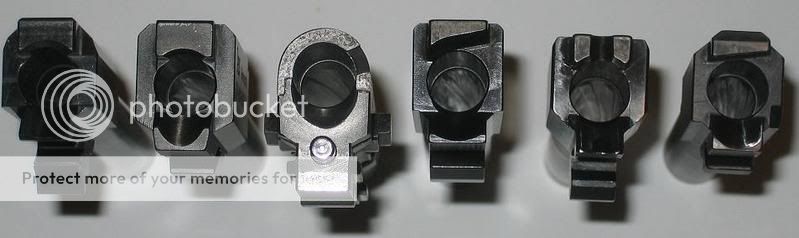
This is a similiar type of photo. Left to right: GLOCK, HK USP, Steyr, Walther. Pretty much all barrels have some material removed in this area, but notice how it is more with the GLOCK 17 barrel in this photo:
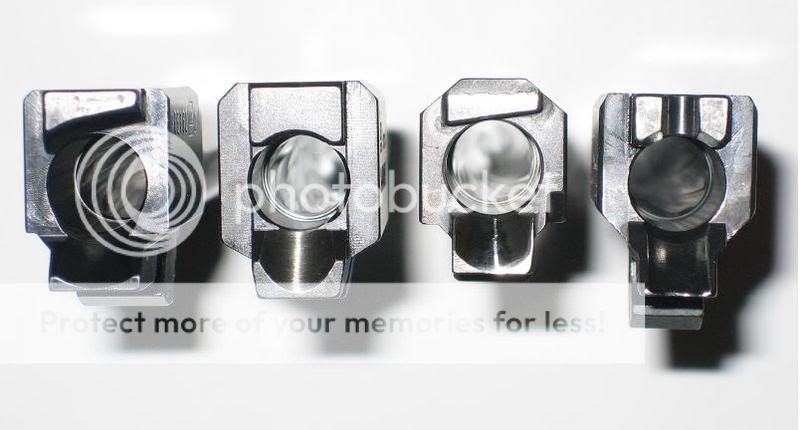
This is another way of looking at it. Notice how much more of the case-wall is visible on the brass in the GLOCK barrel versus some of the others. Left to right: GLOCK, HK USP, Steyr, Walther.
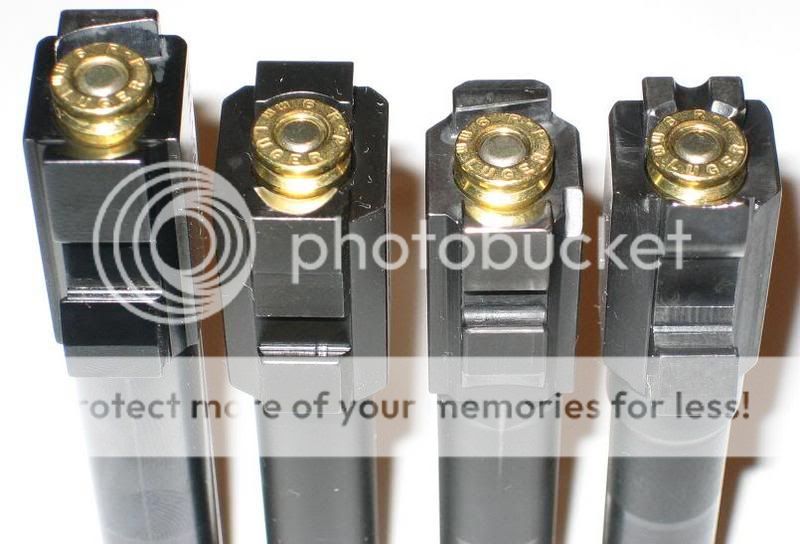
Different calibres in GLOCK are all a little different, but I think you will find that their barrels are noticably more "scalloped" out than their competitors calibre-for-calibre.
It makes the guns super reliable. Some people say it makes GLOCK brass less suitable for reloading, especially multiple reloads. Others believe there is a connection between this and "kabooms". I don't think you are going to be seeing that in a 9mm GLOCK using factory ammo... and in the meantime the gun will feed and cycle just about anything no matter how dirty it is, and a huge part of that is that scalloped out chamber.
Left to right: SIG, HK USP, Beretta 92, GLOCK, Walther P99, Steyr M9A1
See how the GLOCK barrel has almost another "ramp" after the ramp.
This is a similiar type of photo. Left to right: GLOCK, HK USP, Steyr, Walther. Pretty much all barrels have some material removed in this area, but notice how it is more with the GLOCK 17 barrel in this photo:
This is another way of looking at it. Notice how much more of the case-wall is visible on the brass in the GLOCK barrel versus some of the others. Left to right: GLOCK, HK USP, Steyr, Walther.
Different calibres in GLOCK are all a little different, but I think you will find that their barrels are noticably more "scalloped" out than their competitors calibre-for-calibre.
It makes the guns super reliable. Some people say it makes GLOCK brass less suitable for reloading, especially multiple reloads. Others believe there is a connection between this and "kabooms". I don't think you are going to be seeing that in a 9mm GLOCK using factory ammo... and in the meantime the gun will feed and cycle just about anything no matter how dirty it is, and a huge part of that is that scalloped out chamber.
Fewer parts, simple design, but the number one thing in my view is that the barrel is "scalloped" out just above the feed ramp. Or, in otherwords, they are not a "fully supported chamber". In saying this I don't mean it as a negative. Fully supported chamber is an idiotic and unnecessary idea for a 9mm pistol, especially anything that is not a target pistol.
Left to right: SIG, HK USP, Beretta 92, GLOCK, Walther P99, Steyr M9A1
See how the GLOCK barrel has almost another "ramp" after the ramp.
This is a similiar type of photo. Left to right: GLOCK, HK USP, Steyr, Walther. Pretty much all barrels have some material removed in this area, but notice how it is more with the GLOCK 17 barrel in this photo:
This is another way of looking at it. Notice how much more of the case-wall is visible on the brass in the GLOCK barrel versus some of the others. Left to right: GLOCK, HK USP, Steyr, Walther.
Different calibres in GLOCK are all a little different, but I think you will find that their barrels are noticably more "scalloped" out than their competitors calibre-for-calibre.
It makes the guns super reliable. Some people say it makes GLOCK brass less suitable for reloading, especially multiple reloads. Others believe there is a connection between this and "kabooms". I don't think you are going to be seeing that in a 9mm GLOCK using factory ammo... and in the meantime the gun will feed and cycle just about anything no matter how dirty it is, and a huge part of that is that scalloped out chamber.
cool, thanks.


I don't know what you guys are talking about with glocks jamming. I've over 20k rounds though mine, and the only stoppage was a squib....the only squib I've ever had.
I spoke with someone in the states with had 200k rounds through his without even cleaning it.....still worked fine at at 200k he decided to clean the feed ramp. That was it
I think glocks are reliable probably because striker fired pistols seem to have simpler designs and fewer parts.
I spoke with someone in the states with had 200k rounds through his without even cleaning it.....still worked fine at at 200k he decided to clean the feed ramp. That was it
I think glocks are reliable probably because striker fired pistols seem to have simpler designs and fewer parts.
what about the "glock torture test"? would a CZ, HK or 92 F be able to withstand the same punishment? im no Glock fan boy (only own 1 unfired baby Glock) but i think its its metallurgy ,clearances and design(squareness?) that make the glock so dependable..

I don't know what you guys are talking about with glocks jamming. I've over 20k rounds though mine, and the only stoppage was a squib....the only squib I've ever had.
I spoke with someone in the states with had 200k rounds through his without even cleaning it.....still worked fine at at 200k he decided to clean the feed ramp. That was it
I think glocks are reliable probably because striker fired pistols seem to have simpler designs and fewer parts.
+1
One particular 2nd gen Glock 22 .40 cal that I was well familiar with had thousands [35,000 +] of rounds thru it without one single fail to feed, fire, extract or eject.
Most cases of "jamming issues" with Glocks can be put to "limp wristing", which is a shooter induced failure.
Simply put, Glocks work.
That's why my current 2nd gen Glock 22 .40 cal would be my "go to" if the situation dictated.
My .02....... your mileage may vary.

------------
NAA.

Fewer parts, simple design, but the number one thing in my view is that the barrel is "scalloped" out just above the feed ramp. Or, in otherwords, they are not a "fully supported chamber". In saying this I don't mean it as a negative. Fully supported chamber is an idiotic and unnecessary idea for a 9mm pistol, especially anything that is not a target pistol...
Awesome pics, thanks for posting.

Fewer parts, simple design, but the number one thing in my view is that the barrel is "scalloped" out just above the feed ramp. Or, in otherwords, they are not a "fully supported chamber". In saying this I don't mean it as a negative. Fully supported chamber is an idiotic and unnecessary idea for a 9mm pistol, especially anything that is not a target pistol.
Left to right: SIG, HK USP, Beretta 92, GLOCK, Walther P99, Steyr M9A1
See how the GLOCK barrel has almost another "ramp" after the ramp.
This is a similiar type of photo. Left to right: GLOCK, HK USP, Steyr, Walther. Pretty much all barrels have some material removed in this area, but notice how it is more with the GLOCK 17 barrel in this photo:
This is another way of looking at it. Notice how much more of the case-wall is visible on the brass in the GLOCK barrel versus some of the others. Left to right: GLOCK, HK USP, Steyr, Walther.
Different calibres in GLOCK are all a little different, but I think you will find that their barrels are noticably more "scalloped" out than their competitors calibre-for-calibre.
It makes the guns super reliable. Some people say it makes GLOCK brass less suitable for reloading, especially multiple reloads. Others believe there is a connection between this and "kabooms". I don't think you are going to be seeing that in a 9mm GLOCK using factory ammo... and in the meantime the gun will feed and cycle just about anything no matter how dirty it is, and a huge part of that is that scalloped out chamber.
That likely is the last reason not the first. Glock has gradually increased the amount of support under the webbing on their guns after numerous kabooms were reported.
Here are three of their iterations."
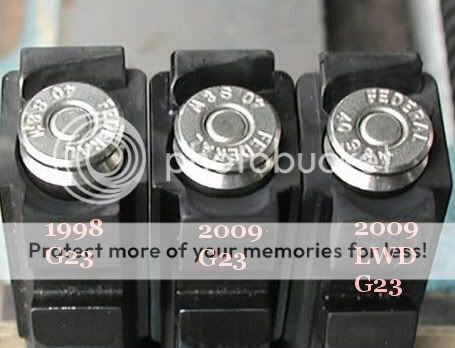
Glocks have relatively heavy slides and are susceptible to limp wristing induced jams as noted previously.
Take Care
Bob
- Status
- Not open for further replies.