February Purchases

fugawi

CGN Ultra frequent flyer
EE Expired
Rating - 100%
31   0   0
Its a short month so its time to kick things off..

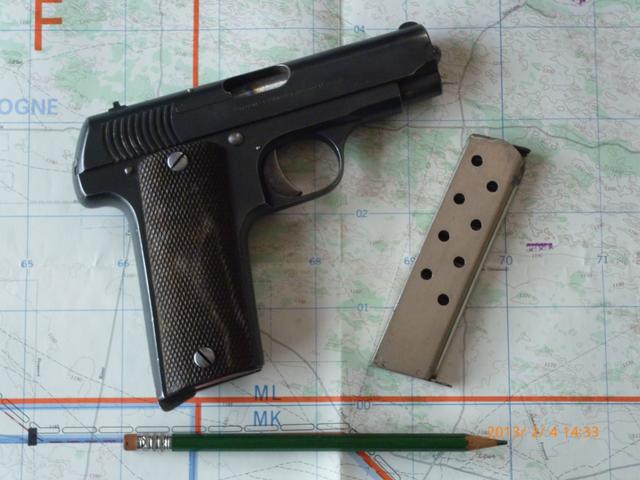
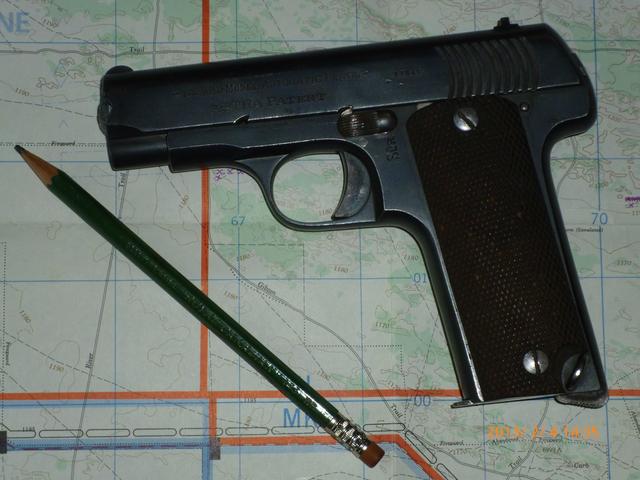
Spanish Esperanza y Unceta, Guernica Model 16 'Astra Patent' more commonly known by its generic name 'Ruby'. This prohibited pistol languished at a seller's web site for eight months with no takers before I made an offer to buy it.
JFIBZqF.jpg


Spanish Ruby pistols were purchased by France in WW1 to replace losses as the French armaments plants had to prioritize production of rifles and machine guns. Magazine is stamped EU in an oval on the bottom plate as magazines were often not interchangeable amongst pistol manufacturers. It was not refurbished by the French in the 1920's as it lacks the "safety knob" put on the left slide to avoid accidentally pushing the safety to 'Fire' when holstering or upholstering the pistol.
vA4Q0O6.jpg


Yes, its a dewat - I need to file down the blob of metal at the barrel.

Here's the link to an excellent write up by 1886Lebel: http://forums.gunboards.com/showthread.php?88044-Pistolet-Automatique-de-7-millim%E8tre-65-genre-Ruby
 
Thanks Joe, I've got another dewat but I'm posting a big picture thread first....

BTW the best pistols (ie most reliable) were used by the French trench sweepers as the Ruby magazines held nine rounds.

 
Fugawi, I have the identical mate to yours, except that mine is by Azanza y Arrizabalaga. It is one of my Mom's guns which I inherited some years back. It is an operational 12.6 which will get a workout some time in July, I would think.

In other news, just had an old friend, quite homeless, walk in the door earlier today, looking for lunch and some rack room.

Brazilian 1908 Mauser, made at DWM Oberndorf a/N, which was the combine address for the original Mauser Brothers plant. Bore is not bad, shoots well (I have shot it in the past), just needs a few original parts put back on. The handguard arrived with it, the barrel-bands are coming. Interesting point is that this one is Serial Number 25, which means that quite likely it would have been handled and inspected personally by Paul Mauser before being crated for shipment. The bore is getting a little tired, but I know for a fact that it will still shoot 1-1/4 inches at 100. It, too, will be "home on the Range" in July, so that gives me a bit of time to make up some 7x57 for it.

Also arriving today, from the same collection, was a Remington Model 30 Express rifle which has been fitted with a diamond-lapped P-17 barrel with a Match crown. The original Model 30 barrel, which came with it, is not in what you would call "poor" condition, but it is not pristine either. These two rifles are from the collection of my long-time range buddy Gavin Tait, who tuned them and pushed them and babied them mercilessly in a 25-year project to see just how accurate the old-time rifles could be MADE to shoot. The last time we had the Model 30 out, we had 3 sportered P-17s along, a Winchester 54 and a Remington 725 with a truck-axle Hart barrel and everything was wearing Leupold or Leica glass except for a P-17 with a Lyman Alaskan, all set up as a copy of the Philippine military sniping rifle of 1941. NONE of them shot anything bigger than 1-1/4 inches that day and 3 of them cut the half-inch very nicely.

The Remington Model 30 S, later called the Model 30 Express, was the first factory development from the wartime Model of 1917 US military rifle. M-1917 was a development of the P-'14 which was developed from the P-'13 which was developed via complete redesign from the 1896 Boer Mauser. The first Model 30 rifles were built-up of wartime components, even receivers being modded from originals. By the time the Express came out, the actions had been changed-over to ####-on-open but still retained the pure Mauser extractor and controlled feed. Remington later redesigned the action as the 725, which was pretty much end-of-the-line for development of the pure Mauser type. Their later rifles, such as the 721, 722 and 700 use the Mauser-type bolt body but without the long-claw controlled-feed extractor; they are push-feed rifles with the inferior (but convenient and cheap) bolt-face extractors as used also on the 40X. Original Model 30 rifles are very rare today. There never were that many of them, for they cost $65 back in the day of $20 a week pay for a skilled worker. Mine is s/n 161xx and it is a beautifully-preserved piece of period workmanship. For the military collector, the Model 30 was developed into the Costa Rica Model 1934 rifle..... but you already knew that, anyway.

The 54 was Winchester's development along the same lines, starting with the 1917 and ending as the prototype for the Model 70 of 1937. The Model 70, too, went from a pure Mauser to a modded Mauser with push-feed...... and back again to the reliable controlled-feed Mauser type.... and then the plant went broke...... and was bought out..... and it is back in production again!

Just old stuff, I know, except that now I gotta buy a set of Redfield rings and possibly another scope. Think I might make up a set of shims and use this old Bausch & Lomb turretless Balvar-8 which is cluttering up my top dresser-drawer. The B&L Balvar was the indestructible scope, so it should even be me-proof!

It's fun.
 
Great Ruby! Always thought they were really under appreciated little guns. Well, historically speaking, maybe not so much in terms of manufacture.... Either way I'm jealous!
 
6.35mm Mauser M1910

Mauser Pocket Pistols of the 1910 design

"Mauser pocket pistols are a scaled down version of an earlier design prototype. Between
1907and 1909 a prototype in 9mm was introduced. This early pistol, very similar to the 6.35mm
‘Sidelatch’, was not commercially successful and production was short run. The first 6.35mm
pistol, the ‘Sidelatch’, was introduced in 1910 and was very successful. 61,000 were produced
during the first 3 years. Mauser continued to experiment with the design in larger calibers.
Another 9mm prototype known as the model 1912/14 was produced but again the production was
a short run. The prototype in 7.65mm was successful and the early version is known as the
‘Humpback’. Improvements in the design and methods of manufacturing discovered between
1910 and 1913 were applied to the 6.35mm pistols. In 1914 the 7.65mm and the revised 6.35mm
were introduced and production continued till 1940 when the introduction of the Hammer Self
Cocking ‘HSC’ model and WWII ended manufacturing of the design. Close to a million 6.35mm
and 7.65mm pistols were produced so even in today’s market some variations are common,
some are rare and some are very rare."

Factory marking variations

"The style of the address changed through out production and during some of the model variations.
The style of Mauser banner stamped on the side plate changed through out production and was omitted on some variations.
The proof mark on nearly all is the crown U. This was changed to the eagle N in early 1940 shortly before the end of production."

KKovHkb.jpg


FECPHWi.jpg


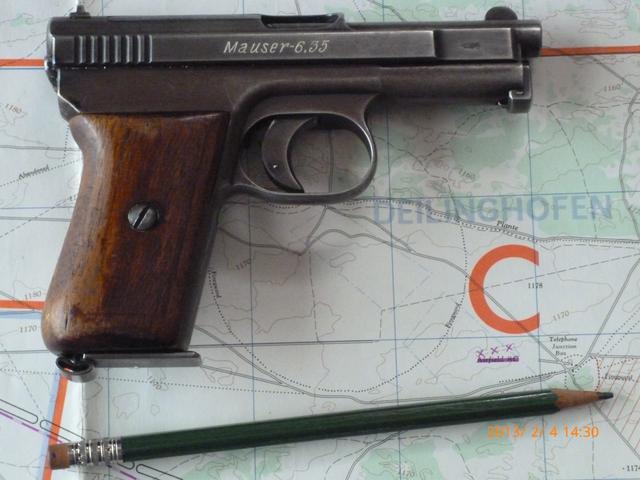
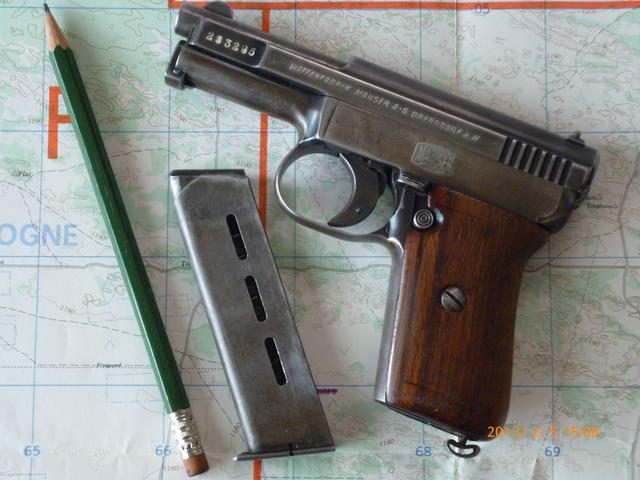
Mauser M1910/14, manufactured from 1921 to 1928, serial number range 221800-345000 (7 slide serrations) The 1910/14 is the most commonly found model. Caliber 6.35mm.

This prohibited pistol is a commercial model with Waffenfabrik Mauser A-G. Oberndorf A.N. and the Mauser banner on the left, and Mauser 6.35 on the right of the slide respectively. Four matching serial numbers are visible: on the left side of the slide near the front, on the rear of the frame, on the front barrel support and on the side plate. Prussian crown over 'U' on the right slide near the front. There is also a '1' on the trigger guard where it attaches to the front grip strap. Plain wooden one piece wrap-around grips. Unserialized magazine.

Sadly deactivated.

References:

www.MauserGuns.com article.
'Mauser Pocket Pistols 1910-1946' by Roy G. Pender III, 1971.

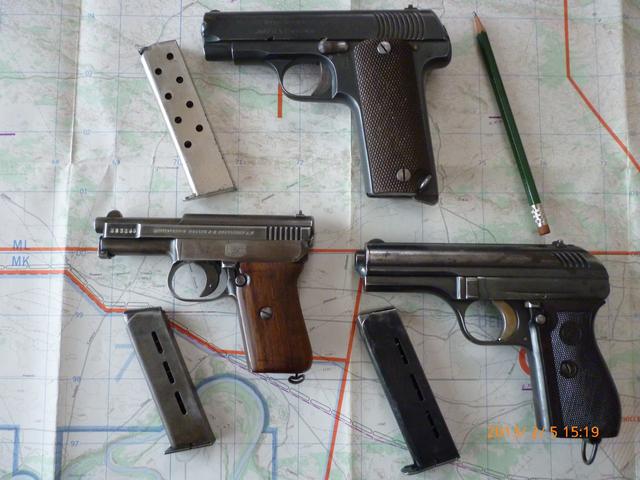
Three dewats that I have acquired for my display on prewar 2nd Polish Republic weapons - Spanish Ruby as sold to Poland by France after WW1, Mauser M1910 either acquired by commercial purchase or captured from Imperial German soldiers and armouries by the Polish Army, and Czech vz.24 (Poland used a variant known as the vz.28 - essentially the same as a vz.24) purchased by the Polish government prior to the development of the Radom VIS 35. These are representative samples not actual Polish issued pistols:



fCxI2GH.jpg


These were just some of the weapons used by the prewar Wojsko Polskie, with the end of the partitioning of Poland by the defeat of the occupying powers in WW1.
 
Last edited:
Great Ruby! Always thought they were really under appreciated little guns. Well, historically speaking, maybe not so much in terms of manufacture.... Either way I'm jealous!

You jealous... come on Nyles.

I'm jealous of those nice milsurp levers you have! Plus that prewar Roth Steyr... if you ever want to sell any of these, may I be first in line?

I just wish I had a prohibited license so I wouldn't have to dewat these guns. Other than the Spanish Rubies, the Czech and German pocket pistols were known for their fine machining and fit.
 
Last edited:
Was hoping to see some RC aquisitions here. But since no, here is a bargain basement warhorse but still full of character non capture k98. Someone ####ed with the bolt, which is surprisingly smooth to cycle. Plan to find a proper bolt and shoot her. Matching except floorplate and rear site, and bolt, of course. Thanks for looking.
ce44047.jpg

ce44046.jpg

ce44049.jpg

ce44050.jpg

ce44052.jpg

ce44053.jpg

ce44054.jpg

ce44055.jpg
 
Last edited:
Always love to see one of your mausers joe.

For me is a Saginaw of grand rapids m1 carbine, looks to be original but who knows. Has all early correct S'G' and IP parts, this one has a buffalo arms contracted barrel :) Picked up the carbine off the EE, the mag pouch and C-tip sling off eBay

362960DD-50CD-407F-A7F8-54CAA2227428-2666-000002F2FEE1446C.jpg

99B45886-0E55-41B0-8F62-E8CA8C392E6A-2666-000002F30BA55E5D.jpg

47572813-B68C-42F2-BE86-2A2E9BC2065C-2666-000002F3052639A1.jpg

E0705A03-6D83-4C92-A67B-A5C59C482A16-2666-000002F301D98567.jpg

2EFA5D8D-F252-4748-96EC-49682991805F-2666-000002FBB2E14727.jpg

4E2F380F-AB52-4715-8479-F42328EC4699-2666-000002F307B4BA3A.jpg

CF1CB020-61AD-45E3-AE95-91C0EEA696C0-2666-000002F30E9A6B08.jpg
 
Back
Top Bottom