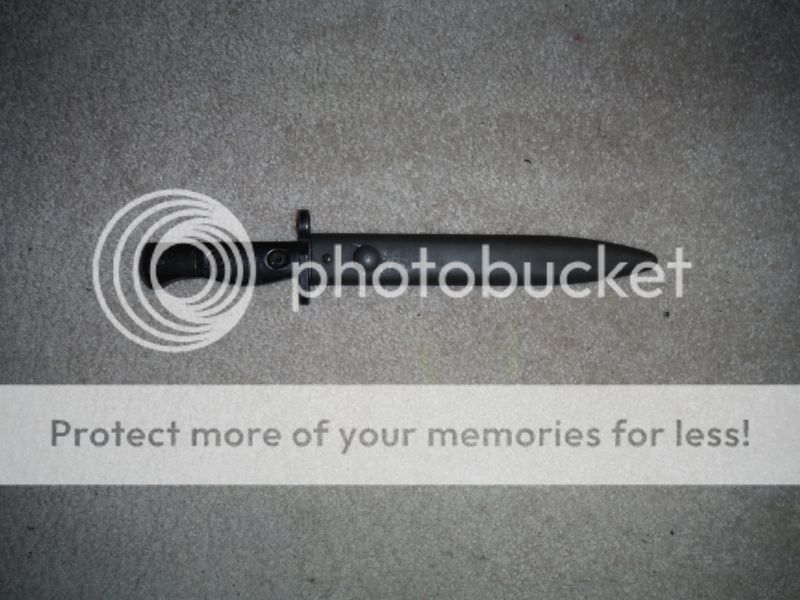
For all you Military Veterans I have a bayonet question

Eaglelord17

CGN Ultra frequent flyer
Rating - 100%
64   0   0
Location
Sault Ste. Marie
Hi all,

I recently got this from a relative who served in the Army in the 1980's (back when we had the FN C1)
It is a FN C1 bayonet manufactured in 1960 with no serial number and it is different from all the other ones I have seen.
The blade is black like the handle (you can see in the pics) which is weird as all the others I have seen have the bright steel blades. The wear on the blade is from taking it out of the scabbard.
He said the guy who he bought it from (also in the 1980's) called it a special forces bayonet (or some such thing) but I am not sure (who knows). He did say the guy did spend some time with the Parachute regiment before it was disbanded so maybe that could be where it originated from? I was just wondering if anyone could shed some light on this particular bayonet.

Thanks
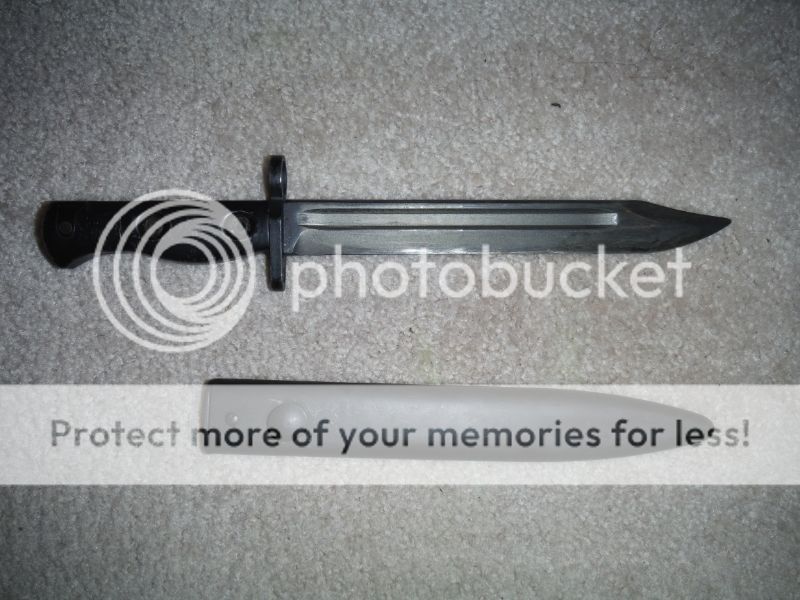


Standard FN C1 bayonet. God knows, I fixed them on my rifle often enough! That's a nice find and it sure brings back memories for me and any other old vet from the 70's.
 
i betting on british rather than canadian, pic of the other side, and the pommel/blade area? canadian ones all should be marked C1 on the pommel iirc
 
Looks like a Brit/Aussie bayonet, ours has the bright blade. If it's Cdn it should have a C with a broad arrow inside and a date. You should post a good shot of the markings on both sides of the blade.
 
To paraphraise Bruce Canfield, the knowledgeable US writer, buy the bayonet not the story. There are enough half-truths in the story to worry. The Special Forces didn't have a "Special Forces Knife". Some guys had an entitlement to the Russell Belt Knife, and some of those guys were parachute jumpmasters. Every mother lovin' rifleman and submachinegunner also had an entitlement to the issue FN C1A1 bayonet, and every one in the Canadian Airborne Regiment considered himself a rifleman. The Parachute Regiment is the British version.
 
The markings will tell the tale. It sure looks like a standard Cdn FN bayo. They were issued with a bright blade. Once in use they were sent to 202 Wksp Montreal in batches for reparkerizing when required. Could be they reparkerized the entire bayo and not just the grip portion. I had a couple of M1903 Springfields reparkerized at 202 back in the late 1970s. They had a humongous parkerizing tank which was run by a black man. I wondered if he was naturally black or if he got that way after spending many yrs hanging over that tank.
 
Looks like a Brit/Aussie bayonet, ours has the bright blade. If it's Cdn it should have a C with a broad arrow inside and a date. You should post a good shot of the markings on both sides of the blade.

most aussie ones are identifiable by the rounded fuller, canadian and brit ones have edges like the one above
 
I didn't believe that it was some sort of special forces one but I am curious about it as it is like none that I have seen. Here are some more pics of it including the only markings on it.
I am just curious where the other guy got this.


The last picture is what it looks like in standard lighting so you can see the darkening of the blade properly.

Thanks for all the help so far.

 
To paraphraise Bruce Canfield, the knowledgeable US writer, buy the bayonet not the story. There are enough half-truths in the story to worry. The Special Forces didn't have a "Special Forces Knife". Some guys had an entitlement to the Russell Belt Knife, and some of those guys were parachute jumpmasters. Every mother lovin' rifleman and submachinegunner also had an entitlement to the issue FN C1A1 bayonet, and every one in the Canadian Airborne Regiment considered himself a rifleman/paratrooper. The Parachute Regiment is the British version.

^This is the closest truth, and purple is usually right up there too. I'll tell you what about the black coating friend. Regiments such as the PPCLI had thier boys use boot blackening on thier bayonet handles to make them a little prettier on formal parade. I suspect the former infantry soldier was present for the occasional trooping of the regimental colors. Sometimes only the color party blackened thier bayonets, sometimes the whole battalion on parade. This was the RSM's choice. The "special forces knife" talk is an attempt to get more money then it's really worth, out of some unwitting civilian for beer money IMO. lol..........
The only thing "special" about it, is the poor sod spent alot of time (several weeks in preparation) on the parade square doing foot drill in all sorts of weather conditions.
My feet have hurtful memories just looking at this bayonet friend!!! ;)
 
Last edited:
^This is the closest truth, and purple is usually right up there too. I'll tell you what about the black coating friend. Regiments such as the PPCLI had thier boys use boot blackening on thier bayonet handles to make them a little prettier on formal parade. I suspect the former infantry soldier was present for the occasional trooping of the regimental colors. Sometimes only the color party blackened thier bayonets, sometimes the whole battalion on parade. This was the RSM's choice. The "special forces knife" talk is an attempt to get more money then it's really worth, out of some unwitting civilian for beer money IMO.
The only thing "special" about it, is the poor sod spent alot of time (several weeks in preparation) on the parade square doing foot drill in all sorts of weather conditions.
My feet have hurtful memories just looking at this bayonet friend!!! ;)

My relative wasn't a civilian but when he got it he got it with a bunch of older kit (a metal helmet and some other things) and said that was the story he was told (he said at the time he didn't believe it but passed it on anyways in case there was some truth in the matter). Blackening the handle wouldn't explain the blued blade as it seems to be factory. If it was just polish I would be able to rub it off the blade no problem. All I can say for a fact is it sturdier than the C7 bayonet (but that isn't saying much).
 
Well, anyone can put a wire wheel to and cold blue a bare blade IMO.

Mmmkay, you asked military veterans for thier opinion, I answered.

Cheers!

Sorry if my response was seemed offensive, it was not intended to be that way. I personally am a current serving member so I have a pretty good idea about the stupid things you have to do because someone higher up said so. I just did some more searching on the internet and found a bayonet that is exactly the same as mine here ht tp://www.old-smithy.info/bayonets/SLR.htm (its a bit past 3/4 of the way down under C1) apparently some were manufactured with the blued blade go figure.

I am still curious as to who was issued it as everyone else I have talked to used the bright steel ones, maybe they just sat as war stocks some where.

Thanks for the help everyone, it is much appreciated.

 
During the '70's I was in 3rd Patricias and it was quite normal to spit shine the bayonet handle for parades like "Freedom of the City" when the Regimental colours were brought out.
 
The C with the little A inside is for Canadian Arsenals, so it's definitely Canadian. As to the blade being the duller colour, perhaps there was a change that year in the specifications. I have only seen the Canadian blades in silver, but the link you give show the same darker colour on a 1960. Interesting, now I have to search for this variation for my collection.

Is there no markings on the pommel just under the date? The earlier ones had the last 7 digits of the NSN marked on them (1005-21-150-3900), although that link you gave also shows a different variation with only the "C1" on it.
 
The C with the little A inside is for Canadian Arsenals, so it's definitely Canadian. As to the blade being the duller colour, perhaps there was a change that year in the specifications. I have only seen the Canadian blades in silver, but the link you give show the same darker colour on a 1960. Interesting, now I have to search for this variation for my collection.

Is there no markings on the pommel just under the date? The earlier ones had the last 7 digits of the NSN marked on them (1005-21-150-3900), although that link you gave also shows a different variation with only the "C1" on it.

I just took a quick look and it only has C1 on the pommel, no serial numbers on the whole thing (maybe there is something under the grips but I am not disassembling that far). The reason I asked on here was it is a variant I have never encountered anywhere else and everyone else I have met that has used the C1 and its bayonet all said that they were silver blades.
 
Even the 1959 model on the link you gave had only C1 on the pommel, so it looks like there was a change in the marking somewhere along the line.

I am pretty sure I have seen 1966 or 68 dated bayonets and they were silver as well on the blade. The manual only gives the one NSN, so it may just be that either they happened to be made with the dark blade that year, or someone may have re-finished them at some point. I'm not even sure there was a separate NSN for the chromed ones. I know my unit had them chromed at the unit level.

The C1 bayonets were never serialized, nor matched to the rifles.

Highly doubtful this had anything to do with a different unit, but more likely was just a variation in production or in re-finishing. I could imagine that RSMs would not have liked them. They were not keen on variation. 99 silver bayonets and one black one would stand out on the parade square.

Now you have me thinking I need to make a trip downstairs to check out my C1 bayonet collection.
 
Back
Top Bottom