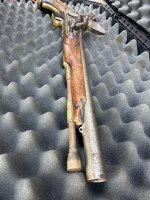
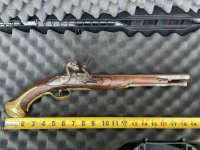
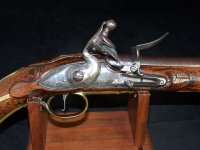
1761 Jordan Flintlock Dragoon Pistol

dbmeed

Regular
Rating - 100%
20   0   0
Location
ON
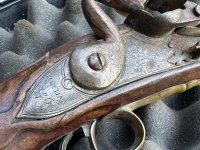
Hello all, I recently inherited an old flintlock pistol. From what I have been able to tell so far, it’s a 1761 Thomas Jordan, likely issued to loyalist officers during the revolutionary war. I’m trying to find more information about it, and curious if anyone has suggestions where to start my search. If anyone has any more details about the history or usage, I’d love to hear it! It does seem to be functional, but I’m guessing it’s shooting days are over-although reportedly my grandfather used it possible as recently as 30 years ago to shoot raccoons in his blacksmith shop. I’d like to have a nice display case built for it; does anyone have suggestions in that regard? How I could make it look like a museum exhibit maybe? Do I need to be concerned about temperature/humidity?
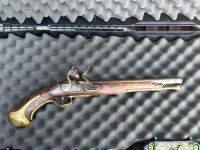
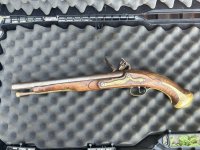
IMG_4402.jpegIMG_4403.jpegIMG_4405.jpegIMG_4406.jpegIMG_4408.jpegIMG_4410.jpegIMG_4411.jpeg
 
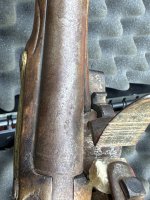
C ock assembly is a replacement. You could probably get an accurate replacement from Blackley or Dyson in England. Don't discard the one on the gun - part of the pistol's history.
Without actual provenance, possible use is speculation.
During the last 263 years, its been exposed to all sorts of humidity and temperature fluctuations. Keep it clean and dry. Application of Conservator's Wax might be a good idea. Museums use it.
 
Last edited:
C ock assembly is a replacement. You could probably get an accurate replacement from Blackley or Dyson in England. Don't discard the one on the gun - part of the pistol's history.
Without actual provenance, possible use is speculation.
During the last 263 years, its been exposed to all sorts of humidity and temperature fluctuations. Keep it clean and dry. Application of Conservator's Wax might be a good idea. Museums use it.
Thanks for the info! What about the #### assembly indicates a replacement? I’ll look for some wax to try to preserve it, I was just wondering if there’s an optimal humidity range? If it’s too dry is there any risk?
 
Lee Valley, Amazon sell the microcrystalline wax used to protect specimens. You want to avoid temperature and humidity extremes. Damp storage isn't a good idea. A closed case with desicant packs might not be a bad idea. Fingerprints can result in corrosion.
I did a quick 'net search - here's a photo which shows what an original c ock looks like:
398-4 flintlock.jpg
 
No one chiming in on history? OK, I'll add a bit.

There's not much to be found in the usual references about Thomas Jordan, other than his being a Birmingham gunmaker, the son of Edward Jordan, perhaps in business from 1740 until his death in 1762.

Many Birmingham gunmakers at the time were contractors to the Board of Ordnance. The histories of Edward and Thomas Jordan, James Farmer, along with other big names in the supplying of pistols, muskets and parts, are much intertwined. Their business arrangements, along with details on the orders and quantities supplied, are covered in fascinating detail in the well-researched book Empire of Guns, The Violent Making of the Industrial Revolution, by Priya Satia (2018), a book that I highly recommend to anyone that has an arm from this period of gunmaking.
 
Excellent, that’s the info I’m hunting for! I’ll be on the hunt for that book, sounds fascinating, thanks!
 
My reference says: Jordan 1733-1760. Made flintlock holster pistols and flintlock Grenadiers' muskets, both with Royal cipher. Shop in London.
A nice piece and early hammers were prone to breaking, have seen a fair number brazed together, re-inforced #### appeared about 1809 copying the French.
 
Clean it, an slather it in conservators wax, then buff (by hand, with a soft cotton cloth). Your great, great, grandchildren will thank you.
 
Back
Top Bottom