













































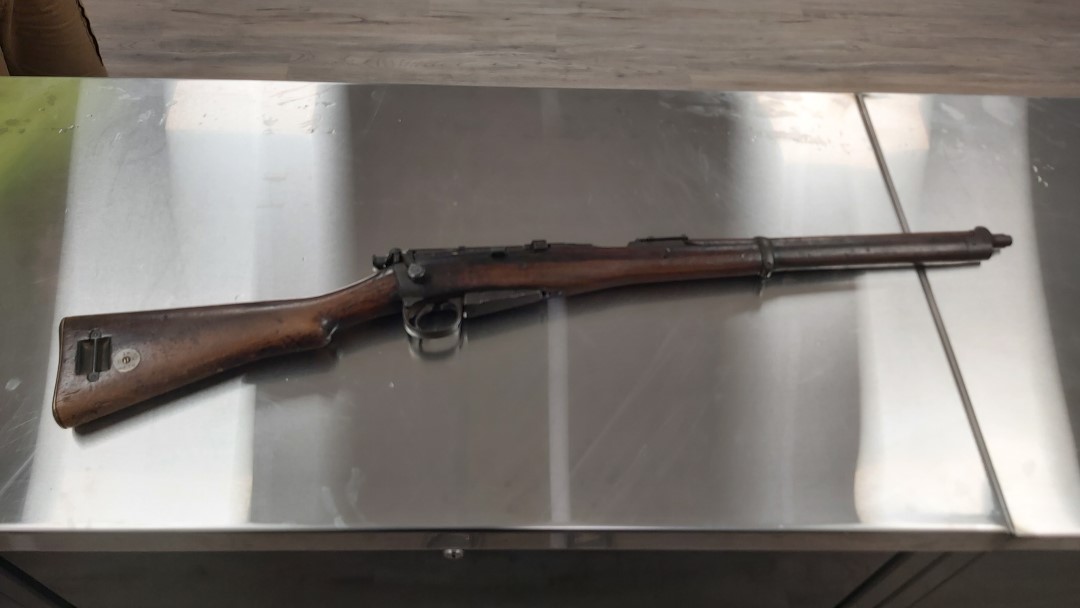
A customer brought this little guy in with some questions. I know a bit about SMLEs and No. 4's but not much about the older or more rare stuff.
Complete gallery with commentary here: https://imgur.com/gallery/eFXTFu5
I don't imagine much can be done about a 125-year-old shot-out carbine barrel. Rifling is fairly clear with minor pitting along most of its length, but the last few inches seem to be worn mostly smooth. Accuracy is not great, and the customer says the bullets are keyholing past 30 or so yards. This is a well-used gun, and the customer has used it for moose-hunting (probably in Newfoundland, where his family is from). It's seen some years of hard use and probably limited maintenance.
I do not know if it is all-numbers-matching. Everything appears original, nothing looks noticeably newer than the rest. A lot of the markings are very faint and/or obscured due to the deep patina. My photography didn't do them any favors either, but I can possibly arrange for clearer photos if needed. I don't have many photos of the proof marks, etc. It has opposed broad arrow stamping on the receiver, which indicates that it was sold out of service. I didn't see anything in that marked it as Canadian issue.
I can ballpark a value of a SMLE or No.4 Mk 1 in this condition, but I don't have much info on these. Anyone have any insight?
Complete gallery with commentary here: https://imgur.com/gallery/eFXTFu5
I don't imagine much can be done about a 125-year-old shot-out carbine barrel. Rifling is fairly clear with minor pitting along most of its length, but the last few inches seem to be worn mostly smooth. Accuracy is not great, and the customer says the bullets are keyholing past 30 or so yards. This is a well-used gun, and the customer has used it for moose-hunting (probably in Newfoundland, where his family is from). It's seen some years of hard use and probably limited maintenance.
I do not know if it is all-numbers-matching. Everything appears original, nothing looks noticeably newer than the rest. A lot of the markings are very faint and/or obscured due to the deep patina. My photography didn't do them any favors either, but I can possibly arrange for clearer photos if needed. I don't have many photos of the proof marks, etc. It has opposed broad arrow stamping on the receiver, which indicates that it was sold out of service. I didn't see anything in that marked it as Canadian issue.
I can ballpark a value of a SMLE or No.4 Mk 1 in this condition, but I don't have much info on these. Anyone have any insight?
Last edited:
























