1917 .308 Lee Enfield value?

archerynut

Regular
Rating - 96.9%
31   1   0
Location
Calgary, Alberta
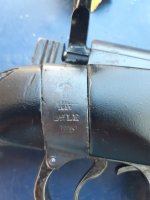
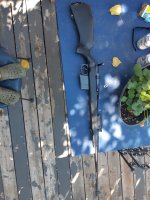
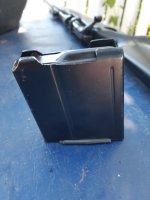
I have a .308 LE dated 1917 that I am trying to ascertain the value of. It is mounted in a fiberglass sporter type stock. Still has what appears to be an original length barrel. The recoil pad has begun to fall apart I'm guessing due to age. The numbers on bolt, barrel and receiver do not match. I am looking to post this for sale just needed an idea of it's worth before I put it up.
Thank you to all who respond.

 

Attachments

  • 17556288023612206507564845114493.jpg
    17556288023612206507564845114493.jpg
    70.6 KB · Views: 100
  • 17556288417862078732221479830868.jpg
    17556288417862078732221479830868.jpg
    124.3 KB · Views: 100
  • 17556292637127713833651003921971.jpg
    17556292637127713833651003921971.jpg
    65.8 KB · Views: 100
Did you mean to type 303 as I doubt very much that this is 308. Given the description and pictures the rifle is worth very little. Maybe $150
 
OK. How? Headspace? Test fire? While conversion of No. 4 rifles was approved, Brit and Aussie experiments determined that conversion of SMLE rifles to 7.62x51 was not successful. Proof testing procedure resulted in bent bodies.
 
OK. How? Headspace? Test fire? While conversion of No. 4 rifles was approved, Brit and Aussie experiments determined that conversion of SMLE rifles to 7.62x51 was not successful. Proof testing procedure resulted in bent bodies.
With the exception of the purpose made 2A and 2A1 actions, of course.
 
The Indians solved the bent receiver in proof testing problem by changing the proof testing procedure.
That was not for the 2A series. That was for the .303 receivers made after 1949 with cheaper steels. For the 2A series they returned to EN steel, but apparently also adopted an updated heat treating procedure.

I have never seen a bent or failed 2A series receiver. YMMV.
 
Did the Indians revert to the previous proof testing regimen for the 2A series rifles?
Anyway, the OP's rifle has a 1917 receiver and could chamber 7.62x51 and .308Win cartridges. I'd not be comfortable shooting it with factory ammunition. Handloads at .300 Savage etc. levels should be fine. Could there be a liability issue selling it?
 
Did the Indians revert to the previous proof testing regimen for the 2A series rifles?
Anyway, the OP's rifle has a 1917 receiver and could chamber 7.62x51 and .308Win cartridges. I'd not be comfortable shooting it with factory ammunition. Handloads at .300 Savage etc. levels should be fine. Could there be a liability issue selling it?
According to Skennerton's big Enfield book, they changes the steel and heat treatment - he does not go into what proof load the Indians used.

That said, there are 10's of thousands of these rifles in (mostly) the USA and I've never heard of one failing. I would assume them safe at 7.62 NATO pressures.

Of the 3 examples I've owned (a 2A and a couple 2A1's), I shot all of them without any negative consequences. Now that said, the dark Indian hardwood they used on the forestocks (luan Mahogany?) was (my opinion) too soft for the battering 7.62 put on the rifles, and all 3 rifles needed walnut blocks pinned and glued into the draws to restore a tight fit.
 
The gun was tested by a gunsmith by test firing. This was confirmed by my brother in law who gave me the gun.
The folks don't disbelieve you, what they're going on about is "Did the smith know what he was doing? Did the smith know about the tests done by a couple of different nations and the outcome of those tests?"

It's very likely the receiver will stand up to some use with 7.62 Nato, or factory 308Winchester ammunition, until it doesn't.

Likely, the receiver will stretch or bend after a point. No one can predict when or what round count this will start happening, or how quickly it will get to an unsafe condition.

The rear locking lugs, combined with the steel used in your receiver, are not compatible with the ammunition the rifle will accept, and safety issues are more likely to occur than not. Not a matter of IF, but when.
 
I would listen to Bearhunter. I fully agree with him on this. The SMLE receiver isn’t strong enough to handle full power loads. It’s just a matter of when something will go wrong. It could be used with reduced loads but full power 308 will cause that rifle to fail.
 
The folks don't disbelieve you, what they're going on about is "Did the smith know what he was doing? Did the smith know about the tests done by a couple of different nations and the outcome of those tests?"

It's very likely the receiver will stand up to some use with 7.62 Nato, or factory 308Winchester ammunition, until it doesn't.

Likely, the receiver will stretch or bend after a point. No one can predict when or what round count this will start happening, or how quickly it will get to an unsafe condition.

The rear locking lugs, combined with the steel used in your receiver, are not compatible with the ammunition the rifle will accept, and safety issues are more likely to occur than not. Not a matter of IF, but when.
this
 
Back
Top Bottom