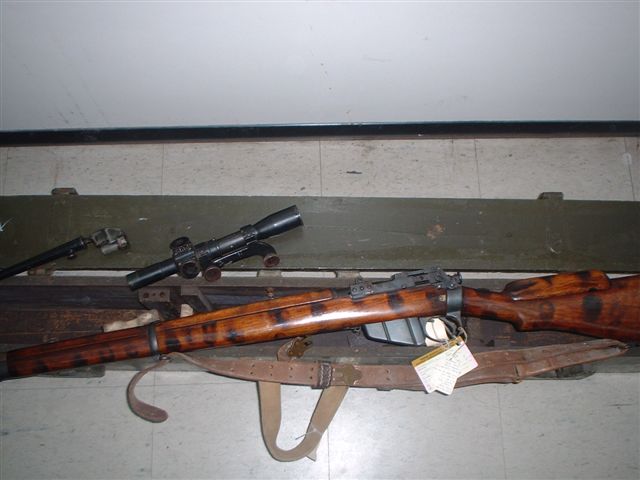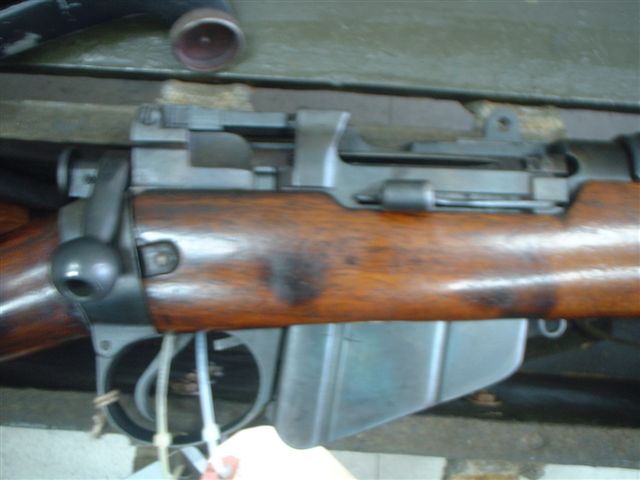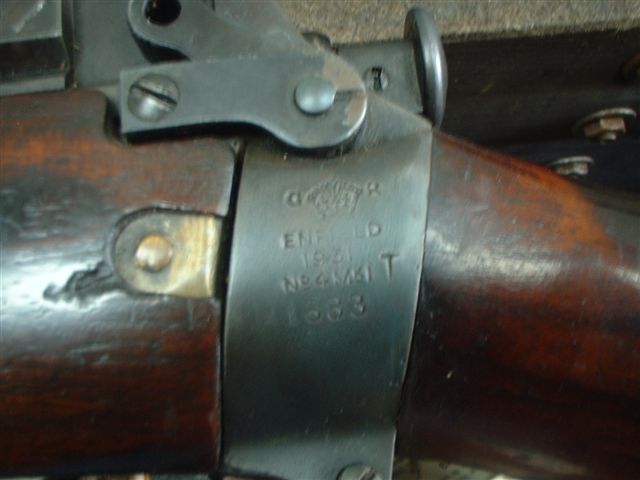










































1931 dated #4 (T)

NavyShooter

CGN Ultra frequent flyer
Rating - 100%
100   0   0
Location
XMU Local .303
Hey gang,

If anyone's interested, I was in a gunshop this past week, and passed on what's probably a damn good deal.

There was a 1931 dated #4, Mk 1, (T) rifle, pads and screws appeared correct. It's probably a very early conversion to the (T) standard, since it retained a number of the #1 type rifle components, including the Magazine cut-off, the rounded rear on the striker, etc.

The scope was non-matching, and was damaged (ocular lens was free-floating inside the tube) but it was a Mk III scope, and so I would think it not to be the proper one for this rifle anyhow (an early trials rifle dated 1931 with a 1943/44 production scope? Unlikely I think.) I would have anticipated that the scope would have been a Mk I.

Anyhow, the asking price, with a #7 rifle transit chest (so marked) was $2k.

If anyone's interested in looking at it, or wants to know where it's at in Southern Ontario, drop me a PM.

NavyShooter
 
Claven2 said:
despite the rarity of the early receiver, 2K is ALOT for a mixmaster 4T IMHO...

If the parts are all origional, it is worth it. Origional scope brackets have hit the $750 mark these days on Ebay. The scope can be repaired using the optics of a #42 or 52 scope (usually priced at around $100). Once compete, the scopes fetch anywhere from $800 to $1500, depending on the maker. If the scope can is with the outfit, they are over the $400 mark these days. Pawn these things off and you have a Enfield made trials rifle for free (or even a few bucks into your pocket).
Shame the box is a .22 chest (worth about $20-50). If it was an origional #15 chest, they are about $400+ these days.

I picked up one of the trials T rifles a few years back at the Brandon show. Back then Ts with no accessories were only worth about $350. While walking it around the show, I had a couple guys think it was a mongrel #1mk3/#4mk1 combination.

If you are by the shop again, how about getting the numbers off the rifle, the rifle butt, the scope bracket, and the scope just for interest sake.
 
Early #4Mk1 T

What you saw was I suspect a prototype #4 that was converted to the Sniper model. I have seen a couple of them and they are very rare. There weren't that many made before eliminationg the mag cutoff in the #4 MK 1 configuration. The amount produced can be found out from Skinnertons book ( I believe).The scope should be the early model also #3 Mk1. Just found a reference to the No 1 Mk VI which is what I think you saw. The reference is from one of Strattons books descriptions on the Internet.
 
Last edited:
I guess the secret is out.I could not pass up a trials rifle.Without this forum I would not have known anything about it.Thanks alot guys!The fact that it's a sniper is a bonus.Anybody know where i can get the scope repaired?
Anybody have a mk1 scope to trade?
Now if I could find a longbranch sniper!!Apparently the same gunshop had one a short time ago.It sold for $4800.00.

Cheers,Eric
 
The rifle was built and marked as a Number 4 actually BEFORE the formal adoption. There were about 1,000 of these "trials" rifles built. In 1940, they were the most modern rifle the British had and they had only a few, Enfield being crushed under the burden of trying to supply the entire war effort.... from precisely one main production line..... while trying to build everything in the world and the parts for it.
These trials rifles, the ones that survived testing and so forth, were put in storage about 1936 from what I am told, then hauled out again about 1941 and converted into snipers simply because they were available at a time when nothing else was.

A rifle such as this represents a chunk of history and should be looked at very carefully.
 
superbee said:
Anybody know where i can get the scope repaired? Anybody have a mk1 scope to trade? Cheers,Eric

Hello Eric ... :)

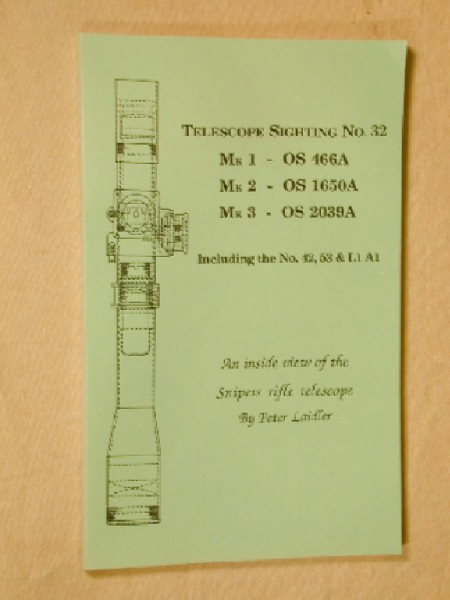
The No.32 Mk1 scopes are rare to find, but they do surface on eBay from time to time. I think that before anyone would consider a trade, you'll need to get your broken No.32 Mk3 repaired and refurbished. I also think that you'd have a hard time getting an even trade of a Mk1 for a Mk3, probably having to outlay additional cash in the process, but that's just a guess on my part.

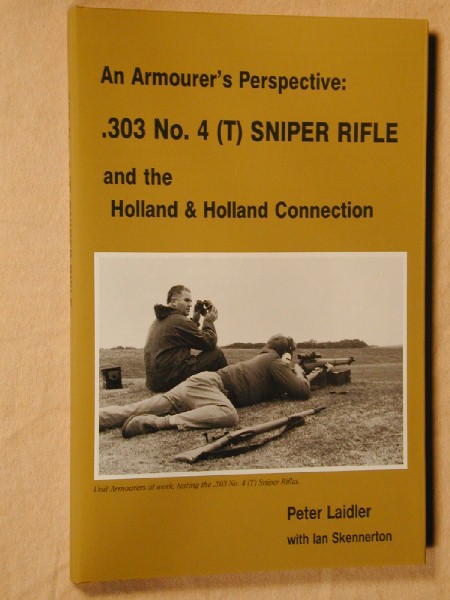
Contact Brian #### at BDL Ltd (click here)http://www.bdlltd.com/ and arrange for him to send it off to Peter Laidler in England. Brian has the exclusive North American rights to do all of Peter's work. If the innards are messed, then it will most likely cost about $400 (or more) for a complete rebuild, but you couldn't ask for a better expert than Peter to do it. It will come back in perfect working order and be good for another 50 years, plus it's value will be substantially enhanced. Brian and Tina were just up visiting us, so say hello for us when you're speaking to him.

For the benefit of the CGN folks who don't frequent Gunboards in the U.S, I've reproduced the pics you posted here. I trust that was ok to do?


Click PIC to ENLARGE


Click PIC to ENLARGE


Click PIC to ENLARGE

Regards,
Badger
 
Last edited:
A follow-up....... :D

According to page 242 of ‘The BRITISH SNIPER’ by Skennerton (ISBN 0 949749 03 6) which is now out of print, the quantity produced of original 1931 No.4 Mk1(T) trials rifles was 1403. He said .... These were original trials rifles upgraded and converted to sniper configuration, and so some of the early trials rifles features such as cocking piece, sight protectors, and butt marking disc, may have been changed. There is a provision for a magazine cut-off, which was removed. Although these were originally fitted with the Mk1 sight, some units were later upgraded for fitting Mk2 or Mk3 telescopes. Originality may be ascertained by matching serials.

There's a new post in our MKB under "Lee-Enfield Accessories and Research Material", showing an excellent example of a 1941 No.32 Mk1 Watson Sniper Scope (click here and scroll down)http://www.canadiangunnutz.com/forum/showthread.php?p=786558.

Also, someone wrote me a PM and suggested there are people who repair No.32 scopes cheaper. That's true, but I certainly wouldn't trust an expensive No.32 scope to anyone other then Peter Laidler. He's refurbished two of ~Angel~'s, has access to any parts needed and does excellent work. He certainly knows his stuff and has authored two books on the subject ...... so yes, you can find cheaper sources, but Caveat Emptor. ;)

Click PIC to ENLARGE


Regards,
Badger
 
Last edited:
I'm curious about the dark spots on the wood. Did someone work it over with a torch for the "tiger-stripe" look, or is it a natural pattern?
 
smellie said:
The rifle was built and marked as a Number 4 actually BEFORE the formal adoption. There were about 1,000 of these "trials" rifles built. In 1940, they were the most modern rifle the British had and they had only a few, Enfield being crushed under the burden of trying to supply the entire war effort.... from precisely one main production line..... while trying to build everything in the world and the parts for it.
These trials rifles, the ones that survived testing and so forth, were put in storage about 1936 from what I am told, then hauled out again about 1941 and converted into snipers simply because they were available at a time when nothing else was.

A rifle such as this represents a chunk of history and should be looked at very carefully.

Exactly but they were marked as No1 MkV1. With mag cut offs, many wererefurbed for service post Dunkirk and given an A suffix?prefix or both in some cases as they werent fully interchangeable with the No4. I have handled one at an HBSA match. It was the logical move from the No1 MkV which I do own. The design for the No 4 T was based on an accurate version of the No4 which at the time the only spare ones were the No1 MkV1 conversions. Many retained the cut off and were deemed a success. The No 32 scope was actually designed for the Bren Lmg and it was by chance that this scope was selected for use. The original Mk1 Brens had a big mount bracket on the left side of the body and some were later converted to L7 7.62 Lmgs which meant that the IWS etc could and was mounted. This I know as I had a 1943 Mk 1 from John Inglis on my last deployment to Ulster in 1986. It broke my heart to hand it in for a GPMG.
 
Back
Top Bottom