






























You are using an out of date browser. It may not display this or other websites correctly.
You should upgrade or use an alternative browser.
You should upgrade or use an alternative browser.
3 days after VE Day
- Thread starter gareez
- Start date


Dr van Nostran
CGN Ultra frequent flyer
- Location
- Lower Mainland, B.C.
How is it that a German soldier is also on guard duty?
The German Army wasn't actually demobilized until several months after the surrender.
Armed German military police were in operation until 1946.
stirlingsmg
Member
- Location
- East Central Alberta
Because hostilities ended May 8th but arrangements to disarm followed later.
Unidentified German soldier turning in his rifle to a Canadian soldier, IJmuiden, Netherlands, 11 May 1945.
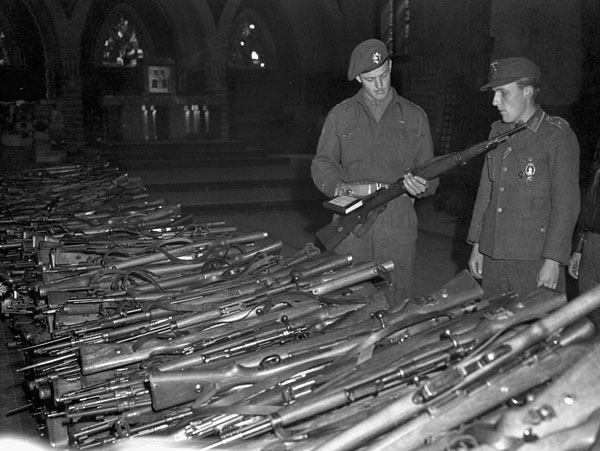
The Canadian is from the Royal Canadian Regiment , "RCR".. judging by the badge in his beret

Two other pics but of slightly different views are PA134396 and PA151185 in 134396 it shows the German soldier has a FG42 rifle. One great picture I have seen in the past shows a large formation of disarmed Germans marching in to surrender but each and every soldat has a pair of stick grenades slung together with a string hanging back of the neck.

The German Army wasn't actually demobilized until several months after the surrender.
Armed German military police were in operation until 1946.
Interesting.

Coyote Ugly
CGN Ultra frequent flyer
G43 in the pic, bottom right!
Because hostilities ended May 8th but arrangements to disarm followed later.
Unidentified German soldier turning in his rifle to a Canadian soldier, IJmuiden, Netherlands, 11 May 1945.
This is an interesting idea http://www.dailymail.co.uk/news/art...Warstuff_Newsletter_Mar_2012&utm_medium=email and more here http://thechive.com/2010/12/14/ghosts-of-world-war-ii-23-hq-photos/
Last edited:

How is it that a German soldier is also on guard duty?
Many officers were also allowed to keep their pistols to help keep the enlisted men under control.

This is an interesting idea http://www.dailymail.co.uk/news/art...Warstuff_Newsletter_Mar_2012&utm_medium=email and more here http://thechive.com/2010/12/14/ghosts-of-world-war-ii-23-hq-photos/
those picture are simply some of the most amazing photoshop pictures ever
Because hostilities ended May 8th but arrangements to disarm followed later.
Unidentified German soldier turning in his rifle to a Canadian soldier, IJmuiden, Netherlands, 11 May 1945.
One of those probably belonged to my dad.
 That's where he was when the war ended.
Grizz
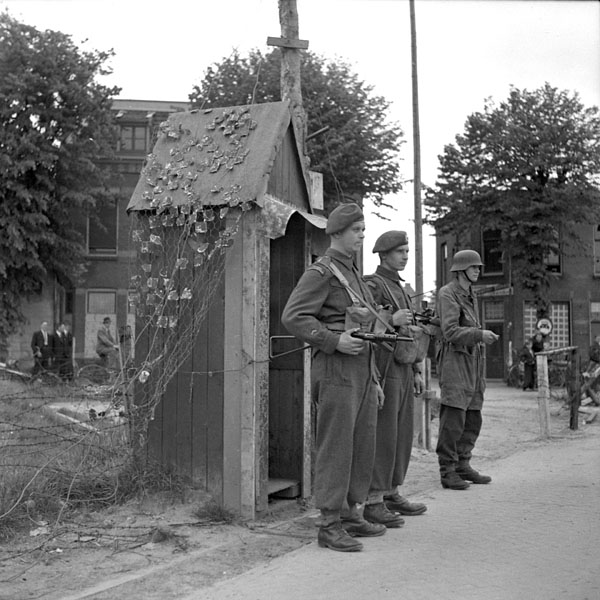
Privates W.R. Hill and M.A. Gammon of 1st Canadian Corps on guard duty with a German soldier, also on guard duty, at the German garrison, Ijmuiden, Netherlands, 11 May 1945.
German looks like he's wearing a paratrooper smock.
Grizz


How is it that a German soldier is also on guard duty?
Prisoners of war are bound to obey lawful orders of the capturing power. When hostilities have ended, you can arm them and put them to security duties like this. The Allies used Japanese troops to maintain control of Vietnam after WWII until the French could re-establish their possession, contrary to the wishes of the Vietnamese resistance who had been fighting those same Japanese troops.

Donny Fenn1
CGN Ultra frequent flyer
- Location
- East Kootenays
If that looks odd, "Crowd celebrating VE Day, Montreal, Quebec, 8 May 1945."
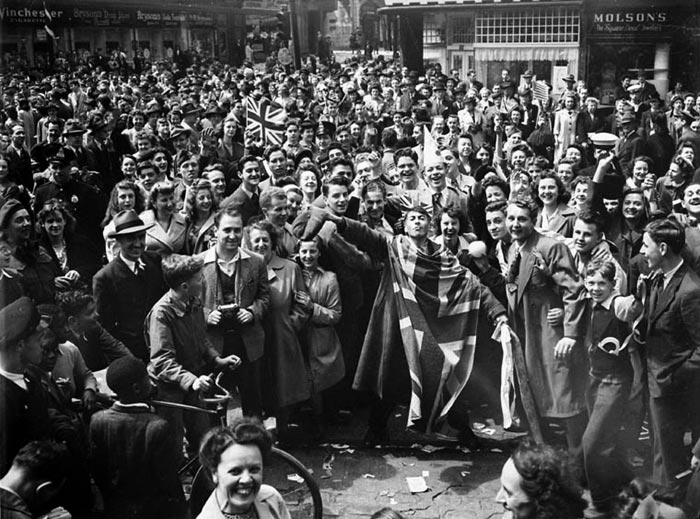
You would get shot for that today.
What? The English signs? The Union Jack?
Or they could be protesting for free education.

Prisoners of war are bound to obey lawful orders of the capturing power. When hostilities have ended, you can arm them and put them to security duties like this. The Allies used Japanese troops to maintain control of Vietnam after WWII until the French could re-establish their possession, contrary to the wishes of the Vietnamese resistance who had been fighting those same Japanese troops.
Unfortunately the days of our enemies conforming to military discipline and international law are long gone. Could you imagine this happening now a days in our trouble spots?