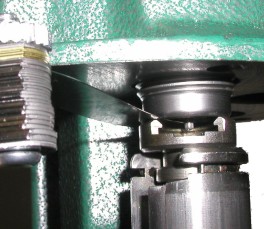
300 WM , shoulder bump , how much is not enough?

Kelly Timoffee

BANNED
BANNED
BANNED
EE Expired
Rating - 100%
52   0   0
Finally stepped up to checking case length on the shoulder to base on my 300WM with the proper equipment.

What I'm finding is that the full length resized brass is approx 0.010" shorter than the fired brass measuring shoulder to base.

What I am reading is that a 0.002" bumped shoulder is kind of what a vast majority reloaders are doing.

To me that seems excessive(0.010"), I may be wrong, should a guy just back out his sizing die or does he run the risk of not size the neck/body sufficiently and required a shoulder bump die?

How detrimental is this to optimizing accuracy on belted magnums as they head space on the belt?
 
Measuring is good but ultimately it needs to fit into your gun. Measure and chamber the brass so you get an idea what is the least you can size the brass and still have good functioning.

Belted brass that has been fired multiple times often needs more sizing as it gets older to get at the part of the case above the belt.
 
Finally stepped up to checking case length on the shoulder to base on my 300WM with the proper equipment.

What I'm finding is that the full length resized brass is approx 0.010" shorter than the fired brass measuring shoulder to base.

What I am reading is that a 0.002" bumped shoulder is kind of what a vast majority reloaders are doing.

To me that seems excessive(0.010"), I may be wrong, should a guy just back out his sizing die or does he run the risk of not size the neck/body sufficiently and required a shoulder bump die?

How detrimental is this to optimizing accuracy on belted magnums as they head space on the belt?

0.002" is correct. Measure a factory round, it will probably be 0.004-5"
My friend's 7mm mag got 0.002" bump no problem. Someone makes a die for belted cartridges that gets to the base. I think it's the "Innovative Technologies" die.
 
Quick and easy is to get a set of Redding Competition Shellholders and forget about measuring cases and adjusting resizing dies. The real number you want is your chamber minus 0.002”. Screw what the number is to an arbitrary datum point.

Most of this is for case life. Chances are it won’t make a rat’s ass difference in provable accuracy gains or losses
 
Quick and easy is to get a set of Redding Competition Shellholders and forget about measuring cases and adjusting resizing dies. The real number you want is your chamber minus 0.002”. Screw what the number is to an arbitrary datum point.

Most of this is for case life. Chances are it won’t make a rat’s ass difference in provable accuracy gains or losses

So might as well just f/l size as normal, load and test and go?
 
Adjust the die by laying a .020 feeler gauge on top of the shell holder and screw the die down till it contacts the feeler gauge.

7FfXhJ7.jpg


Now size a case and see if it chambers, if the bolt is hard to close then use a .018 feeler gauge to adjust the die. Keep working down with thinner feeler gauges until the bolt closes without effort.

The Redding Competition shell holders do not push the case as far into the die as a standard shell holder. These five competition shell holders will size/bump the shoulder from .002 to .010 "LESS" than a standard shell holder.

The difference between using feeler gauges is the die is adjusted with each change in feeler gauge thickness. And with the competition shell holders, the die is not touched and the amount of shoulder bump is controlled by the numbered shell holders.

Competition Shellholder Sets
https://www.redding-reloading.com/online-catalog/35-competition-shellholder-sets

compshellsets.jpg
 
So might as well just f/l size as normal, load and test and go?

For my reloading, all of it for hunting and/or just playing with guns, after many years of chasing ever so slightly smaller groups for whatever reason, that is what I do now for all my loads. I honestly can't remember who said it but someone important apparently once said, "a resized case should fit the chamber like a rat turd in a violin case." Mine are a bit tighter than that, ;) but I have found no practical difference between FL sizing and working to keep the case as large as possible.
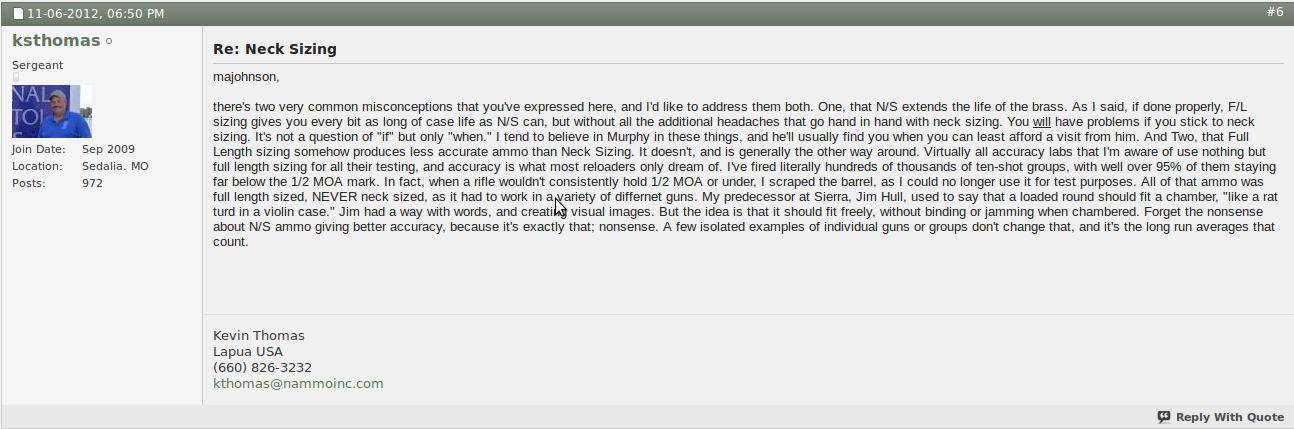

 
For my reloading, all of it for hunting and/or just playing with guns, after many years of chasing ever so slightly smaller groups for whatever reason, that is what I do now for all my loads. I honestly can't remember who said it but someone important apparently once said, "a resized case should fit the chamber like a rat turd in a violin case." Mine are a bit tighter than that, ;) but I have found no practical difference between FL sizing and working to keep the case as large as possible.


The rat turd in the violin case is a humorous way of saying a full length resized case. The case body does not touch the chamber walls, the rear of the case is supported by the recessed bolt face and by the bullet in the throat. The only part of the case touching the chamber is the case shoulder pushed forward by the ejector and the firing pin.

As an example the resized case body for a semi-auto should be .003 to .005 smaller in diameter than its fired diameter. This allows the case to chamber and extract freely without binding. (the rat turd in the violin case)

Jim Hull of Sierra bullets ballistic test lab is the one who said it, and Kevin Thomas of Team Lapua below who worked with Jim Hull repeats it below.

Y3IiYL5.jpg
 
Back
Top Bottom