You are using an out of date browser. It may not display this or other websites correctly.
You should upgrade or use an alternative browser.
You should upgrade or use an alternative browser.
.303 blanks
- Thread starter Timberlord
- Start date
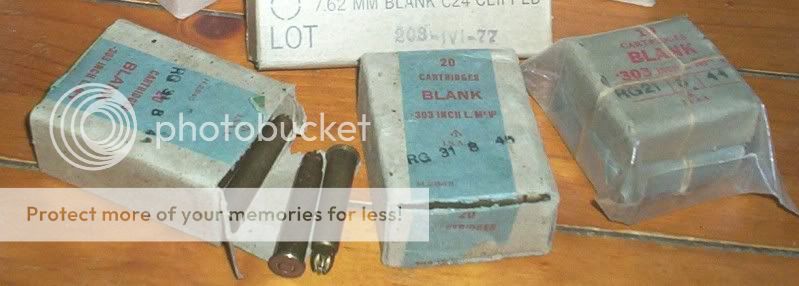

Whatever you do, defiantly keep that sealed pack sealed. A few would probably not be a big deal if you were to fire them off, but Their is really no point IMO. Blanks are not that common and I would keep them or sell the ones you don't want off.
'RG' is Radway Green. Brit. That a stuff is 1944 and '45 vintage. Collector stuff.
You don't want to be practicing anything with it. Certainly not off a range. Blanks were and are for simulating battle sound. No recoil. They won't give you any useful practice.
If you're reloading, make some DP rounds. Regular cartridge with no powder or primer. Drill and deburr a wee hole in the case body. Better for practicing quick reloading. And much safer.
You don't want to be practicing anything with it. Certainly not off a range. Blanks were and are for simulating battle sound. No recoil. They won't give you any useful practice.
If you're reloading, make some DP rounds. Regular cartridge with no powder or primer. Drill and deburr a wee hole in the case body. Better for practicing quick reloading. And much safer.

Largest market is probably with reenactors. List it on EE and watch it go.

Hi-Standard
CGN frequent flyer
- Location
- Republic of Newfoundland
I'd love to have one for my bullet collection
I could really go for a sealed box and a handful of loose rounds...... it's wartime and it's a headstamp I don't have.
Interesting: in the old days, the Brits used to make blanks out of just about anything at all that they had left-over and lying around. I have found several very rare headstamps in old lots of blank ammo, and that includes a CANADIAN headstamp for the Cordite Mark III, which was a soft-point in the Dum-dum series and generally not known to have been made in Canada.
Dedicated production of blank ammo all should have a headstamp that shows the code letter "L", which indicates Blank ammunition.
No code: Ball, but there will be a Mark (VI, VII, VIII or 7 or 8)
Powder code: C for Cordite, Z for Nobel neonite or some other NC powder
Blank: L
Tracer: G, generally with a number; there were navu and army, day and night tracers
Armour-Piercing: P for the really early stuff, middle of War One, supplanted by W late in the Great War and most often seen in the standard W II version, which continued to the end of production
Incendiary: code letter B, comes from Buckingham, which originallh was made for torching Zells. A really interesting variant is the B IV and B IV Z, which is an armour-piercing tracer incendiary designed for torching the self-sealing and armoured gas tanks on ME-109s. This stuff is very rare, although the Government gave away buckets of it during the War for target practice, ebing that only really fresh stuff went to the Hurris and Spits. It is likelt to be even scarcer, now that free Canadians are not allowed to own it. I have actually seen a couple....
Blanks are sort of like politicians.... a lot of noise but you don't dare take them too seriously. Still, they can be interesting.
Interesting: in the old days, the Brits used to make blanks out of just about anything at all that they had left-over and lying around. I have found several very rare headstamps in old lots of blank ammo, and that includes a CANADIAN headstamp for the Cordite Mark III, which was a soft-point in the Dum-dum series and generally not known to have been made in Canada.
Dedicated production of blank ammo all should have a headstamp that shows the code letter "L", which indicates Blank ammunition.
No code: Ball, but there will be a Mark (VI, VII, VIII or 7 or 8)
Powder code: C for Cordite, Z for Nobel neonite or some other NC powder
Blank: L
Tracer: G, generally with a number; there were navu and army, day and night tracers
Armour-Piercing: P for the really early stuff, middle of War One, supplanted by W late in the Great War and most often seen in the standard W II version, which continued to the end of production
Incendiary: code letter B, comes from Buckingham, which originallh was made for torching Zells. A really interesting variant is the B IV and B IV Z, which is an armour-piercing tracer incendiary designed for torching the self-sealing and armoured gas tanks on ME-109s. This stuff is very rare, although the Government gave away buckets of it during the War for target practice, ebing that only really fresh stuff went to the Hurris and Spits. It is likelt to be even scarcer, now that free Canadians are not allowed to own it. I have actually seen a couple....
Blanks are sort of like politicians.... a lot of noise but you don't dare take them too seriously. Still, they can be interesting.
Curse this pesky keyboard! I think the Red Baron has been here.
Buckingham bullets came out for torching ZEPPS, which are Zeppelins: big ugly airship thingies that drop bombs on London and frighten very small Army girls who are on leave (or so my grandmother said). I have no idea what ZELLs might be, unless they are related to Zeller's, which is a large department store that changes location every time I buy something. Are they sending me a message?
Likely.
Anyway, I do apologise for the fying flingers there.
New glasses might help, but it's doubtful......
Buckingham bullets came out for torching ZEPPS, which are Zeppelins: big ugly airship thingies that drop bombs on London and frighten very small Army girls who are on leave (or so my grandmother said). I have no idea what ZELLs might be, unless they are related to Zeller's, which is a large department store that changes location every time I buy something. Are they sending me a message?
Likely.
Anyway, I do apologise for the fying flingers there.
New glasses might help, but it's doubtful......
The blanks are collectors items.
Rapid fire with the blanks is not practical because of feeding problems. The current issue blanks all have a bullet shape as part of the cartridge case to overcome the feeding problems of blanks like the ones pictured.
Rapid fire with the blanks is not practical because of feeding problems. The current issue blanks all have a bullet shape as part of the cartridge case to overcome the feeding problems of blanks like the ones pictured.
- Location
- Tucson, Arizona
I have a case of Canadian blanks but i'm saving them for the Vickers when I get round to it.