303 British Epps Improved

horseman2

CGN Ultra frequent flyer
Rating - 100%
163   0   1
Location
Fraser Valley
Have a friend who traded for a 303 British or so he thought.

The 303 British fire formed into what appears to be an Epps Improved or what ever name might be attached to it.

This is assuming the rifle is actually an Epps Improved and that the FL dies must be exact or is close good enough or will a 303 British dies suffice.

Assuming too that seating can be accomplished with a standard 303 British seating die.

Looking for dies once the exactness is established.
 
I would think a good calliper or a micrometer is in order. I have seen some 303 British chambers that fire form to much different than the factory brass that went in - some were result of WWI British Army "making it work", really crappy and sub standard ammo they had to work with - but, some chambers were a later "wildcat". You won't know until you get some good numbers on your fired brass or from casting the chamber. Shoulder angle would be a useful number to establish. For various reasons, you would want the first firing to have some way of holding tight against the bolt face - rubber o-ring, etc.; - if did not do that want to check inside for potential case separation ring - once pass that - want to try to shift that brass from using the rim to set headspace, to using the front of the brass case shoulder to set headspace - reloads will last much longer. Original military scheme was to headspace on the rim - cartridge must go bang, and then extract - no concern whatsoever whether that brass case could be used again or not - hence they had no concern about de-forming, etc. so long as case did not burst or impede extraction.
 
I would think a good calliper or a micrometer is in order. I have seen some 303 British chambers that fire form to much different than the factory brass that went in - some were result of WWI British Army "making it work", really crappy and sub standard ammo they had to work with - but, some chambers were a later "wildcat". You won't know until you get some good numbers on your fired brass or from casting the chamber. Shoulder angle would be a useful number to establish. For various reasons, you would want the first firing to have some way of holding tight against the bolt face - rubber o-ring, etc.; - if did not do that want to check inside for potential case separation ring - once pass that - want to try to shift that brass from using the rim to set headspace, to using the front of the brass case shoulder to set headspace - reloads will last much longer. Original military scheme was to headspace on the rim - cartridge must go bang, and then extract - no concern whatsoever whether that brass case could be used again or not - hence they had no concern about de-forming, etc. so long as case did not burst or impede extraction.


It's a 35 degree shoulder as near as I can get to it as measured against the P O Ackley picture in the book.


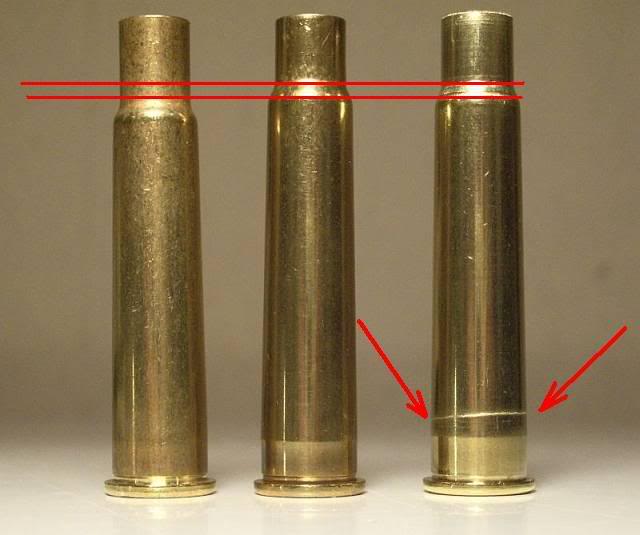
Picture of the fired round attached
 
Last edited:
If it is actually a 303 Epps, you cannot use the standard 303 British FL die, nor the seating die.
You need a set of 303 Epps dies. The Epps is quite a bit larger at the shoulder, and has a lot
less taper over the length of the case. Dave.
 
Can you neck size with a Lee collet die?

Seat with a 308 ?

303 Brit Collet Die - yes there's a chance, but the neck on the 303 Epps is usually shorter than 303 Brit, so there's a risk too that it won't work. I do think that you could neck size with a 308 F/L die and seat with the 308 Seater as suggested.

This all depends of course on what you actually have.
 
Last edited:
I am still looking for actual 303 Epps chamber dimensions. I just read there were more than one version of "improved" 303 British chambers, several more than just by Elwood Epps - so really no telling what you have from picture? Most references say that the 303 Epps was done in a P14 - so I am assuming that is what you have bought? Not a No. 1 or a No. 4? I had read that the British Army enlarged the chambers in 303 British SMLE (No. 1) to chamber and handle some really crappy ammo they had to use - not certain that was done with the P14's? So what rifle you have might also be a bit of a clue to figure it out?
 
I am still looking for actual 303 Epps chamber dimensions. I just read there were more than one version of "improved" 303 British chambers, several more than just by Elwood Epps - so really no telling what you have from picture? Most references say that the 303 Epps was done in a P14 - so I am assuming that is what you have bought? Not a No. 1 or a No. 4? I had read that the British Army enlarged the chambers in 303 British SMLE (No. 1) to chamber and handle some really crappy ammo they had to use - not certain that was done with the P14's? So what rifle you have might also be a bit of a clue to figure it out?

I can only imagine if you phone Wes at Ellwood Epps he may be able to help you with dimensions.
There is also an Ackley Improved facebook group as well.

Cat
 
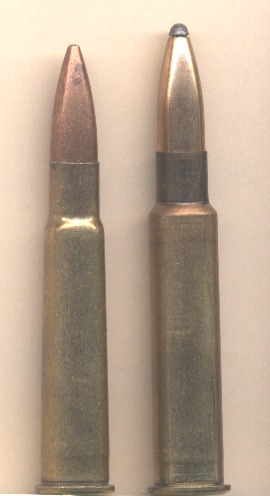
.303 Brit left vs. .303 Epps Improved on right. The decreased body taper and increased surface area would decrease bolt thrust.

epps-vi.jpg


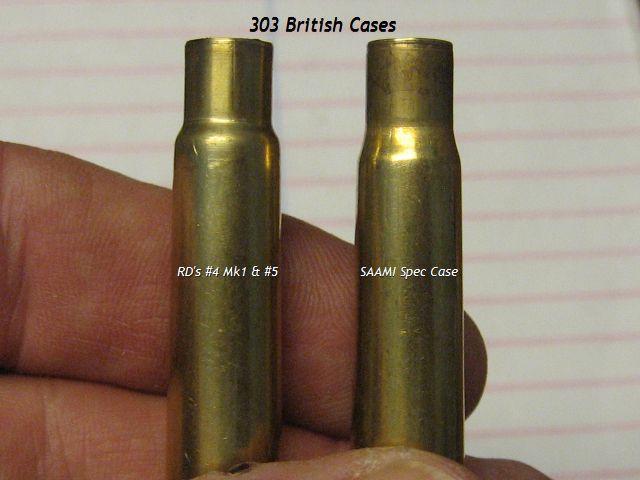
Fired .303 British case on left new unfired case on right.

303_British_cases.jpg


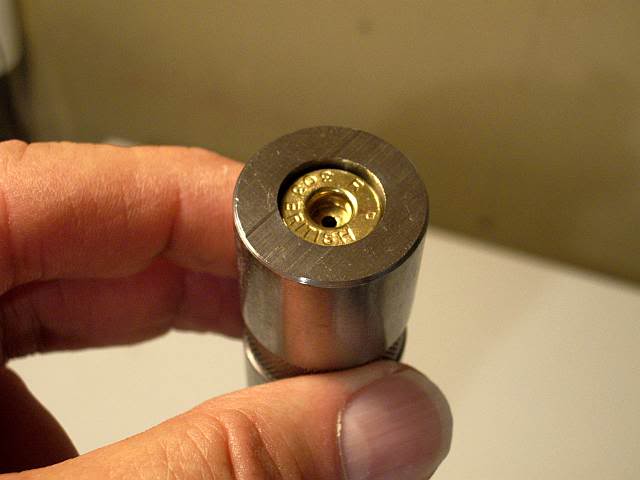
Below a new unfired .303 British case in a Wilson case gauge. The case would drop in further but it is stoped by the case rim.

RBeuevm.jpg


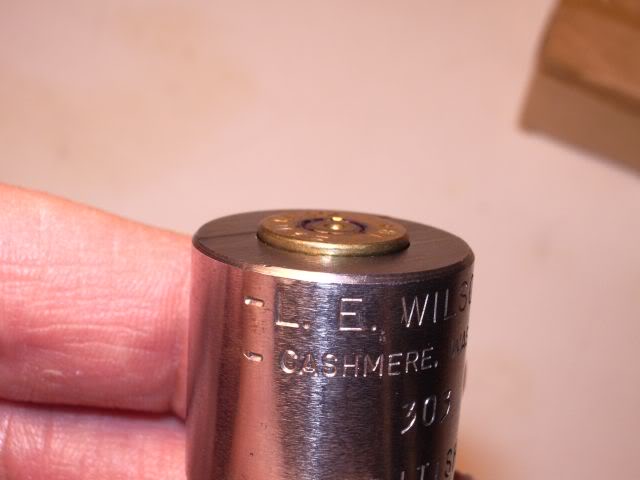
Below a fired case in the Wilson case gauge, the difference below and above the top of the gauge shows how much further forward the chamber's shoulder was.

HrqwFOG.jpg


Below a new unfired case on the left, and fired cases center and right fired in my 1943 No.4 Enfield rifle. The case on the far right shows what happens if you full length resize the case and do not let the case headspace on its shoulder.

NHlR9jO.jpg
 
Last edited:
I am still looking for actual 303 Epps chamber dimensions. I just read there were more than one version of "improved" 303 British chambers, several more than just by Elwood Epps - so really no telling what you have from picture? Most references say that the 303 Epps was done in a P14 - so I am assuming that is what you have bought? Not a No. 1 or a No. 4? I had read that the British Army enlarged the chambers in 303 British SMLE (No. 1) to chamber and handle some really crappy ammo they had to use - not certain that was done with the P14's? So what rifle you have might also be a bit of a clue to figure it out?

Somewhere I have a Epps reloading book for .303. Will send a PM if I find it.
Regards, C1A1
 
Despite my earlier commitment, just did not find dimensions for 303 Epps here. Best I can come up with, Steve Redgwell's site says that Epps removed .050" taper in the case. If so, a "standard" 303 British case is about 0.4010" diameter at the shoulder. That would mean that a 303 Epps would be 0.4510" diameter at the shoulder? Just can not tell from OP's picture if the fired one has that much difference in diameter at the shoulder. Sorta thinking from what I see, with no dimensions, that what that is, is a "semi normal" fired 303 British cartridge from a wartime 303 British chamber. OP has not yet mentioned what rifle this is from - would help with the "guess work"...
 
Last edited:
The "303 Epps" is not approved with SAAMI, so there is no standard established - the Epps store will have their standard and others will have their own. If you just order a set of dies going by that name, you run the risk of yours not being that 303 Epps, or of them asking for measurements or more likely a couple of fired cases.

I would have thought that by now that there'd have been some measurements shared, but perhaps as is often the case the OP doesn't possess the tool to do that, or has just lost interest in finding out for his friend. If so, please tell us.


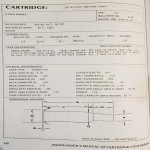
Here's some info on (one version of) 303 Epps:

303 Epps.jpg
 

Attachments

  • 303 Epps.jpg
    303 Epps.jpg
    72.7 KB · Views: 214
Pictures sent which explains a lot. The Epps Improved is a Lee Enfield that was sporterized and a lot of work and money ent in to it.

Kept telling me about his P14 which is still in 303 British . . . not the same rifle. Suggested a barrel switch but the threads will probably not match.

The articles and help suggest there is little to gain especially when EPPS quoted a price of $185 for dies.

The various articles were a real education and many thanks to the contributors.
 
I own a 303 Epps. It is on a P14 Action, and has a 25" barrel. I'm here to tell you that under
no circumstances can you get a 180 to 2900 fps safely in this chambering. 2700 and pennies
is a much more realistic figure. [about what a factory 30-06 will do] In my P14, brass lasts a
long time, and it is actually an easy to load cartridge. But equivalent to the 300 H&H it is NOT.
Regards, Dave.
 
i like the comment in the article which states 'suitable rifles may be had for about 50$ and up.' i saw a 303 epps im on a #4 action for a couple of years at a gun show many years ago that was complete with dies. apparently, no one wanted to pick it up and the price dropped a bit more with each show.

seemed to me like the epps imp was a solution for a issue that never really existed. easier to pick up a ishapore 308 or a m17 if you wanted a bit more velocity relative to the standard 303, which to me, still remains a great round and iconic rifle.
 
I have an Epps Improved in a 25-303 and puts out the same as a 257 improved, a very accurate rifle also, running 50gr 4831 surplus behind 100 gr Herter. Epps built a lot of improved cartridges in all different calibers, still have his 2 catalogs from the 70s with all the prices.
 
Back
Top Bottom