303 british Mark VII cartridge loading problem

commonman

CGN Regular
Rating - 100%
94   0   0
Location
Alberta
I am loading for an old BSA factory Sporting rifle that is regulated and sighted for the Mark VII cartridge. I have been purchasing the Winchester super X 180 grain that has a muzzle velocity of 2460 FPS and it seems to be quite close to the sighting on the rifle, BUT I would like to reload for this rifle and use the iron sights. Problem is locating a powder that would give me that speed with a 174 or even a 180 grain bullet. I am hoping that there are members who have done this for military arms competitions etc. and can help. It looks like Reloader 15 might work but so far have not located this powder.

Any ideas?

 
IMR 3031 or IMR 4064 are very good candidates, however, RE15 gives me the best accuracy in most of my 303's. I load the 150 gr to min load with RE15 - this gives a good approximation of the design velocity (2440 fps). I call it "303 lite"
 
IMR 3031 or IMR 4064 are very good candidates, however, RE15 gives me the best accuracy in most of my 303's. I load the 150 gr to min load with RE15 - this gives a good approximation of the design velocity (2440 fps). I call it "303 lite"

Question? Does a load for a 150 grain bullet moving at 2440 fps have the same POI as a 174 grain bullet moving at 2440 fps?
 
Question? Does a load for a 150 grain bullet moving at 2440 fps have the same POI as a 174 grain bullet moving at 2440 fps?

No. But the difference will vary by rifle and distance. By all measn try some 150s.

As for powder, anything from 3031 speed to RL15 will duplicate factory velocity. This would include 4895, 748, BLC2, H335 and even Varget.
 
Answer: No
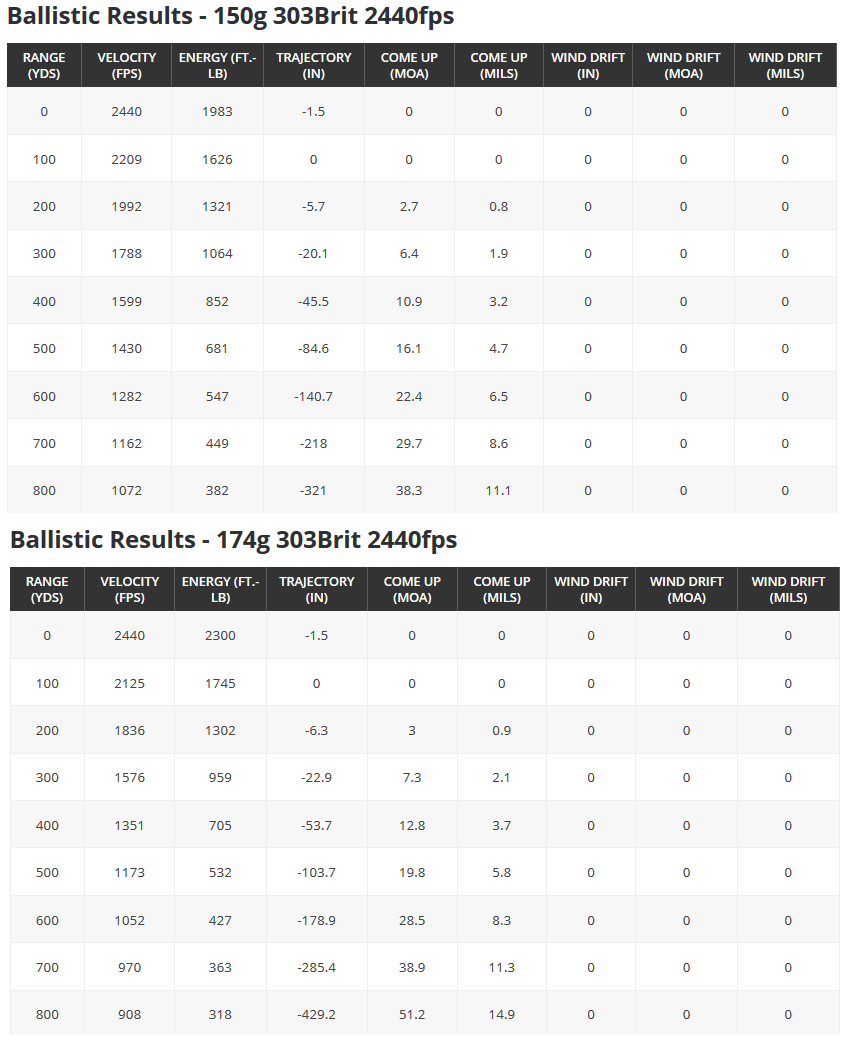
The comparisons follow (I generated these results here: https://www.hornady.com/team-hornady/ballistic-calculators/#!/):

efrs8c3.png
 
Something wrong with that program, it shows a 150 grain hitting harder than 174 grain with both going out at same speed!
 
Ballistic calculator 101

So I'm trying to figure out this chart. Perhaps someone will tell me if my conclusion makes sense.

The two bullets leave the muzzle at the same speed. They will both cross the 100 yard line at the same point, the heavier one will still have more energy even though it is now going slightly slower than the lighter bullet. At the 200 yard line the heavier bullet will be .6 of an inch lower then the lighter one and still have a slight lead as far as energy but is now going noticeably slower. After that the heavier bullet loses energy faster so at 300 the lighter bullet has more retained energy and is moving much faster than the heavy one, it also has not dropped as much.

So if using the iron sights on my rifle (which are set up for the heavier bullet) my 100 yard sight should be the same for both. The 200 leaf will find the 150 grain bullet about 1/2" high, and at the 300 yard leaf will be 2 3/4" high. So for hunting deer, Cosmic's 303 Lite is a workable load for my sights and a better load for the occasional long shot, ballisticly wise anyway.

Okay, so tell me where I'm screwed up. I need to know if I'm reading this right.

Oh and thanks to K-C for the intro to online calculators.:)
 
A ballistic chart shows velocity and drop.

It has nothing to do with what happens in the real world with a rifle, because the barrel is flexing (whipping) and the different weight (velocity) bullets leave the barrel at different angles.

If you have a rifle that shoots to POA with military ammo and want handloaded ammo that will do the same, the only way to find this is to load a bunch of test rounds with different powder charges and find the bullet weight/powder charge that hits at the same place at X yards.

Tables mean nothing, if this is what you want to do.
 
The Hornady calculator is using a 150 gr spire point vs a 174 gr round nose. One would normally expect the heavier bullet to retain more energy at distance, but the round nose has higher drag than the spire point.
FWIW - You don't have many loading choices for 303. Try some of the 174 grain pills and some of the 150 grain pills - one of those will shoot better than the other, right out of the gate. Moreover, if your BSA is a Pattern 14 based sporter, you may find that its rather picky in the bullet profile it likes to feed out of the magazine.
 
Last edited:
No commercial bullet exists that duplicates the shape, much less the composition of the Mark VII 174 gr bullet. Of course neither are today's powders and primers duplicates.

All that said, you've already hit on a commercial load that seemed to mimic the original to your satisfaction. That ammo uses the 180 gr Power-Point bullet, which you might be able to buy, or at least approximate with another brand (i.e. flat-based, 180 gr). Have you pulled down any of that ammunition and noted the bullet shape, and measured how many grains of powder were in it? Did you chronograph it in your rifle, or are you taking the MV from the box or the Winchester website?

AX303B1.JPG


You can surmise that Winchester would be using a Winchester powder, so it shouldn't be difficult to determine which powder was used based on the amount and the MV of the 180 gr bullet. If there are around 45.0 grs of Ball Powder, it's likely Win 760 (H414).
 
Last edited:
If the Winchester 180 gr round nose hits to point of aim, and you want to make ammo that duplicates this, I suggest buying a 180 gr round nose bullet (Hornady makes one - 174 gr, close enough) and make a test with your powder in 0.5 gr increments, and shoot off a bench.

Shoot 3 of each, letting the barrel cool well between shots. Does not matter much which powder you use. Just pick a suitable one in the 3031 to 4350 range. One of those loads should shoot the same elevation, or the elevation of your target. Don't worry about the wind. The front sight can be drifted.
 
If you wanted to do this on the cheap, you could acquire some Hungarian 7.62X54R "Heavy Ball" (~180 gr) ammo and pull it down. You'd then have some bullets to try and if you wanted to use the powder, you'd need to reduce the powder charge by 6-7 grains and work up to the 2400 fps range.
 
If those 180 grains work well for you, Sierra makes awesome ones, depends as well if your rifle like boat tails or not. These are flat based spitzer bullets, soft points 180 gr. A little higher in price, but awesome accuracy from them, many use them as match loads with 4895 behind.

If she does like boat tails, PPU makes some nice 174 gr
 
Try Budget Shooter Supply. They ship Canpar and rates are reasonable. Likewise for Rusty Wood Trading.

Wow this is the first time I can remember since I started reloading that I can buy from a shop that has pretty much anything I want in stock. It was always look, figure and substitute. Course I guess I have to get the $20 per can picture out of my head.
 
A ballistic chart shows velocity and drop.

It has nothing to do with what happens in the real world with a rifle, because the barrel is flexing (whipping) and the different weight (velocity) bullets leave the barrel at different angles.

If you have a rifle that shoots to POA with military ammo and want handloaded ammo that will do the same, the only way to find this is to load a bunch of test rounds with different powder charges and find the bullet weight/powder charge that hits at the same place at X yards.

Tables mean nothing, if this is what you want to do.

Exactly. OP question was about a load that would shoot to POA with iron sights, not about ballistics. 150 gr can do that just fine by adjusting the powder charge. Any mid range powder will work.
 
No commercial bullet exists that duplicates the shape, much less the composition of the Mark VII 174 gr bullet. Of course neither are today's powders and primers duplicates.

All that said, you've already hit on a commercial load that seemed to mimic the original to your satisfaction. That ammo uses the 180 gr Power-Point bullet, which you might be able to buy, or at least approximate with another brand (i.e. flat-based, 180 gr). Have you pulled down any of that ammunition and noted the bullet shape, and measured how many grains of powder were in it? Did you chronograph it in your rifle, or are you taking the MV from the box or the Winchester website?

AX303B1.JPG


You can surmise that Winchester would be using a Winchester powder, so it shouldn't be difficult to determine which powder was used based on the amount and the MV of the 180 gr bullet. If there are around 45.0 grs of Ball Powder, it's likely Win 760 (H414).

No I haven't run it through the chronograph yet but I will now, the rifle is a Bsa sporter but they cut the chamber with a military cutter so every shot is fire forming a fair bit. Anybody's guess what the real MV is. I think pulling this winchester cartridge apart may give me a better starting point on this journey, but the road is long and fraught with pit falls. In other words you know what I'll be loading for the next 6 months or so......

Thanks for the help fellas.
 
One of the first surplus powders Hodgdon's sold after WWII was BLC2 from torn down British .303 ammunition. Meaning Winchester made .303 British ammo with BLC2 a double base powder, and I believe Remington made .303 British with a single base powder for aircraft machine guns. Cordite powder .303 ammunition was banned from machine gun use due to barrel wear.

Bottom line, during WWII with BLC2 the U.S. manufactures could duplicate the Mk. VII cordite ballistics.
 
Back
Top Bottom