38 SW reloading problem

MattE93

CGN frequent flyer
Rating - 100%
46   0   0
I am having an issue reloading my .38 S&W revolver. I have sized my 200 gr SWC bullets to .359” diameter. At this diameter I can drop a bullet in the cylinder and push it through with very little force. I can also drop an unloaded sized case into the cylinder and it falls easily to the rim as it should. However, when I load rounds it takes significant force to get the round to chamber up to the rim and allow the cylinder to rotate freely. I must be bulging the case at some point but can’t figure out where.

Is it possible that I am not crimping enough to remove the flare during the expansion stage?
 
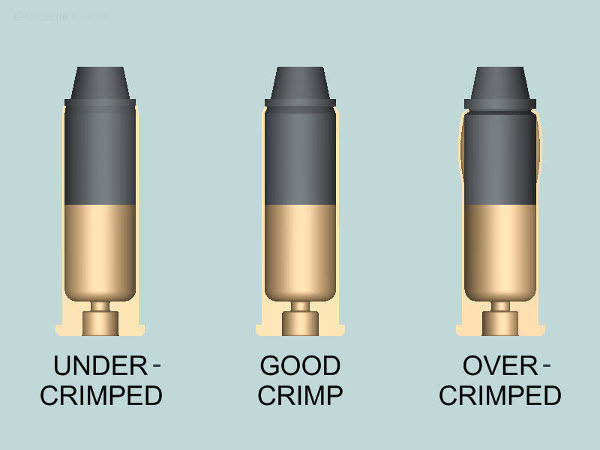
I have the Lee factory crimp die. I think maybe I am over crimping and swelling the round? Also the bullets must be the proper size as they feed find out of a case. So either I am swelling the bullet, swelling the case, or I’m not removing the flare in the case
 
Seat and crimp in separate operations, you may be creating a case bulge below the crimp.

The Lee factory crimp die with the carbide ring in its base can size oversized cast bullets smaller depending on case wall thickness.

Below most chambering problems are caused by bulges below the crimp.

QMWa7Bx.jpg


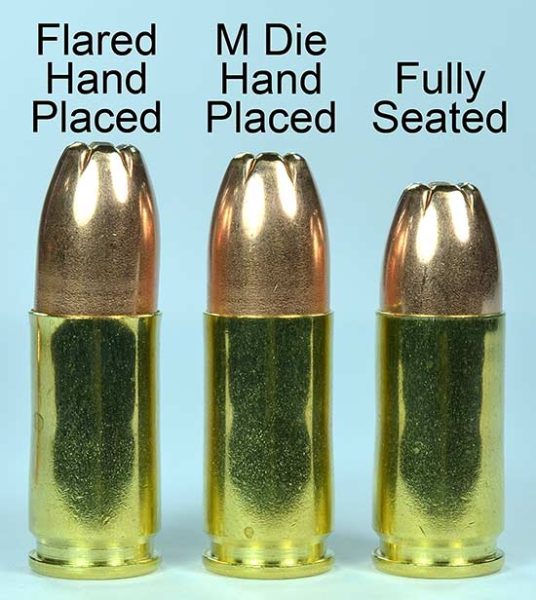
A Lyman type "M" expander does not over flare the case mouth and aids straight inline seating.

vwgkeH3.jpg
 
Looks like it was a combo of over crimping and dirty cylinder. I am now crimping in a separate step and thoroughly cleaned each cylinder chamber and that seems to have fixed my problem
 
Okay I just loaded another few rounds. The rounds are sized to .359 before seating, checked with a dial caliper. After seating, the end of the cylinder near the nose on the SWC comes out to .363, while the rest of the SWC cylinder remains .359

My issue seems to be during seating the pressure from the press is slightly swelling the nose, making them hard to push into the cylinder. Is there a way to stop this from happening during seating?
 
I'll assume that because you have a LEE FCD, that your other dies are LEE as well. LEE sometimes shares dies between calibers, could you give us the caliber stamped on each die.

The 38 S&W, not to be confused with the 38 S&W Special, is a short cased cartridge with rather thick walls. The sizing operation reduces the internal diameter of the case, and because the walls of the case are tapered, this diameter gets even smaller as you go deeper into the case. The expander increases that diameter so that a bullet can be seated. But, it only increases that diameter for a short distance. A long(ish) 200 gr bullet can easily be seated well past that expanded portion.

The only operation that can "bump" the bullet up in diameter is seating. So, when you're seating the bullet, the force is sufficient to bump the bullet up in diameter. I'd first try and seat the bullet just a bit, then check the diameter again. At some point the force has to increase enough to bump the bullet. Go in steps, of 0.050".

The cause will have to be determined before a solution can be formulated.

Perhaps you'll need harder bullets. Perhaps a deeper expander, something like a ht tp://noebulletmolds.com/NV/product_info.php?cPath=565_88&products_id=5582

OR

Pictures help.
 
I’m using a set of Lee dies. The sizer is .38 Auto, while the expander and seating die are labeled .38 S&W

It must be during seating. The bullets are quite long and definitely go past the expanded portion. I feel no resistance when o start seating and then it gets a little stiffer the deeper into the case I go. Since the bullets change size right after seating I guess the seating has to be the cause. I guess I can try a longer OAL and work back to see how short I can make them without swelling them
 
If you are using once fired brass, try backing out the sizer, only neck size down about as far as the expander goes into the case. The factory crimp die will look after any oversize in the body. I've done this, on 38 Special or something like that, and it is OK in revolvers. I wasn't getting enough neck tension, so I sized in a 9mm Luger die, just enough to size the part that holds the bullet.

It's not what the dies is labeled, it's the job it accomplishes that counts. the other day I used a 30-06 neck die to size 45 ACP. I compared dimensions after I got my "real" die, dimensions were within a thou.
 
If you are using once fired brass, try backing out the sizer, only neck size down about as far as the expander goes into the case. The factory crimp die will look after any oversize in the body. I've done this, on 38 Special or something like that, and it is OK in revolvers. I wasn't getting enough neck tension, so I sized in a 9mm Luger die, just enough to size the part that holds the bullet.

It's not what the dies is labeled, it's the job it accomplishes that counts. the other day I used a 30-06 neck die to size 45 ACP. I compared dimensions after I got my "real" die, dimensions were within a thou.

I also size my .38 S&W in a 9mm carbide die. Works fine.

Similarly, I use a 30 Mauser die (7.63X25) for my TT33 7.62x25 rounds.
 
Back
Top Bottom