6.5x55 Swede - Jump

track

CGN Ultra frequent flyer
Rating - 100%
89   0   0
Location
Okotoks
I have a modern day rifle (Viking Arms 1900 Deluxe) chambered in the noted above.
My question is: What measurement of jump do you use for the 140 grain Nosler Ballistaic Tip bullet, for best accuracy results?
I've never handloaded for this cartridge and searchng for experienced users.
Thanks!
 
Last edited:
Assuming cup and core bullets:

Magazine length, less about 10 thousandths of an inch.

I am also a proponent of a minimum of 3/4 of a caliber length of bearing surface engaged in the case neck.(~.200”)

Set your depth to the shorter of the 2 criteria, and if you need to tweak, go shorter.

Swede spec chambers have long throats, and therefore it’s a pretty long reach to the lands………..
 
Assuming cup and core bullets:

Magazine length, less about 10 thousandths of an inch.

I am also a proponent of a minimum of 3/4 of a caliber length of bearing surface engaged in the case neck.(~.200”)

Set your depth to the shorter of the 2 criteria, and if you need to tweak, go shorter.

Swede spec chambers have long throats, and therefore it’s a pretty long reach to the lands………..
Using the Hornady Lock and load bullet comparator, I've set the jump at .020". I have about 1/3rd of an inch remaining in the magazine box...........plenty of room. The tail of the bullet is at the junction of the neck and shoulder. If required for better accuracy, I'll move slightly to the lands. Thanks for the tip!
 
  • Like
Reactions: DGY
In my 6.5x55 I am around 30-50 thou off the lands with a variety of lead core bullets. With monometal 130 Cx I do 50 thou off

If the relationship between bullet ogive and the barrel matters for accuracy, I generally haven't seen it. Some of my rifles have 200 thou jump and group fantastic.
 
In my 6.5x55 I am around 30-50 thou off the lands with a variety of lead core bullets. With monometal 130 Cx I do 50 thou off

If the relationship between bullet ogive and the barrel matters for accuracy, I generally haven't seen it. Some of my rifles have 200 thou jump and group fantastic.
I can attest to that - have two rifles 7mm08 and 6.5 Swede - both shot best 90 thou off jam.

OP - I have a second 6.5 Swede (a Sauer 100). Shoots 140gr SST and Nosler BT sub-MOA 30 thou off the lands.
 
Last edited:
My T3x I load 140 SST's out as far as they can go and I still have a 0.200 (thats right, 200 thou) jump and it is very accurate.
T3s have tighter tolerances, especially in the neck/throats than most other commercial 6.5 Swedes in my experience, which often gives better accuracy.

I have two other rifes with 6.5Swede chambers, one on a Remington 700, and another on a Winchester Mod 70.

The 700 is in a class by itself, as it has a 30in tube, 1-7.5 twist, and a match tolerance chamber. I can't seat the 140 grn VLD or 160 grn ELD to touch the leade in either of these rifles.

The Tikka T3 will shoot everything well, from flat base 90 grain to 160 grn of all shapes. The model 70, which has sloppy dimensions, will not start shooting well until 120 grain bullets are loaded and won't shoot anything heavier than 140 grain boat tails consistently well. It will shoot round nose, flat base 160s, but they have to be pushed faster than loading manuals show. It has a 1-9 twist.

Your 1900 will have a 1-8 twist rate, with a long throat, and it should shoot very well.

It's also a very strong action, and you can easily excede loads listed in manuals. Just watch your cases for pressure signs.
 
Last edited:
T3s have tighter tolerances, especially in the neck/throats than most other commercial 6.5 Swedes in my experience, which often gives better accuracy.

I have two other rifes with 6.5Swede chambers, one on a Remington 700, and another on a Winchester Mod 70.

The 700 is in a class by itself, as it has a 30in tube, 1-7.5 twist, and a match tolerance chamber. I can't seat the 140 grn VLD or 160 grn ELD to touch the leade in either of these rifles.

The Tikka T3 will shoot everything well, from flat base 90 grain to 160 grn of all shapes. The model 70, which has sloppy dimensions, will not start shooting well until 120 grain bullets are loaded and won't shoot anything heavier than 140 grain boat tails consistently well. It will shoot round nose, flat base 160s, but they have to be pushed faster than loading manuals show. It has a 1-9 twist.

Your 1900 will have a 1-8 twist rate, with a long throat, and it should shoot very well.

It's also a very strong action, and you can easily excede loads listed in manuals. Just watch your cases for pressure signs.
Thanks for the tips! I have two different powder handload's to date, with the 140 grain Nosler Ballistic Tip. Starting with H-4831SC, then RL#22. I set the ogive at .020" jump, COAL is 3.166". Base of the bullet is located at the junction of the neck and shoulder. I'm heading out to the gun club around the middle of January (15th or 16th) for the first shoot, can't wait!
 
I'm surprised you can get that close to the leade and still keep your bullets straight.

I've had a couple of 1900s as well as an Antonio Zoli, chambered for the 6.5x55, and they all had very deep throats.

The Zoli wasn't as deep, and I might have been able to get that close, but someone offered me a healthy sum for it, because it was smooth as silk to operate, and it was very accurate with just about any factory ammunition. He bought it for his wife, who shoots whatever ammo is on sale for the past 15 years. She only cleans it when groups start to open, usually after a couple of boxes.

Husqvarna 1900s are old school, but incredible rifles, especially at the prices they're selling for from some of our banner advertisers.

One thing I noticed is that they were very light foulers. If you don't overheat the barrel with extended size groups, they will shoot ammo they like into 1.5 moa or less for 40-50 shots, without having to clean. Much less if you insist on shooting 10 quick shots into each group.

They're hunting rifles, not combat rifles. 3-5 shot groups will tell you everything you need to know for hunting purposes.

I've found, if you're shooting a third round, you've likely lost the animal, unless it's for a kill shot.

 
I'm surprised you can get that close to the leade and still keep your bullets straight.

I've had a couple of 1900s as well as an Antonio Zoli, chambered for the 6.5x55, and they all had very deep throats.

The Zoli wasn't as deep, and I might have been able to get that close, but someone offered me a healthy sum for it, because it was smooth as silk to operate, and it was very accurate with just about any factory ammunition. He bought it for his wife, who shoots whatever ammo is on sale for the past 15 years. She only cleans it when groups start to open, usually after a couple of boxes.

Husqvarna 1900s are old school, but incredible rifles, especially at the prices they're selling for from some of our banner advertisers.

One thing I noticed is that they were very light foulers. If you don't overheat the barrel with extended size groups, they will shoot ammo they like into 1.5 moa or less for 40-50 shots, without having to clean. Much less if you insist on shooting 10 quick shots into each group.

They're hunting rifles, not combat rifles. 3-5 shot groups will tell you everything you need to know for hunting purposes.

I've found, if you're shooting a third round, you've likely lost the animal, unless it's for a kill shot.

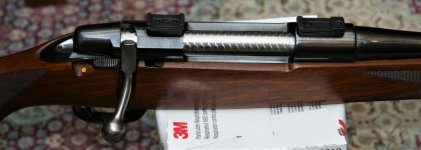
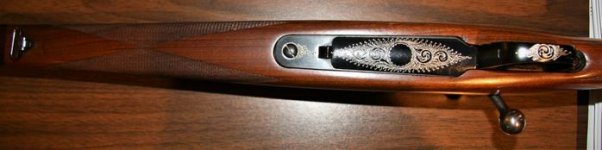
Here is the rifle. Photo's taken from another forum, The Gunboard. The previous owner of the rifle is also on this site, his user name is "South Pender". The rifle was for sale at Reliable Gun in Vancouver and I grabbed it right-away, hence seaching for a 6.5x55 Swede. I tried to reachout to him, but to no avail.

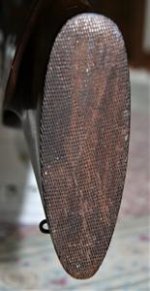
Thanks for the additional tips. This action is just as smooth as a Tikka, but better looking! The butt plate is totally hand checkered. Butte plate, pistol grip and forend tip is made from rosewood. Bolt body is jeweled, barrel is 23.60 inches. Condition is about 96%

1767992646352.jpeg
1767992671479.jpeg
1767992693484.jpeg
1767992751514.jpeg
1767992776795.jpeg
 
Most of them are just "vanilla" offerings, but your rifle was likely a special run or a special order.

Back in the 60s, customers were still able to specify what they wanted on their rifles and order directly from the factory.

I believe "southpender" is a flipper and may have traded it to Reliable for something he wanted. Not sure.

I've seen some very elaborate 1600 series rifles.

There are some very serious Husqvarna rifle collectors out there. Most of them are long in the tooth, and their firearms are being sold off at ridiculously low prices.

Many of them are custom one offs, some of them have been sent to very talented engravers, and others are just about as basic as it gets.

All of them are smooth to operate.

One thing you should think about, if it's not already done, is glass bedding the receiver. Those stocks are 60 years old, and in most cases are not as tight as they once were.

I would do this before taking it to the range if I intended to keep it.

One other thing to consider, it has controlled round feed, and it may not allow you to single feed into the chamber without stripping it from the magwell.

You don't want to break the tip off the extractor by trying to force the bolt closed.
 
Assuming cup and core bullets:

Magazine length, less about 10 thousandths of an inch.

I am also a proponent of a minimum of 3/4 of a caliber length of bearing surface engaged in the case neck.(~.200”)

Set your depth to the shorter of the 2 criteria, and if you need to tweak, go shorter.

Swede spec chambers have long throats, and therefore it’s a pretty long reach to the lands………..
Well stated. I have a modern Zastava in 6.5 X 55; noticeably tighter chamber.
 
Most of them are just "vanilla" offerings, but your rifle was likely a special run or a special order.

Back in the 60s, customers were still able to specify what they wanted on their rifles and order directly from the factory.

I believe "southpender" is a flipper and may have traded it to Reliable for something he wanted. Not sure.

I've seen some very elaborate 1600 series rifles.

There are some very serious Husqvarna rifle collectors out there. Most of them are long in the tooth, and their firearms are being sold off at ridiculously low prices.

Many of them are custom one offs, some of them have been sent to very talented engravers, and others are just about as basic as it gets.

All of them are smooth to operate.

One thing you should think about, if it's not already done, is glass bedding the receiver. Those stocks are 60 years old, and in most cases are not as tight as they once were.

I would do this before taking it to the range if I intended to keep it.

One other thing to consider, it has controlled round feed, and it may not allow you to single feed into the chamber without stripping it from the magwell.

You don't want to break the tip off the extractor by trying to force the bolt closed.
It's all good with single feeding into the chamber, I tried it with a dummy round when locating the rifling. The gun is glass bedded. I found that out when my gunsmith (Henry Remple) worked on the trigger. He removed the main spring, shortened it and then adjusted the trigger weight. When the bolt is removed, there is a small hole infront of the tange, above the trigger. There is an adjustment screw to increase or decrease the trigger weight. It's set now at 1.75 pounds.

Furthermore, in front of the bolt handle, there is a small button which can be depressed to work the bolt while the safety is on, similar to a Sako rifle. I had some Talley QD 30mm rings kicking around and slapped a Steiner Predator 4 4-16x50 on it to get started. It's a diamond in the rough, for me anyway.
 
Last edited:
I have a modern day rifle (Viking Arms 1900 Deluxe) chambered in the noted above.
My question is: What measurement of jump do you use for the 140 grain Nosler Ballistaic Tip bullet, for best accuracy results?
I've never handloaded for this cartridge and searchng for experienced users.
Thanks!

You'll really have to experiment to see what your rifle likes. I have some that like a huge jump, and some that want to bullet jammed into the lands. I'd start with max mag length minus 1.5 hundreths and move out from there. Also, you should measure to see how much space you have to seat the bullet forward. Try to keep .264 in the neck at minimum for proper support and alignment.

Good luck.
 
Back
Top Bottom