













































I don't often post in this forum, but here's another stab at promoting the least known of the black-powder guns, the pin-fire game gun. Built in Britain for just over a decade and mainly available to the super-wealthy, these were the first breech-loading sporting guns to fire self-contained cartridges with primer, powder and shot. A French innovation of the 1830s, the pin-fire came into acceptance in Britain during the mid- to late-1850s, pretty much at the same time as the first centre-fire cartridges started to appear (another French invention). The pin-fire rose to dominance in the early 1860s, but by the end of the 1860s, the centre-fire all but replaced the pin-fire in Britain, though the system remained popular on the Continent until the beginning of the 20th Century.
These were hand-made guns, made at simple workbenches, not factories. It was not unusual for a prosperous gunmaker to build fewer than ten a year, and even the most illustrious makers worked hard to move a few dozen in a year, with just a handful of guns being of the highest grade. Apart from the reluctance to try something new, there was the matter of cost – at around 50 guineas for a 'best' quality gun, this represented about two years' wages for a senior army officer. It was no small purchase, even for the wealthy.
Few have seen or handled an original-condition pin-fire game gun because of their natural rarity. This is made worse by the fact that most pin-fires were converted to centre-fire at some point to extend their usefulness in the field, and it takes a sharp eye to spot the conversion. Only the wealthiest could afford to retire a pin-fire gun to a corner of the gun room and buy a new centre-fire without first considering the relatively small cost of conversion.
The American Civil War saw the change from percussion to rim-fire and centre-fire cartridges (though pin-fire revolvers saw much use), and sporting guns bypassed the pin-fire system altogether. Other than a few being carried across the Atlantic in someone's luggage or imported as novelties to a few city retailers, there was no source of pin-fire shotguns in North America. Public interest was in mass-produced factory-made guns, leaving a limited market for high-end pieces, and pin-fire ammunition would have been hard to come by. Most of the pin-fires one might come across in Canada now are later Belgian-made utility guns, not dissimilar to the cheap hardware-store double guns that flooded the low-end market.
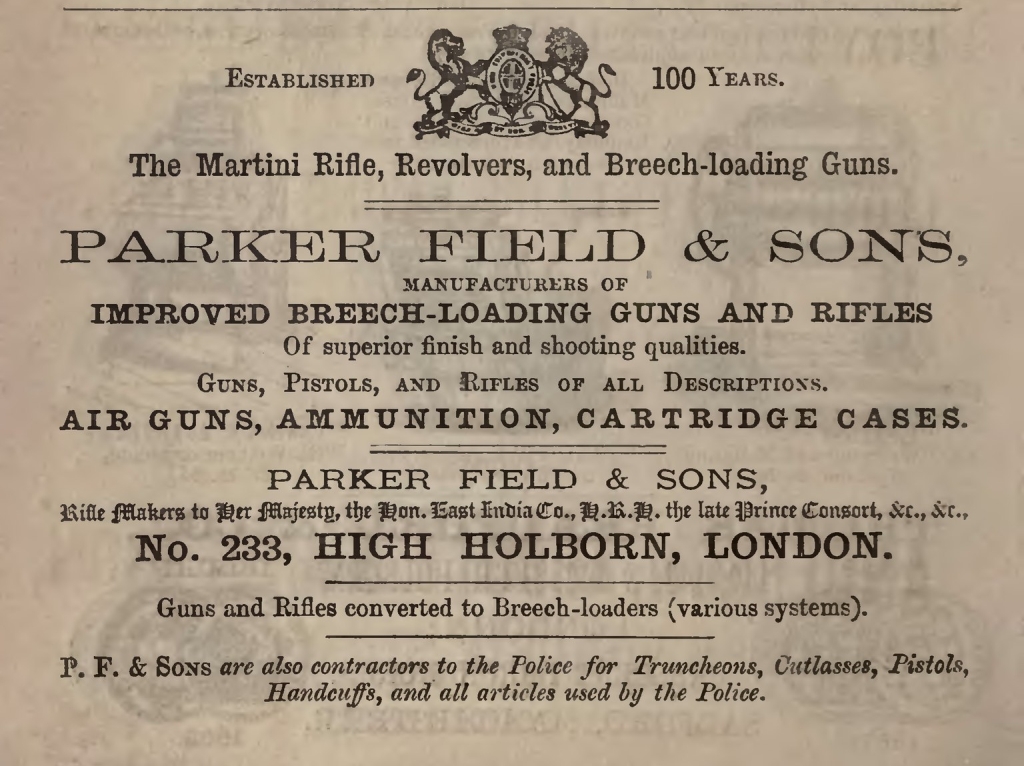
Here is a Parker – not the famous American maker, but the English firm of Parker, Field & Sons. It is a name you might find on the lock-plate of a Pattern 1853 Enfield or a converted Snider-Enfield. Parker, Field & Sons is probably best known for its military contracts with the Honourable East India Company and for military Enfield P1853 muskets supplied to both sides in the Civil War. The firm also supplied trade muskets to the Hudson's Bay and North West Companies and equipped police forces with pistols, truncheons, tipstaffs, cutlasses, handcuffs, wrist shackles, leg irons, and "all articles used by police." And yes, they made sporting guns, too. Despite their success, little has been written about Parker, Field & Sons, and even less on their sporting guns. Surviving pieces show off the high quality of their flint and percussion pistols and sporting guns, but very little is known of their pin-fire game guns.
The origins of the business started with John Field, who began as a goldsmith, sword cutler and gun maker in 1783 at 233 High Holborn street in London. When he died in 1791, William Parker partnered with his widow and traded as Field & Parker. In 1814, William's daughter, Mary, married John Field Junior, further entwining the families. William became gun maker to Prince Edward, Duke of Kent and Strathearn (the future Queen Victoria's father), and King William IV. When William died in 1841, John Field Jr and his sons John William Parker Field and William Shakespeare Field started trading as Parker, Field & Sons. Shortly after, the firm received the greatest accolade, becoming gunmaker to Her Majesty Queen Victoria, a recognition the firm made good use of in their case labels and advertisements. The firm ceased business in 1886 after over 100 years in the trade.
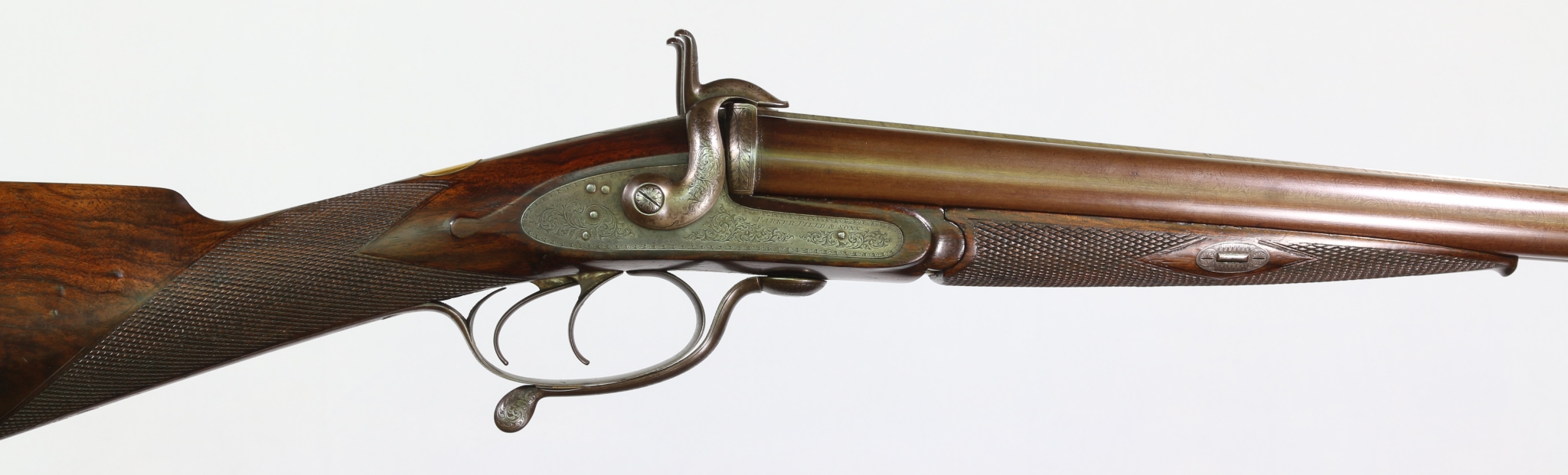
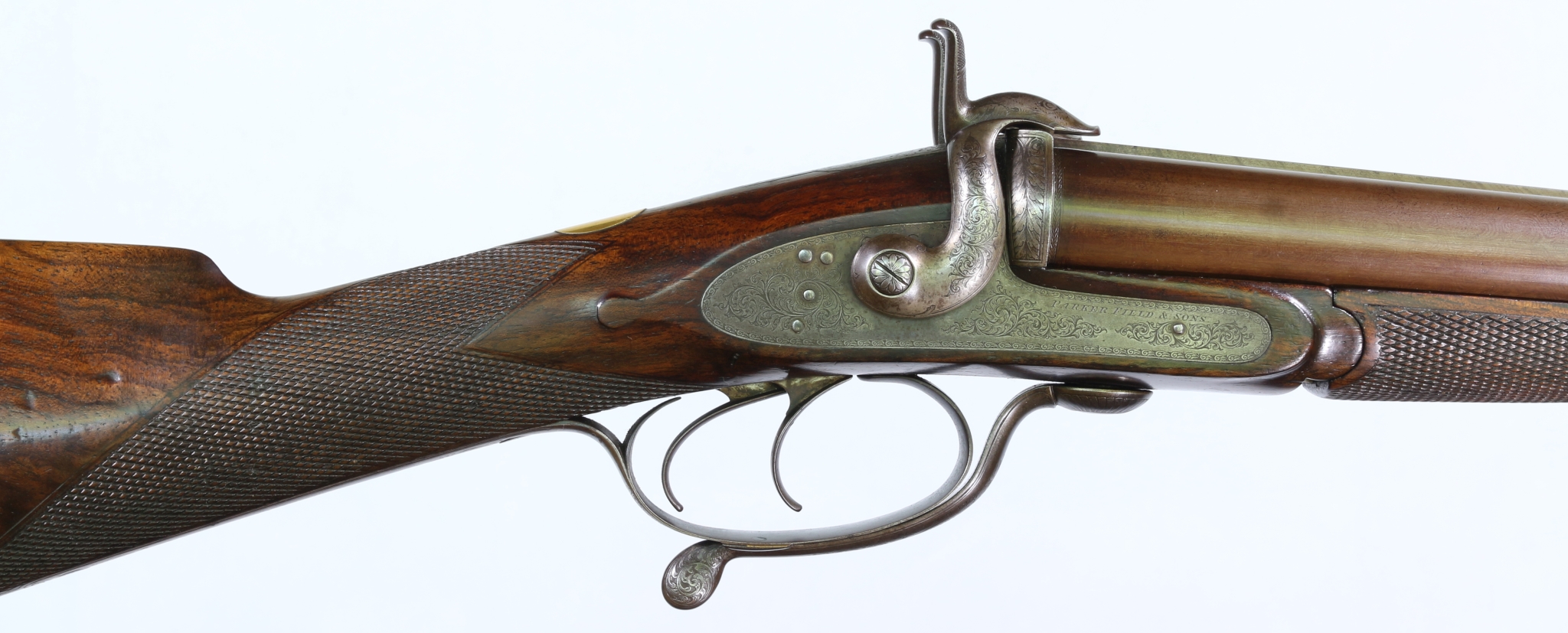
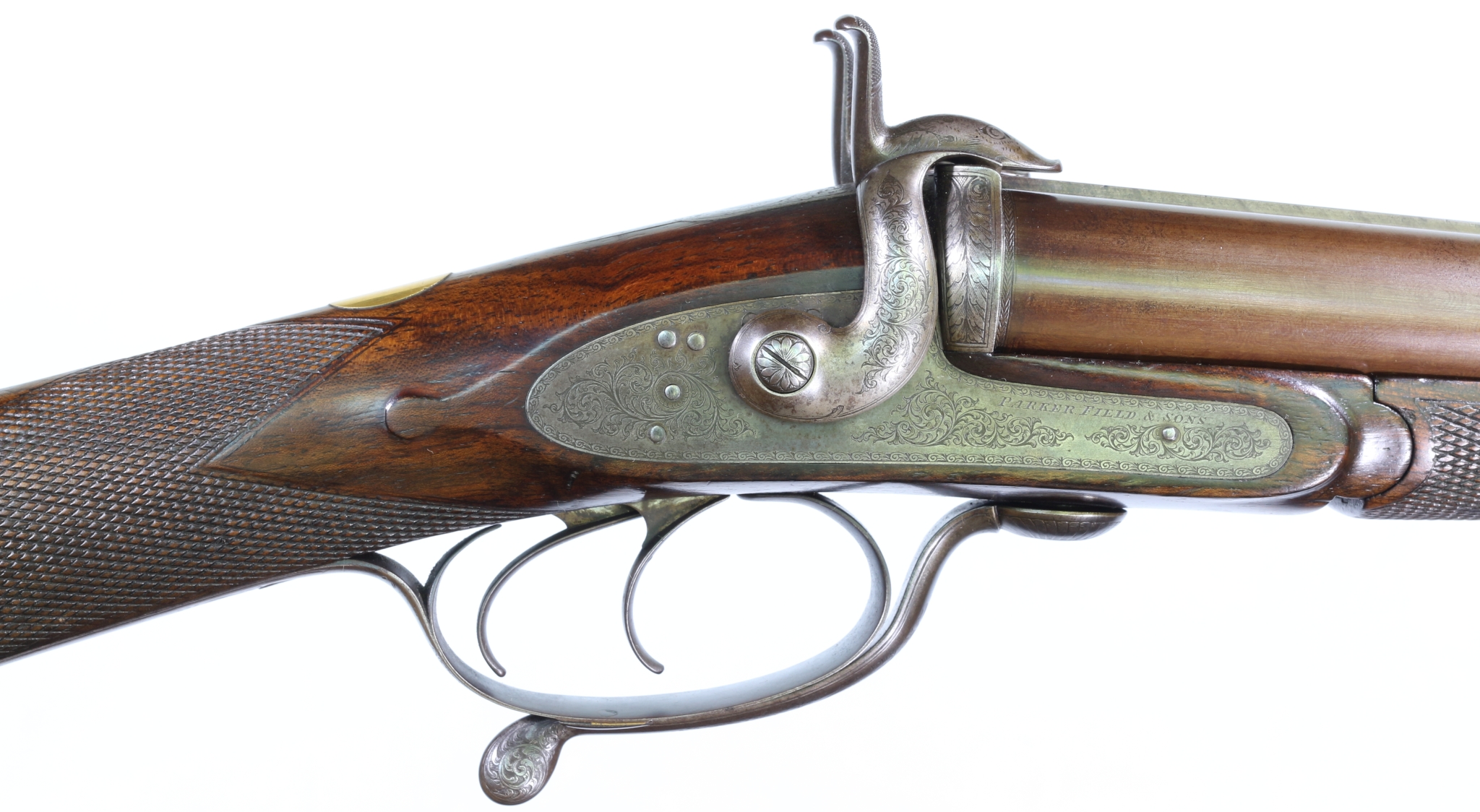
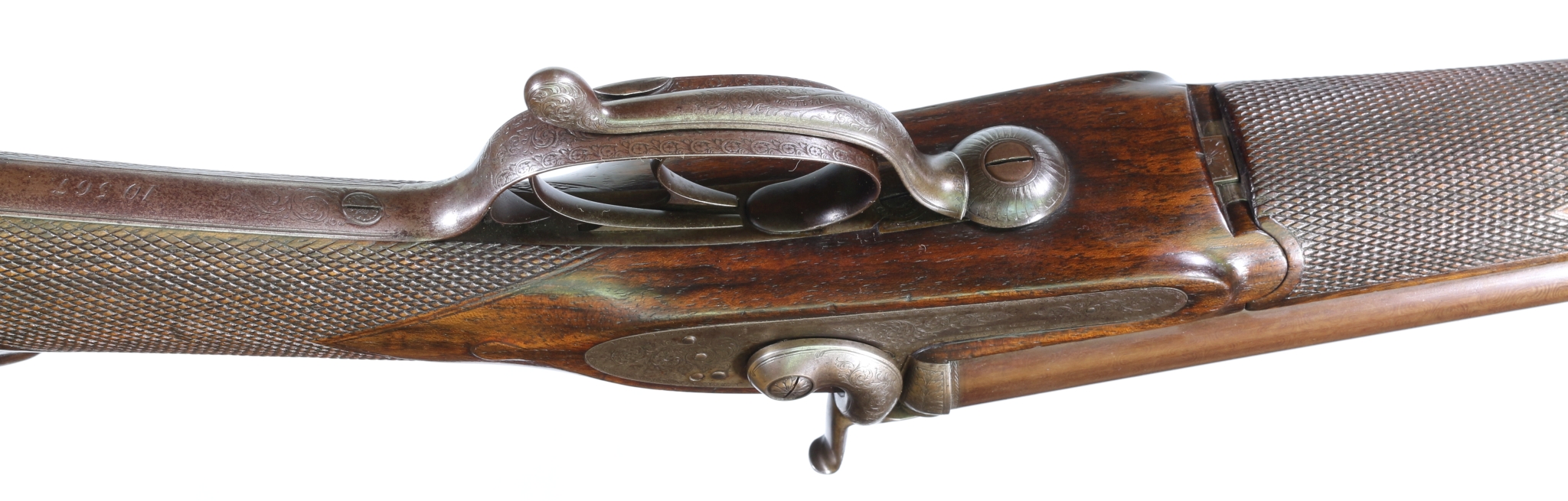
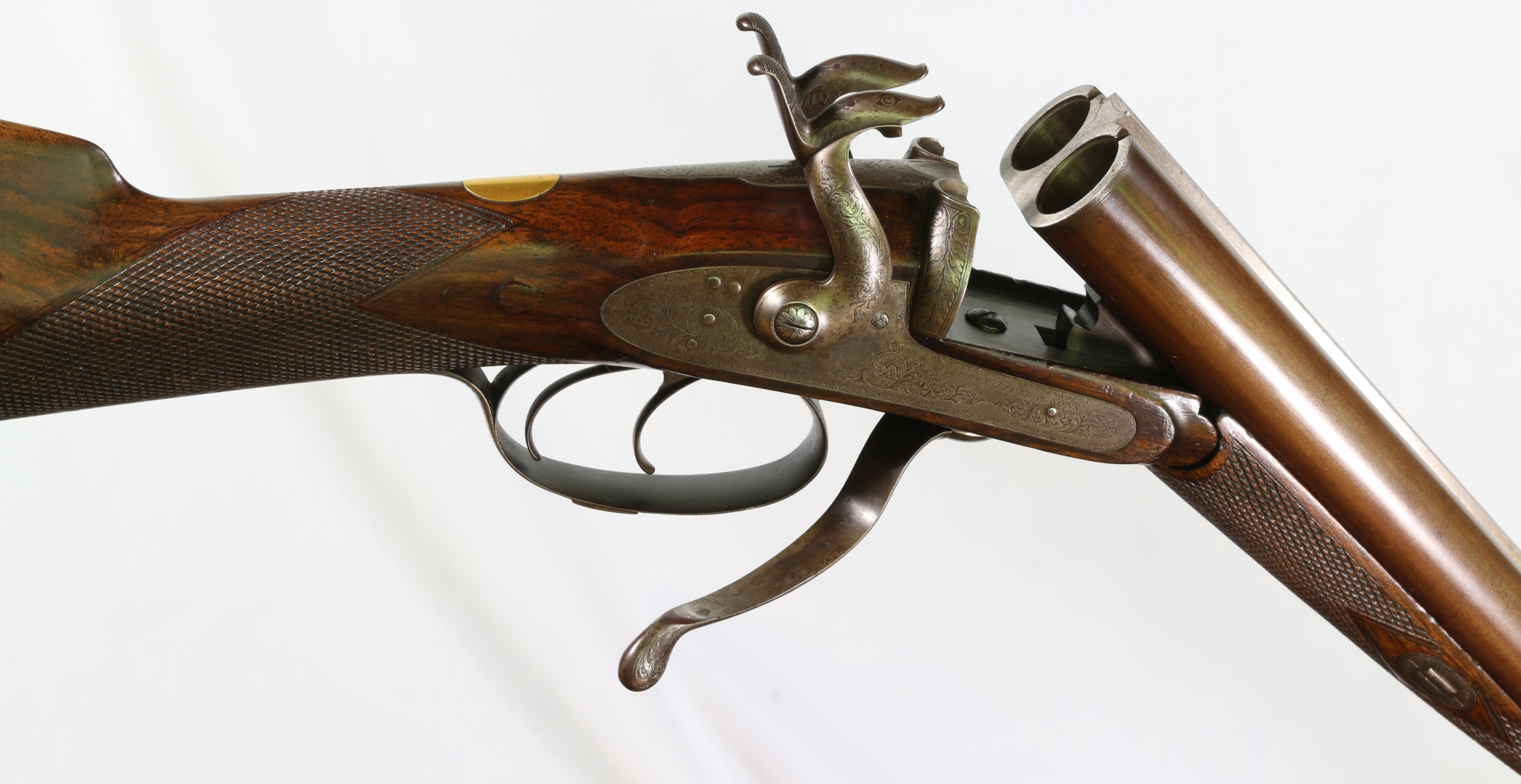
In the pin-fire era, their 'best' offering was a bar-in-wood partial snap-action game gun, shown here. The bar-in-wood construction aimed to hide the hinge and minimize the visual differences between muzzle-loaders and the early breech-loaders. It is a 12-bore, with the top rib signed 'Parker Field & Sons Makers to her Majesty 233 Holborn London' in cursive and 'Field's Patent' within a decorative scroll. The 30" damascus barrels carry the barrel maker's mark 'R.W.,' which I believe is for Robert Wall of 9 Little Compton St., Soho (1864-65). The rotary underlever action is John William Parker Field's patent No. 3485 of December 1862. The action looks like the well-known 'Jones underlever,' but it is quite different. It is a single-bite design with the underlever under spring tension. The gun weighs a tidy 6 lb 15 oz., and the bores are still mirror-bright. The gun still has its original leather-covered case, though it is in poor condition, and the label is darkly stained. Mid-Victorian gunmaking at its best!
No Parker, Field & Sons records survive, so it is impossible to date the gun precisely. However, from known serial numbers, the patent date, and the barrel maker's mark, one can reasonably assume a build date somewhere around 1865. The firm of Parker, Field & Sons was still making percussion guns and even flintlocks at that time, confirming that a maker would make anything the client desired.
Here is the gun in its tired case and label, together with my Great-Grandfather's Parker Field & Sons truncheon, from when he was a police officer in England.
These were hand-made guns, made at simple workbenches, not factories. It was not unusual for a prosperous gunmaker to build fewer than ten a year, and even the most illustrious makers worked hard to move a few dozen in a year, with just a handful of guns being of the highest grade. Apart from the reluctance to try something new, there was the matter of cost – at around 50 guineas for a 'best' quality gun, this represented about two years' wages for a senior army officer. It was no small purchase, even for the wealthy.
Few have seen or handled an original-condition pin-fire game gun because of their natural rarity. This is made worse by the fact that most pin-fires were converted to centre-fire at some point to extend their usefulness in the field, and it takes a sharp eye to spot the conversion. Only the wealthiest could afford to retire a pin-fire gun to a corner of the gun room and buy a new centre-fire without first considering the relatively small cost of conversion.
The American Civil War saw the change from percussion to rim-fire and centre-fire cartridges (though pin-fire revolvers saw much use), and sporting guns bypassed the pin-fire system altogether. Other than a few being carried across the Atlantic in someone's luggage or imported as novelties to a few city retailers, there was no source of pin-fire shotguns in North America. Public interest was in mass-produced factory-made guns, leaving a limited market for high-end pieces, and pin-fire ammunition would have been hard to come by. Most of the pin-fires one might come across in Canada now are later Belgian-made utility guns, not dissimilar to the cheap hardware-store double guns that flooded the low-end market.
Here is a Parker – not the famous American maker, but the English firm of Parker, Field & Sons. It is a name you might find on the lock-plate of a Pattern 1853 Enfield or a converted Snider-Enfield. Parker, Field & Sons is probably best known for its military contracts with the Honourable East India Company and for military Enfield P1853 muskets supplied to both sides in the Civil War. The firm also supplied trade muskets to the Hudson's Bay and North West Companies and equipped police forces with pistols, truncheons, tipstaffs, cutlasses, handcuffs, wrist shackles, leg irons, and "all articles used by police." And yes, they made sporting guns, too. Despite their success, little has been written about Parker, Field & Sons, and even less on their sporting guns. Surviving pieces show off the high quality of their flint and percussion pistols and sporting guns, but very little is known of their pin-fire game guns.
The origins of the business started with John Field, who began as a goldsmith, sword cutler and gun maker in 1783 at 233 High Holborn street in London. When he died in 1791, William Parker partnered with his widow and traded as Field & Parker. In 1814, William's daughter, Mary, married John Field Junior, further entwining the families. William became gun maker to Prince Edward, Duke of Kent and Strathearn (the future Queen Victoria's father), and King William IV. When William died in 1841, John Field Jr and his sons John William Parker Field and William Shakespeare Field started trading as Parker, Field & Sons. Shortly after, the firm received the greatest accolade, becoming gunmaker to Her Majesty Queen Victoria, a recognition the firm made good use of in their case labels and advertisements. The firm ceased business in 1886 after over 100 years in the trade.
In the pin-fire era, their 'best' offering was a bar-in-wood partial snap-action game gun, shown here. The bar-in-wood construction aimed to hide the hinge and minimize the visual differences between muzzle-loaders and the early breech-loaders. It is a 12-bore, with the top rib signed 'Parker Field & Sons Makers to her Majesty 233 Holborn London' in cursive and 'Field's Patent' within a decorative scroll. The 30" damascus barrels carry the barrel maker's mark 'R.W.,' which I believe is for Robert Wall of 9 Little Compton St., Soho (1864-65). The rotary underlever action is John William Parker Field's patent No. 3485 of December 1862. The action looks like the well-known 'Jones underlever,' but it is quite different. It is a single-bite design with the underlever under spring tension. The gun weighs a tidy 6 lb 15 oz., and the bores are still mirror-bright. The gun still has its original leather-covered case, though it is in poor condition, and the label is darkly stained. Mid-Victorian gunmaking at its best!
No Parker, Field & Sons records survive, so it is impossible to date the gun precisely. However, from known serial numbers, the patent date, and the barrel maker's mark, one can reasonably assume a build date somewhere around 1865. The firm of Parker, Field & Sons was still making percussion guns and even flintlocks at that time, confirming that a maker would make anything the client desired.
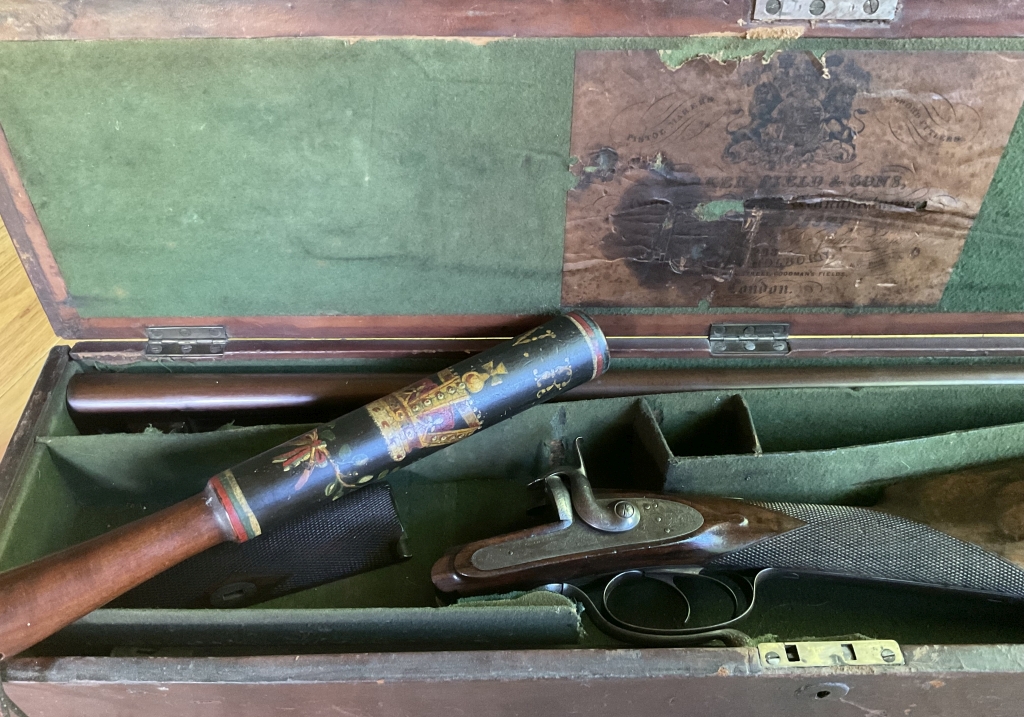
Here is the gun in its tired case and label, together with my Great-Grandfather's Parker Field & Sons truncheon, from when he was a police officer in England.
























