Wasn't sure where to tack this onto.... ....:
....:
http://www.targetsportsmagazine.com/features/view/10316/sniping-remarks-what-a-winchester/
....:http://www.targetsportsmagazine.com/features/view/10316/sniping-remarks-what-a-winchester/
SNIPING REMARKS: WHAT A WINCHESTER
Created on 19th May 2009
NIGEL GREENAWAY looks at the Winchester A5 sniper scope, a model also favoured by the Canadians
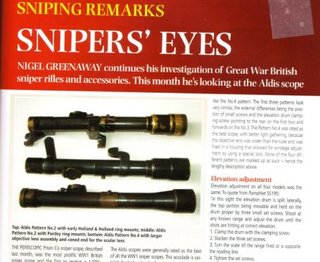
LAST MONTH I described the various patterns of Aldis sniper scopes - the second most prolific WW1 British sniper scope, with a production run of 3,196. This month it is the turn of the Winchester A5 sniper scope - the third most common, with 907 fitted to SMLE rifles. The first contract for 200 was awarded to Whitehead Brothers on 7 October 1915 and the final contract for 500 to the same company on 14 February 1916. Hence it's possible that 1915 and 1916-dated SMLE No.1 MkIII rifles and 1916-dated SMLE No.1 MkIII* rifles were fitted with these scopes.
The Canadians also favoured the Winchester A5, mounted but fitted in the overhead position on the Ross rifle. It is entirely possible that some of these Canadian Winchester A5 scopes were acquired through Canadian channels of supply, as well as those supplied to them by the British on SMLE rifles. Canadian armourers were adept at fitting PPCo, Aldis and Winchester A5 scopes onto Ross rifles, many of which were sporterised with cut down forends and foresights removed (as can be seen in the picture of the Canadian sniper section below). Looking at records of sniper rifles and scopes held by the four Canadian divisions in January 1918 we can see that there were at least two dozen Winchester A5s - a figure regarded as being erroneously low. There were still 32 of the Warner & Swasey scopes in store. These were no longer fitted to rifles and as this was a Canadian and American issue it is not covered in this article.
The Winchester A5 scope was introduced in America in 1909 and remained in production until 1928 - it was a long-term favourite of target rifle shooters. It is 16" long and 0.75" in diameter, with a steel tube, 5x magnification and external ½MOA elevation/windage adjustments. The British specified a crosshair reticle but a few with single crosshair examples are known to exist along with a handful of the slightly shorter 4x magnification Winchester B4 scopes. The scopes sometimes had the rifle's serial number engraved on the side of the steel tube, often highlighted with a red coloured filler in quite large font about 8mm tall. Others have the broad arrow and Enfield examiner's acceptance marks stamped on the mount rings near the base on the opposite side of the clamping screws - but I have yet to see both types of identification used on the same scope.
One of the Winchester A5's drawbacks compared to other British sniper scopes was that it was somewhat fragile: it could easily be knocked out of zero. It also had a narrow field of view; lower light gathering capability which restricted its use at dawn and dusk; and a requirement to pull it back into battery after each shot because the scope moved forward in recoil. Lastly, the external surface of the tube had to be kept scrupulously clean in order for the external adjustments to work properly and consistently. Despite these faults it was a popular and accurate scope praised for its easy windage and elevation adjustments. In fact it was the only British WW1 sniper scope where windage adjustments could be made instantly with the rifle in the shoulder - as long as you had enough light to see - as there were no click adjustments.
Whitehead Brothers fitted the Winchesters in the usual fashion, with a side-mounted system on the left of the SMLE rifle's receiver wall and the front base screwed to the left side of the rear sight protector ears as stipulated by the official contract. As previously discussed this was not conducive to accuracy or easy handling. Hence the Canadians, not prone to obeying stupid rules, were quick to adopt overhead mounts. There is some speculation that the British adopted overhead mounts but nobody today is sure what they looked like or who fitted them. However, an intriguing advert in Parker Hale's 1940 Sporting Section Catalogue (p56) shows what such an overhead combination might have looked like: ‘This bracket was designed by us during the War as a ready means of adapting the Telescope Sight to the SMLE Rifle.' Did it see active service during WW1? Who knows.
Zeroing the Winchester A5
To quote from Pamphlet SS195, Scouting and Patrolling:
‘If shots are going low, raise the rear of the telescope by unscrewing the elevation screw, and vice versa if the shots are going high.
‘If going to the right, move the telescope to the left by tightening the lateral adjustment screw, and vice versa if shots are going to the left.
‘Both screws are graduated in half minutes, one complete turn giving 12.5 minutes. The standards on which these drums operate are marked off with divisions; each division equals 12.5 minutes, or one complete turn of the screw.
‘Test the rifle carefully at 100 yards range, find out the correct elevation and lateral adjustments, then make a note of the scale readings and use them as a zero for the longer ranges, in accordance with the following range table.
‘From 100 yards to 200 yards unscrew five (½MOAs).
From 200 yards to 300 yards unscrew seven.
From 300 yards to 400 yards unscrew eight.
From 400 yards to 500 yards unscrew 10.
From 500 yards to 600 yards unscrew 12 and so on progressively.'
There were other makes of scopes officially fitted to SMLEs and collectively they made up another 855 sights. Some, like the Watts (160+), were fitted by three different companies with three different mounting systems. The next most common was the Evans, of which about 120 were fitted. Space does not allow a full description of these scopes and their mounting systems, so our picture of Roger Payne's incredibly rare Evans scope and overhead mounts will have to suffice.
P14 Mk1*(T)
In last month's article a brief mention was made of the Aldis scopes fitted in overhead mounts on the P14 rifle. The first of these were fitted as early as August 1917 and sample P14 rifles fitted with Aldis scopes were taken to France to get an opinion on the relative merits of the overhead mount fittings. These rifles must have seen action because one was captured - it emerged years later in a British auction house, having been sent by a German arms dealer along with its official capture papers! It is certainly true that the P14 Mk1* W (F), when fitted with a modified fine adjustment rear sight, was used at the sniping schools and recommended for issue on a scale of three per battalion. Some 3,500 were made.
The W stands for Winchester as only Winchester-made rifles were selected for conversion. The sight was modified to accept an elevation screw marked on the head with three lines, each line representing 1MOA. However, it is easy to adjust the sight in ¼ or ½MOAs and some very accurate shooting can be done. Many years ago I was lucky enough to find a couple of dozen of these sights in a large ammunition tin holding about 5,000 P14 rear sights. By the law of averages I figured that I must find a few of the (F) sights - and I did. I can attest to the fact that these are more accurate than scoped SMLEs, having shot in a team equipped with P14(F)s in which I and my teammates never missed the Huns Head targets at 400yd and beat many teams with modern scoped rifles. Ultimately, 2,000 P14(F) rifles were converted by the Periscopic Prism Company and fitted with Model 1918 scope sights in an overhead mount to become the P14 Mk1*W (T). How many of these actually saw service in WW1 is debatable as the new rifle was only approved for service on 11 April 1918 and its specification was not finalised until 31 December 1918.
My thanks to fellow collectors who have sent in pictures and particularly to Roger Payne, a far more knowledgeable guru on WW1 and WW2 British sniper rifles than I will ever be.