










































You are using an out of date browser. It may not display this or other websites correctly.
You should upgrade or use an alternative browser.
You should upgrade or use an alternative browser.
Antique Webley No. 5 Army 450/455 interesting rare gun
- Thread starter DEZ
- Start date


Someone want to clarify for me, WTF a "Triple Action Revolver" is?
As opposed to Single and Double actions?
Good question! IMO the narrator is wrong in calling the Webley a triple action revolver. It's not. It is a double action. There are four ways to describe a revolver action:
single action: you need to #### the hammer using your thumb, and you release it by pulling the trigger.
double action only: the hammer has no spur, and you need to pull the trigger hard to raise the hammer and make it fall at the end of the pulling cycle.
single / double action: (usually just called double action) - you can either #### the hammer with your thumb and then pull the trigger, or you can just pull the trigger and make the hammer rise and fall in one movement of the index finger.
TRIPLE ACTION: this is a rare feature and saw limited use for a while in the late 19th century. There are a few makers who made true "triple action" revolvers - Lefaucheux in France, Nagant and I believe Chamelot & Delvigne had models of this kind. In addition to being able to operate the mechanism as described above (single / double action) the shooter had a third option: by pulling the trigger slowly the hammer could be cocked and locked back in the cocked position until the shooter was sure of his aim, and with a further pull back of the trigger, the hammer would be released. This was supposed to make the shot more accurate rather than pulling the trigger through in one motion. It turned out to be too fickle a mechanism, and was soon abandoned again. I have not heard of any modern revolvers using the triple action design (anyone??). The triple action in early revolvers actually evolved from a second trigger, like in the Starr M1858 Army revolver. In this "double action" design you have to pull the front trigger to #### the hammer, and then move your index finger back to the secondary trigger to release it. A small tab on the back of the forward trigger could be adjusted in such a way that the forward trigger would automatically set off the rear trigger, making it a double-action only revolver. The Starr's hammer could not be cocked single action with the thumb. Starr thought this was genius, and sold a truck-load to the Union Army. They thought it was genius, too, but the decision makers were desk-jockeys and had no idea how it would fare in action. The rank-and-file on the front thought it was a bunch of horse***. They didn't like the newfangled mechanism. It was too cumbersome. The army went back to Starr and told him that if he wanted any further contracts, he better come up with a tried-and-true single action revolver. Starr abandoned the double action design and the new model (1863) was a standard, single-action gun...
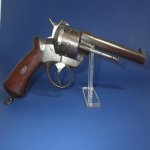
Lefaucheux M1862 "Triple Action"
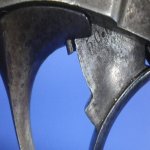
Note the small tab protruding behind the trigger. The hammer will stay cocked until the shooter pulls the trigger all the way, setting off the hammer by way of this tab.
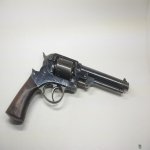
Starr M1858 Double Action. The small tab on the rear of the trigger can be adjusted to act on the rear trigger and set it off all in one movement.
Attachments




vagrantviking
CGN Ultra frequent flyer
- Location
- Southern Alberta
The above is a compelling argument for a definition of triple action. I wonder what Othias would say to that.
As is, I believe he is using triple action to mean single/double action combined but there might be deeper technical issue included in his usage.
As is, I believe he is using triple action to mean single/double action combined but there might be deeper technical issue included in his usage.
Last edited:

gewehr76
CGN Ultra frequent flyer
Triple action is the movement of the hammer away from the primer after striking it, in either single or double action. Almost all modern revolvers are triple action. On some revolvers the triple action occurs after trigger is released and shot is fired or like in M1895 hammer rebounds back right after striking the primer.
This is done for protecting the FP and unlocking /locking the cylinder
M1895 is I believe can be considered as quadruple action as the cylinder moves forward and back to seal the gap in front. Before and after trigger is pulled and released.
Othais at CR did not explain it correctly.
This is done for protecting the FP and unlocking /locking the cylinder
M1895 is I believe can be considered as quadruple action as the cylinder moves forward and back to seal the gap in front. Before and after trigger is pulled and released.
Othais at CR did not explain it correctly.
Double action and Single action are misnomers.
Revolvers used to be described as "Thumb cocking" (like the Colt percussion revolvers") or "Self Cocking" (Like pepperboxes, Deane & Adams 1851 revolvers, Perrin 1858, etc.). If you look at early 1830's-1860's literature, you will never see what we call DA-Only pepperboxes/revolvers called "Double Action", because they were all called "Self Cocking"
Then people came up with the design to have both Thumb Cocking and Self-Cocking, which they called "Double Action", because the revolver had two actions instead of one. At some point the name DA stuck and people started believing "double action" meant that the trigger would perform two actions (#### the hammer and fire the revolver), but that is not historically correct.
So triple action is a complete misnomer as well.
Revolvers used to be described as "Thumb cocking" (like the Colt percussion revolvers") or "Self Cocking" (Like pepperboxes, Deane & Adams 1851 revolvers, Perrin 1858, etc.). If you look at early 1830's-1860's literature, you will never see what we call DA-Only pepperboxes/revolvers called "Double Action", because they were all called "Self Cocking"
Then people came up with the design to have both Thumb Cocking and Self-Cocking, which they called "Double Action", because the revolver had two actions instead of one. At some point the name DA stuck and people started believing "double action" meant that the trigger would perform two actions (#### the hammer and fire the revolver), but that is not historically correct.
So triple action is a complete misnomer as well.
gewehr76
CGN Ultra frequent flyer
Double action and Single action are misnomers.
So triple action is a complete misnomer as well.
You might be on to something here. They call semi autos Automatics.