Any way to tell if primer pocket will be too tight/loose before actually priming?

lavino

CGN frequent flyer
EE Expired
Rating - 100%
2   0   0
My guess would be if you can put the primer pocket cleaning tool in very easily then it might be a bad one? Is that really a good indicator? But then how tight is too tight?

I read that if you felt zero resistance felt with a hand prime tool but if you find out by then you are not able to reuse that primer so you have to deprime it toss and do a new one. (deprime a live primer doesn't sound too much fun to me)

Is there any better way to check? And what if I really got a loose one or a half way really tight one? I assume I still have to deprime them and what is the best way to dispose these used live primers?

I haven't done any yet but good to know before I even start.

 
if you put a unfired primer on the table and you can push the brass down and seat it 50% or more it is too loose (by hand) its done .... unless you can find / use a primer that is a bit bigger
but it is going to the scrap bucket soon

or checking fired brass with primer .... if you put a deprimer rod/ allen key etc. and push on the fired primer and it pops put (by hand) its done ....
 
or checking fired brass with primer .... if you put a deprimer rod/ allen key etc. and push on the fired primer and it pops put (by hand) its done ....

This used to be my test with primed cases before I got the gages. I still use this test after priming. If the primer feels loose when I prime the case, I'll run the case in a Lee decapping die by hand. If the primer pops out I'll toss the case.
 
I keep my ammo in 50 round boxes, and make a check mark inside the box lid each time I reload.

So all the brass in the box ages at the same rate. If I am reloading it and some of the primers go in too easily (I use a hand primer) I throw the bad cases in a box. AT the end of the session, I mark the label on the 50 round box (which now only has 30 rounds in it) SCRAP. Which meas too the brass after this firing.

If there is a fair quantity of primed cases that were not loaded, i deprime them as per usual, and try to catch the live primers to use again. I have done this hundreds, if not thousands of times, and never set one off yet. I doubt I could if aI tried. The saved primers would not be used for match or hunting, but seem to be perfect and get used for non-critical rounds.
 
Last edited:
I keep my ammo in 50 round boxes, and make a check mark inside the box lid each time I reload.


If there is a fair quantity of primed cases that were not loaded, i deprime them as per usual, and try to catch the live primers to use again. I have done this hundreds, if not thousands of times, and never set one off yet. I doubt I could if aI tried. The saved primers would not be used for match or hunting, but seem to be perfect and get sued for non-critical rounds.
This, I also have never set one off ( I`ve been re-loading for 50+ years.)
 
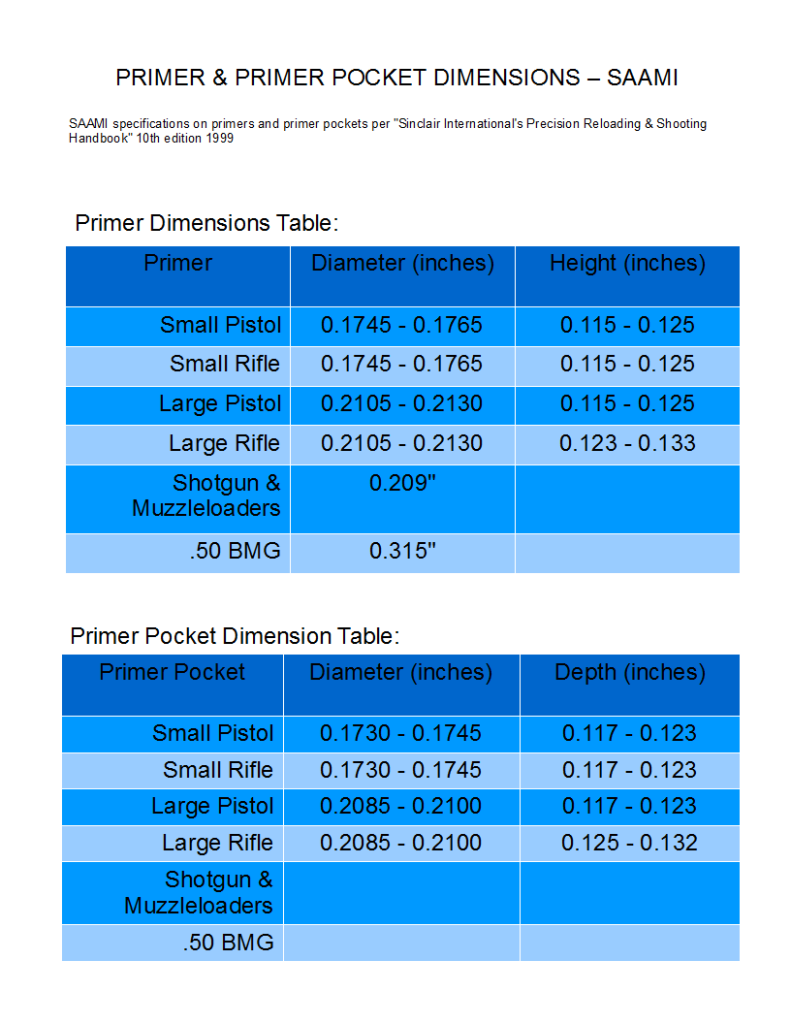
I have the ballistic tool primer pocket gauges and also use pin gauges to check the primer pockets. Just remember primer pocket and primers do vary in diameter and the gauge can be a ball park estimate. Meaning one brand of primer may be loose and another brand of primer be OK.

BlerqTB.png


If I think I have a loose primer pocket after seating a primer I use the Lee depriming tool and if the primer moves with just finger pressure the case is scrapped.

m1PlERq.jpg
 
C-FBMI used to talk about being able to get one more load out of brass with primer pockets that are loosening by seating them with a bench mounted tool which can crush the primer slightly, increasing the diameter of the primer slightly to get a tight enough fit.
 
My guess would be if you can put the primer pocket cleaning tool in very easily then it might be a bad one? Is that really a good indicator? But then how tight is too tight?

I read that if you felt zero resistance felt with a hand prime tool but if you find out by then you are not able to reuse that primer so you have to deprime it toss and do a new one. (deprime a live primer doesn't sound too much fun to me)

Is there any better way to check? And what if I really got a loose one or a half way really tight one? I assume I still have to deprime them and what is the best way to dispose these used live primers?

I haven't done any yet but good to know before I even start.

Not at all primer pocket clean tools are created equal. An aggressive scrubbing with a steel brush cleaning tool could be the reason why your pocket is too loose.

I have a primer pocket depth tool, which cuts the primer pocket to a consistent depth. I use this on virgin brass and once fired factory brass alike. It has the effect of cleaning the primer pocket on the once fired brass. I also clean up the flash holes which can sometimes be very roughly cut. I don't clean primer pockets after that first one because after extensive testing, as long as the flash hole itself is clear, I've never noticed any difference in performance based on a clean or dirty pocket. My long range rifle cases tend to only get 6-8 shots before the next start splitting.

This might be a different situation if I was loading low pressure straight wall cases and getting 20 shots or more out of them.
 
... I have a primer pocket depth tool, which cuts the primer pocket to a consistent depth. I use this on virgin brass and once fired factory brass alike. It has the effect of cleaning the primer pocket on the once fired brass....

What's the make and model of this tool, if I may ask?
 
Having first hand experience at having a bolt face gouged, when a primer failed to seal the gases in a 300 Win Mag, I couldn't help but read the thread.

It's not hard to be ambushed by an expanded primer pocket. In my instance, the load was not excessive, but the brass was from fellow shooter. His load had to have been a bit on the warm side. There weren't any signs, brass sized easy enough, primers pop'd out normally, new primers seated firmly. Unfortunately the primer pocket had expanded near the flash hole, so only a small part of the primer was in contact with the walls of the pocket. When the firing pin struck the primer, and drove it forward, some of the seal was lost, and the leaking gas cut through the primer on the edge and that hole made a bigger leak.


And so, yet another battle scar on the beast. Fortunately the damage was far enough from the firing pin hole that the rifle was still safe to fire, but a bit more and it would have been a different story.

Nitro.
 
Every time I prime a case, I pay attention to how much force it takes to press a primer in. If I get one that feels really soft, like the primer just slipped in, I mark it with an X on the case head and it goes in the garbage after its shot. Otherwise if you want to spend lots of time reloading, there are the gauges you can check every case.
 
Back
Top Bottom