












































You are using an out of date browser. It may not display this or other websites correctly.
You should upgrade or use an alternative browser.
You should upgrade or use an alternative browser.
Anybody seen one of these before????
- Thread starter Missing Something
- Start date




Identify Item
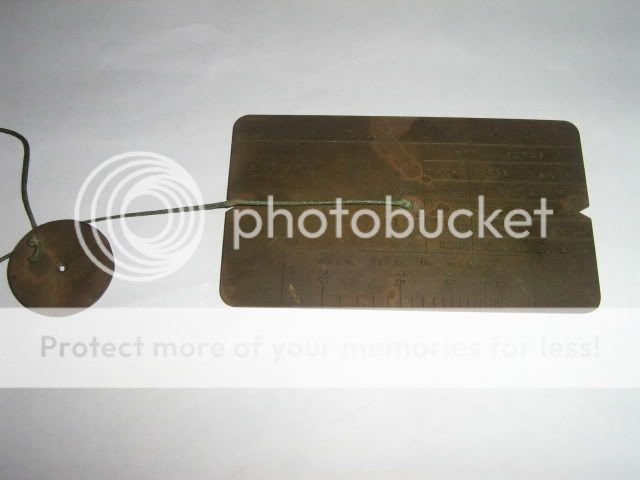
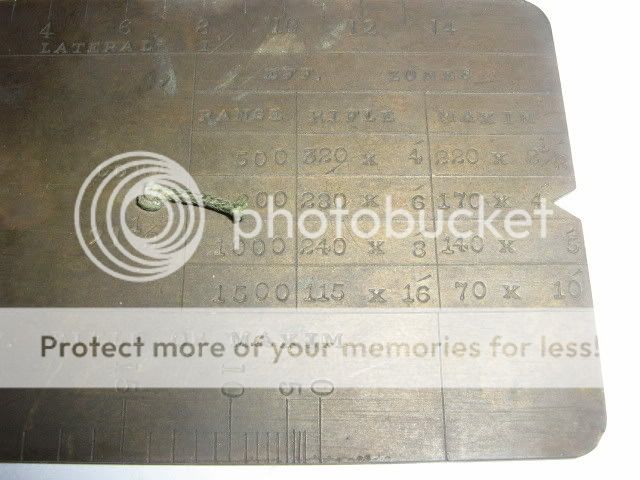
It's for a rifle and Maxim Machine gun. Probably made for range and combat conditions has the distance and elevation and bullet drop info. It loks like it's made of the same material as the British or Canadian dog tags The reason for the color is not to give away a position,
It's for a rifle and Maxim Machine gun. Probably made for range and combat conditions has the distance and elevation and bullet drop info. It loks like it's made of the same material as the British or Canadian dog tags The reason for the color is not to give away a position,


NavyShooter
CGN Ultra frequent flyer
- Location
- XMU Local .303
See anything on this page that it might be able to interface with?
http://www.vickersmachinegun.org.uk/acc-sightingkit.htm
NS
http://www.vickersmachinegun.org.uk/acc-sightingkit.htm
NS
I'd guess it's a Musketry Rule of some sort, for estimating angles and correcting elevation settings from observation of fire. The string with the disc is to ensure you hold it at the correct distance from the eye. May also have a role in generating safety angles for overhead fire.

This looks like an aiming card for a sustained fire or indirect fire application. The range of the enemy would be estimated or determined by splash and the MG would be adjusted and locked to have bullets land there.

NavyShooter
CGN Ultra frequent flyer
- Location
- XMU Local .303
Ok,
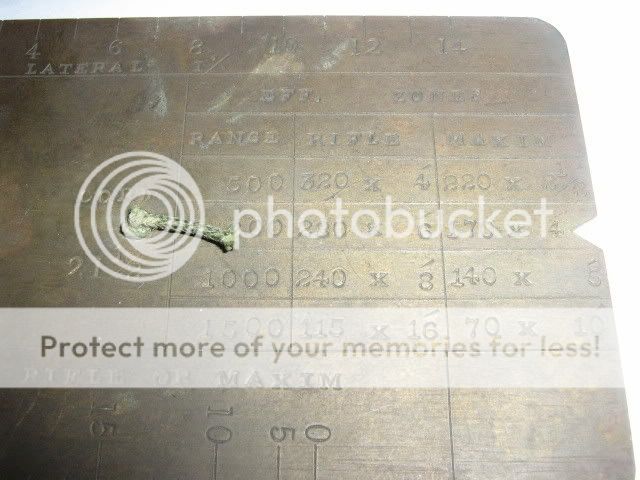
It appears to me that the chart on the right describes the size of a beaten zone. You'll note that as the range increases, the size of the box decreases, this is normal with plunging fire, as would normally be used at longer ranges.
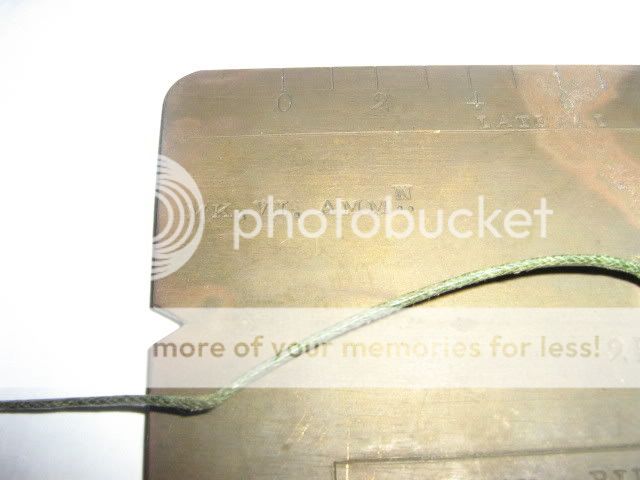
Across the top is a scale allowing you to judge windage against a tripod, and across the bottom would be a guide for setting elevation, using either volley sights on a rifle, or the MG's sight.
I'd think this might be a tool used by either a MG Section commander, or infantry section commander prior to engaging in a long-range supporting fire, to ensure that his personnel would have their sight settings correct. Kinda like a little aide-memoire for long-range machine-gun fire.
As to the little tab attached by a string? No idea.
NS
It appears to me that the chart on the right describes the size of a beaten zone. You'll note that as the range increases, the size of the box decreases, this is normal with plunging fire, as would normally be used at longer ranges.
Across the top is a scale allowing you to judge windage against a tripod, and across the bottom would be a guide for setting elevation, using either volley sights on a rifle, or the MG's sight.
I'd think this might be a tool used by either a MG Section commander, or infantry section commander prior to engaging in a long-range supporting fire, to ensure that his personnel would have their sight settings correct. Kinda like a little aide-memoire for long-range machine-gun fire.
As to the little tab attached by a string? No idea.
NS
This reminds alittle of old photographic flash ranging devices. These were from the 1920s and 30s.
It appears that you look through the pinhole and align with the bottom of the notch but I have no idea what the outcome is supposed to be unless a fixed object would fill the pinhole view or notch at a defined distance.
Regards,
John
It appears that you look through the pinhole and align with the bottom of the notch but I have no idea what the outcome is supposed to be unless a fixed object would fill the pinhole view or notch at a defined distance.
Regards,
John

Just my .02, but the term "Maxim" dates it more to the Boer War or earlier, as does the reference to MkVI, rather than MkVII ammunition. Interesting how the length of the beaten zone decreases as the range increases, due to the steepening of the bullet's trajectory; literally 'plunging fire' at 2000 yards. No acceptance or inspection/ownership marks, so made up 'locally' as the saying used to go.
Last edited:

Missing Something
Regular
Ok, here is what I found out:
What you have is the fore-runner to the Vickers MG slide rule. The brass disc is held to the eye and the line is stretched to arms length and you sight through the vee. The later slide rules had moving scales that could be used for direct comparision, whereas your one would have to be judged off the scales stamped on the brass. A very nice item that would be right at home in my MG collection, should you wish to dispose of it! The slide rules were introduced to replace the old range tables, but were complicated to use. The Vickers dial sight replaced them to a large degree. I have seen no reference to your range plate in any book, but it is obvious what it is when compared to the later slide rules which were first introduced about 1923. Your range plate was probably made during WW1, but not an official issue item.






















