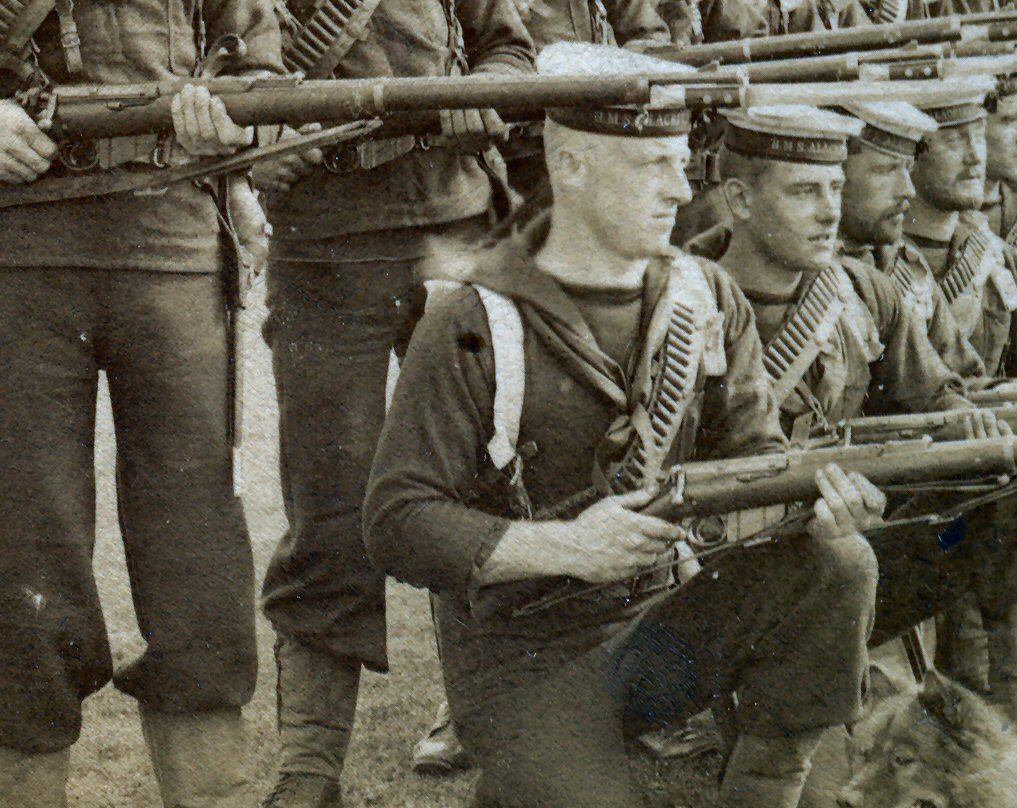
Just reading-up on this particular period of time  , esp. as it show-cased many of the WWI rifles in a non-European theatre......
Any comments/resources?
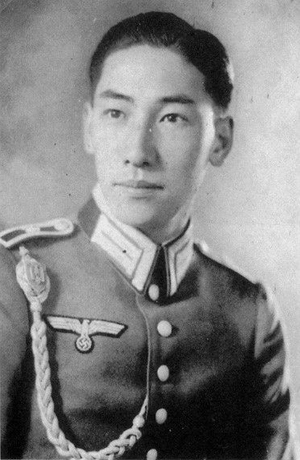
I've got this so far, for the German troops.....
Edit: If you have a "pop-up blocker" on your computer, that site ought to be safe to go to, but I'll reproduce it here, anyhow!...
, esp. as it show-cased many of the WWI rifles in a non-European theatre......Any comments/resources?
I've got this so far, for the German troops.....
Edit: If you have a "pop-up blocker" on your computer, that site ought to be safe to go to, but I'll reproduce it here, anyhow!...
German Forces in the Boxer Rebellion
August 14, 2010
Private, German Third Seebataillon
The German Navy maintained three battalions of marines to protect its foreign naval bases. During the Boxer Rebellion, the 3rd Seebataillon left its station at Tsingtao and fought with the Allies against the Chinese. Full dress uniform for these troops consisted of a medium blue jacket and trousers. The jacket had white Swedish cuffs and white shoulder-straps. The collar and cuff slashes were yellow. The trouser seam stripes were also white. A Jäger shako bore a gilt eagle badge and black-white-red national cockade. A more comfortable and practical khaki uniform was worn in summer. This uniform lacked all distinctions except for white shoulder-straps. On the straps in yellow were the Imperial crown over crossed anchors above the Roman numeral of the unit—in this case ‘III’. The shako was replaced with a white cork helmet with a white metal badge consisting of a crowned Imperial eagle on an anchor. Below the badge was a small national cockade. A khaki cover for the helmet was issued but not always worn. Arms consisted of a 7.92mm. M98 rifle and bayonet.
Private, German East Asia Brigade
The East Asia Brigade was formed and outfitted quickly in Germany during the summer of 1900. The uniforms were officially field grey, but differences in materials, dye batches and suppliers created a wide variety in the shades worn by the troops. In general, the jacket (litewka) was of a slightly darker shade than the hat or trousers. Only in the cavalry does the colour of the tunic appear to be lighter than the trousers.
The hat was made of grey felt and trimmed along the edge of the brim with poppy red (light green for Jägers). The hat band was in the branch colour (white for infantry; light green for Jägers; poppy red for cavalry; black with poppy red trim for artillery, pioneers and railroad troops), but photographs indicate that this was not worn in China. The hat was turned up on the right side and a black-white-red national cockade was attached to the upper edge of the turned-up brim. Beneath the national cockade was worn a small cockade from the soldier's home province, in this case the blue-white-blue of Bavaria.
The model 1892 litewka is of field grey cloth and is fastened down the front by six horn buttons. There are four large pockets on the front of the jacket and, unusually, two in the rear. The two lower front pockets were intended to carry cartridges, and were lined with leather to improve wear. The collar, front seam of the jacket and pocket flaps were trimmed in poppy red for all branches except Jägers, who had light green trim. The shoulder-straps were reversible for either field or garrison duty. When in the field, the straps were field grey trimmed with poppy red (light green for Jägers). For garrison duty, the shoulderstraps were of a solid colour in the unit's branch colour—white for infantry, light green for Jägers, poppy red for cavalry, artillery, pioneer and railroad troops. The shoulder-straps of the infantry bore the unit's number embroidered in red. Artillery had a red grenade, pioneers a red 'P' and railroad troops a red 'E' and lightning bolt.
Boots were of red-brown leather. All other belts and pouches were of 'greenish-brown' leather. A bread sack was worn on the left hip and a canteen on the right hip. The rifle was the Model 1898 Mauser, which fired a five-round clip. Each of the cartridge pouches carried three clips for the rifle.
cyclonic notation: given that the website's pictures shows at least 8 such cartridge-pouches on a single webbing-rig, we're talking about at least 120 rounds per soldier!
For summer service a light-weight khaki uniform and tropical helmet with khaki cover were issued. The cut and style of this uniform was very similar to that of the German Seebataillon . Shoulder-strap colours for garrison and field duty remained the same for the khaki uniform. The Jägers adopted a strange flat-topped sun helmet for their tropical kit, apparently attempting to pattern it after their shako.
In China at the start of hostilities were the 3rd Seebataillon (1,126 men), one battery of Marine Horse Artillery (111 men), the Kommando Detachment (800 men, some mounted), and sailors from the East Asian Squadron. The East Asia Brigade which was sent to China with Graf von Waldersee consisted of two infantry brigades, each of two regiments, each of two battalions of 812 men each. There was a mounted regiment of Ulans (600 men), a field artillery regiment of three gun and one howitzer batteries, and a pioneer battalion with telegraph and railroad engineer companies. The East Asia Brigade also contained sanitation, train, munitions and other support troops.
Last edited:


 :
: