












































You are using an out of date browser. It may not display this or other websites correctly.
You should upgrade or use an alternative browser.
You should upgrade or use an alternative browser.
Belted Mag Headspace
- Thread starter Robmcleod82
- Start date
Did some experimenting trying to get a 300wm to headspace on the belt vs the shoulder. Here is a video with my findings.
https://youtu.be/3x9OEhMfC6o
The reason you couldn't headspace off the belt is that your FL sizing die combined with the shell holder does not allow the shoulder to be pushed far enough back. But there is absolutely no reason to want to headspace off the belt, so it is not a problem. You want to headspace off the shoulder. Ideally you just want enough headspace at the shoulder to just allow the bolt to close easily.

The second icon from the right is the one to post a YouTube video. Did it for you.
Your measurements all assume the brass manufacturer has put the belt on the case at the correct place. With American brass that is often not correct.
Personally, I just FL size enough to make the brass chamber. This means it is headspacing off the shoulder. It lasts longer that way. The exception is 300 H&H. It does not have much of a shoulder.
Your measurements all assume the brass manufacturer has put the belt on the case at the correct place. With American brass that is often not correct.
Personally, I just FL size enough to make the brass chamber. This means it is headspacing off the shoulder. It lasts longer that way. The exception is 300 H&H. It does not have much of a shoulder.
Last edited:

The belted case is a British design dating back to a time of cruder manufacturing. The British used cordite powder that looked like long strings of spaghetti, the powder was placed in the case "before" the case shoulder and neck were formed. This meant the belt allowed for more deviation or sloppiness at the from end of the case.
Bottom line, on a rimmed or belted case let the case headspace on its shoulder to prevent case stretching in the base web area.
Below a .303 British case in a fatter and longer military chamber.
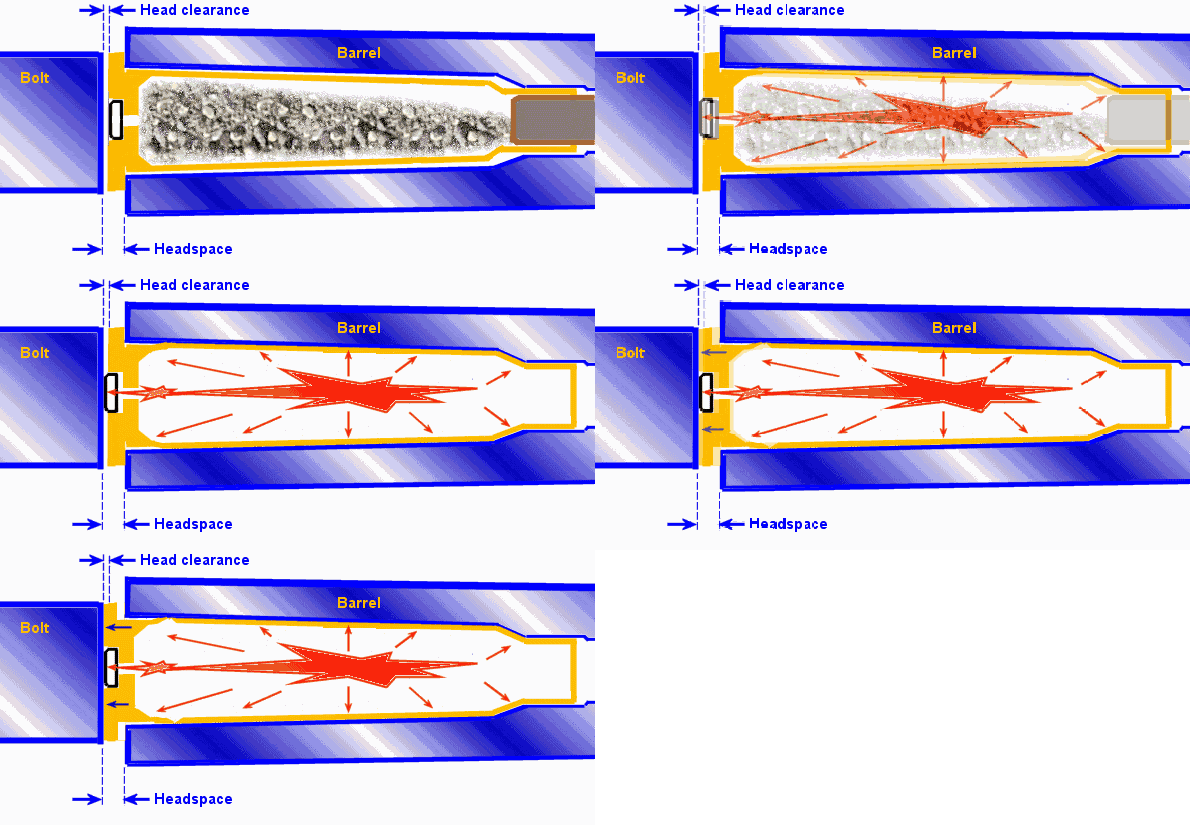
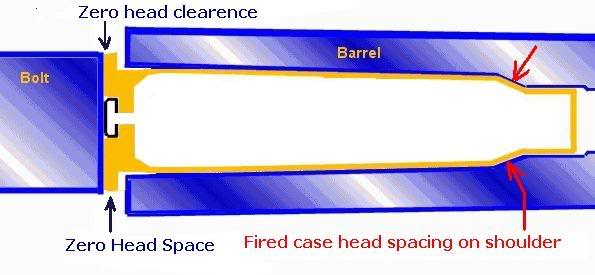
Bottom line, on a rimmed or belted case let the case headspace on its shoulder to prevent case stretching in the base web area.
Below a .303 British case in a fatter and longer military chamber.
Yes I understand that and said it at the end of the video. Seems to be many people that believe that it's commonly possible to do with plain reloading dies. Probably could be done with competition shell holders. Would be a good way to ensure case head seperation as well.The reason you couldn't headspace off the belt is that your FL sizing die combined with the shell holder does not allow the shoulder to be pushed far enough back. But there is absolutely no reason to want to headspace off the belt, so it is not a problem. You want to headspace off the shoulder. Ideally you just want enough headspace at the shoulder to just allow the bolt to close easily.
Thanks for that, have to use that icon next time.The second icon from the right is the one to post a YouTube video. Did it for you.
Your measurements all assume the brass manufacturer has put the belt on the case at the correct place. With American brass that is often not correct.
Personally, I just FL size enough to make the brass chamber. This means it is headspacing off the shoulder. It lasts longer that way. The exception is 300 H&H. It does not have much of a shoulder.
None of my measurements assume anything hence why I measured everything. Most brass I measured was between .208-.218 from case head to top of belt. Drawing spec is .220. Never seen a piece on spec yet.
Thanks for that, have to use that icon next time.
None of my measurements assume anything hence why I measured everything. Most brass I measured was between .208-.218 from case head to top of belt. Drawing spec is .220. Never seen a piece on spec yet.
Me neither, with American brass.
Yes I understand that and said it at the end of the video. Seems to be many people that believe that it's commonly possible to do with plain reloading dies. Probably could be done with competition shell holders. Would be a good way to ensure case head seperation as well.
Competition shell holders will bump the shoulder back from .002 to .010 "LESS" than a standard shell holder. Meaning using them will help "prevent" case head seperations and force your belted case to headspace on its shoulder and not the belt.
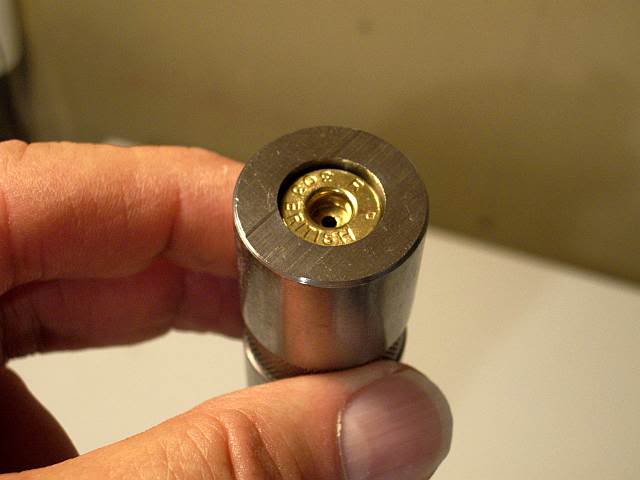
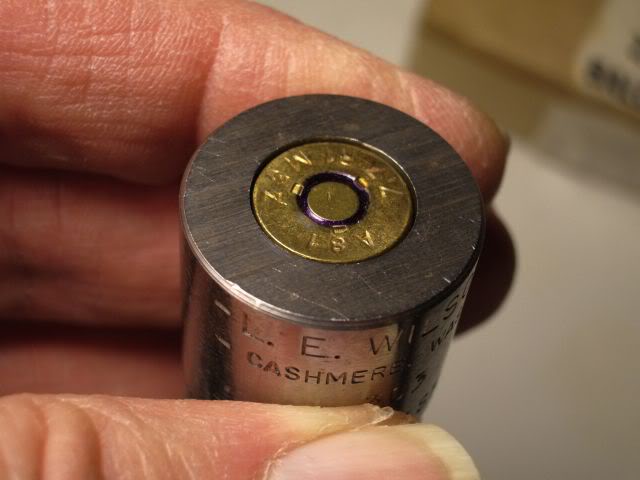
Below is a new unfired Remington .303 British case in a Wilson case gauge. This case would drop in further but the rim is keeping it from going in futher. Meaning the factory shoulder location is very far off from where it should be.
Below is a fired case and the amount sticking above the gauge is how far the die will push the shoulder back when full length resized.
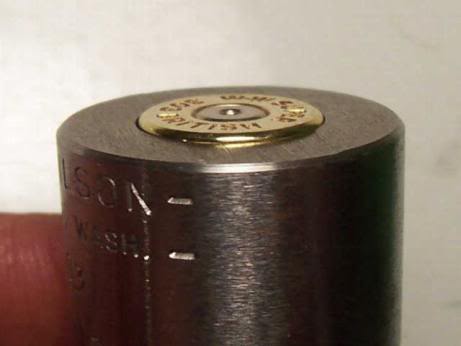
The same will happen to any belted case, and why you should use the Hornady cartridge case headspace gauge and measure the fired location of the case shoulder. And then set the die up for .001 to .002 shoulder bump. This can be done with feeler gauges, Skips shims under the dies lock ring or with competition shell holders.
So do not worry about the belt or rim and let the case shoulder hold the base of the case against the bolt face.
I always set my dies for a 2-3 thou bump. That's pretty wild with that 303 case even being a rimmed case. On those Wilson case gauges would flush be "perfect" size on spec with drawing? I would imagine if your chamber was a bit bigger in diameter than the gauge it wouldn't be much help, or do they just run with the shoulder as the point it measures from and leave the body diameter large?Competition shell holders will bump the shoulder back from .002 to .010 "LESS" than a standard shell holder. Meaning using them will help "prevent" case head seperations and force your belted case to headspace on its shoulder and not the belt.
Below is a new unfired Remington .303 British case in a Wilson case gauge. This case would drop in further but the rim is keeping it from going in futher. Meaning the factory shoulder location is very far off from where it should be.
Below is a fired case and the amount sticking above the gauge is how far the die will push the shoulder back when full length resized.
The same will happen to any belted case, and why you should use the Hornady cartridge case headspace gauge and measure the fired location of the case shoulder. And then set the die up for .001 to .002 shoulder bump. This can be done with feeler gauges, Skips shims under the dies lock ring or with competition shell holders.
So do not worry about the belt or rim and let the case shoulder hold the base of the case against the bolt face.
Yes I understand that and said it at the end of the video. Seems to be many people that believe that it's commonly possible to do with plain reloading dies. Probably could be done with competition shell holders. Would be a good way to ensure case head seperation as well.
Actually Redding's competition shell holders are thicker than normal in 0.002" increments. They reduce your headspace, not increase it.
As far as standard dies and shell holders being able to do it, that will depend on the chamber in your gun and how much headspace it has. If it has a maximum SAAMI dimension to the shoulder a standard die may allow you to headspace on the belt, by creating excessive headspace at the shoulder.
I always set my dies for a 2-3 thou bump. That's pretty wild with that 303 case even being a rimmed case. On those Wilson case gauges would flush be "perfect" size on spec with drawing? I would imagine if your chamber was a bit bigger in diameter than the gauge it wouldn't be much help, or do they just run with the shoulder as the point it measures from and leave the body diameter large?
Below is South African surplus .303 British and right at minimum headspace by the American SAAMI Wilson gauge. "BUT" the military chambers shoulder is approximately 1/8 of an inch further forward of this.
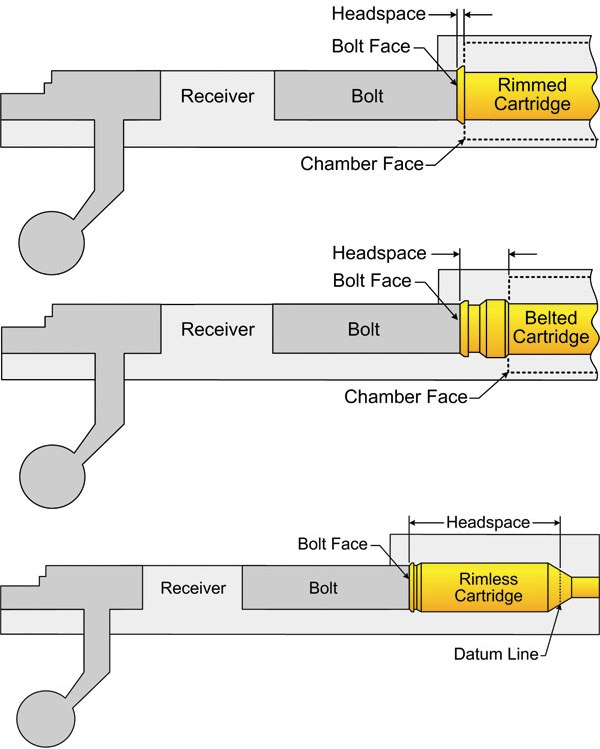
Bottom line, it doesn't matter if the case is rimmed, belted or rimless, they all should headspace off the case shoulder for longer case life. You can't move the case rim or belt but you can put the case shoulder where you want it to be.
And again the old manufacturing methods used before 1900 are long gone and the rim and belt are long in the tooth and from another era.
Find and read "The Enfield Inch" story and how many problems the American company of Pratt and Whitney had in setting up the machinery to manufacture Enfield rifles in Australia.
A British inch was so many kernels of corn, so many grains of barley, etc. Meaning Pratt & Whitney had to find out how long the British inch actually was before the machinery could be made. Needless to say there was less hand fitting done on the Australian Lithgow Enfield rifles than British made rifles at the turn of the 20th century.
On a .303 military Enfield rifle with a case rim thickness of .058 at maximum military headspace you will have .016 head clearance or air space between the rear of the case and the bolt face.
On a 300 Winchester Magnum at maximum headspace and the thinest belt you will have .015 head clearance.
With the 300 WM and using the case shoulder to headspace off of and .002 shoulder bump you will have .002 head clearance. Meaning the distance the case can stretch to meet the bolt face.
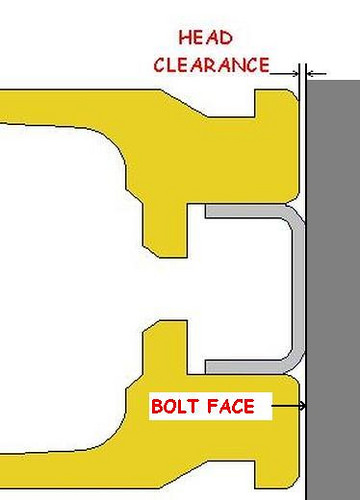
So again forget the rear end of the rimmed and belted cases and let the case headspace off the shoulder. And have the shoulder hold the rear of the case closer to the bolt face.
On a 300 Winchester Magnum at maximum headspace and the thinest belt you will have .015 head clearance.
With the 300 WM and using the case shoulder to headspace off of and .002 shoulder bump you will have .002 head clearance. Meaning the distance the case can stretch to meet the bolt face.
So again forget the rear end of the rimmed and belted cases and let the case headspace off the shoulder. And have the shoulder hold the rear of the case closer to the bolt face.
Actually Redding's competition shell holders are thicker than normal in 0.002" increments. They reduce your headspace, not increase it.
As far as standard dies and shell holders being able to do it, that will depend on the chamber in your gun and how much headspace it has. If it has a maximum SAAMI dimension to the shoulder a standard die may allow you to headspace on the belt, by creating excessive headspace at the shoulder.
Dear Ron AKA
The competition shell holders are not thicker, the deck hight of the shell holder is lower in .002 increments and and being lower it does not push the case as far into the die. The thickness remains the same as a standard shell holder. And you simply change the shell holder without moving the die to change the amount of shoulder bump.
P.S. Do you always repeat what other posters have already stated or do you enjoy being a parrot.
Was sunray this bad????
Last edited:
I completely understand headspace. This was all because of a thread about guys saying they dont set their dies to headspace off the belt on 7mags 300s ect on another forum and I didnt really know if a guy could even do it with normal dies and shell holders. So enter the tests, hence why i was measuring head space gauges belts brass ect. just thought some people might find it interesting is all. These days it seems more like I chamber more rifles than i get to shoot haha. Range day friday and all ammo involved has been headspaced off the shoulder 






















