Best COAL :-(

klink1983

CGN Regular
EE Expired
Rating - 100%
27   0   0
I tried using a trick my buddy told me about to determine my COAL before my projectile would actually touch the lands, and then back off 3-5 thousandths.

I'm chambering a piece of brass with cuts in the neck with my desired projectile. I did it 5 times and got numbers not even close to each other. :-(

I'm wondering if anybody else has tricks or if I should just stick with factory COAL for now.....
 
sounds like your trying to get the COAL by pushing the bullet against the lands to see how far back it would be seated.
this method will only work for that specific bullet model.
if you have a tool to measure from the ogive than you can apply that measurement to all your bullets since that is the distance from the base of the cartridge to the lands.
 
No comparator or anything else fancy. For now my goal is to create template rounds for each projectile (I only use 2 at the moment) to set up my die. I don't even know what an ogive is. (New reloading guy)

Rifle is a Remington 700AACSD chambered in .308
 
sounds like your trying to get the COAL by pushing the bullet against the lands to see how far back it would be seated.
this method will only work for that specific bullet model.
if you have a tool to measure from the ogive than you can apply that measurement to all your bullets since that is the distance from the base of the cartridge to the lands.

He is correct.

Keep in mind with the way you are doing it (similar way I do it) you have to be VERY careful taking the round out. Hold the projectile off the action wall and then let the spring pull it out into your hand. Brass that's been fired may hold a projectile, but I what I do is press one in and then pull it apart a few times till I get the desired tension.

Now, to get accurate you have to watch for contact with the lands. Use a marker, insert, measure, take down a little bit, marker up, insert, take down if still there, etc till you find when it doesn't touch. THEN, measure your COAL. This COAL is now only for THAT bullet. Tips vary quite a bit. Measure what it is, press it whatever distance off the lands you want, mark both lands and distance off lands measurement on the round and leave it alone. You can use this to set up your new rounds now because the press pushes further down on the projectile and not the tips. It's a bit more accurate.

I always mark down the COAL of THAT projectile touching lands. Then measure what it's currently at and it's corresponding distance off lands. Then you know, or if it drops on the ground or something you can pull it apart and press to required COAL (provided it didn't land on the tip)

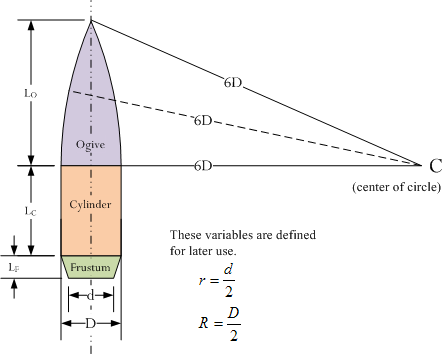
Ogive is the spot on a bullet where your projectile touches the lands. It's kinda the shape, but people usually refer to it as THAT spot where it touches. There will be a spot on every bullet where it contacts the lands around it's circumference. Some further back then others. That location on the projectile's distance from cartridge base will be the exact same on all projectiles. A short section of barrel can be used, or lots of people buy comparators which mount on calipers.

I owned a AAC-SD. They have long throats like most Rem 700's. (my 208's are over 3" long)

 
Last edited:
A picture is worth 1000 words! 2000 with my ramblings..

spitzer2.png


About 80% of the way up the ogive your bullet will no longer "fit" in the barrel. That's the point most people call ogive. From there to the cartridge base will remain constant with all projectiles. You can then set-up your desired distance off lands measurements.
 
He is correct.

Keep in mind with the way you are doing it (similar way I do it) you have to be VERY careful taking the round out. Hold the projectile off the action wall and then let the spring pull it out into your hand. Brass that's been fired may hold a projectile, but I what I do is press one in and then pull it apart a few times till I get the desired tension.

Now, to get accurate you have to watch for contact with the lands. Use a marker, insert, measure, take down a little bit, marker up, insert, take down if still there, etc till you find when it doesn't touch. THEN, measure your COAL. This COAL is now only for THAT bullet. Tips vary quite a bit. Measure what it is, press it whatever distance off the lands you want, mark both lands and distance off lands measurement on the round and leave it alone. You can use this to set up your new rounds now because the press pushes further down on the projectile and not the tips. It's a bit more accurate.

I always mark down the COAL of THAT projectile touching lands. Then measure what it's currently at and it's corresponding distance off lands. Then you know, or if it drops on the ground or something you can pull it apart and press to required COAL (provided it didn't land on the tip)

Ogive is the spot on a bullet where your projectile touches the lands. It's kinda the shape, but people usually refer to it as THAT spot where it touches. There will be a spot on every bullet where it contacts the lands around it's circumference. Some further back then others. That location on the projectile's distance from cartridge base will be the exact same on all projectiles. A short section of barrel can be used, or lots of people buy comparators which mount on calipers.

I owned a AAC-SD. They have long throats like most Rem 700's. (my 208's are over 3" long)

Thanks for doing the typing.
 
Do yourself a favor and get a oal gauge and a bullet comparator. Both very handy tools to have. Makes measuring oal way more repeatable. I have measured some bullets that are .020+ difference in length.
 
I took a spent shell casing that was fireformed in my rifle. Ran it through my neck sizing die making sure that it was not overly tight fit but snug enough that you needed firm pressure to slide the bullet into the case.
With the bullet seated just barely into the case, I took a Sharpie and drew a witness mark on the bullet so I'd know if the bullet was pulled further outwards when removing the case/bullet from the breech.
Remove the firing pin and rear assembly from the bolt. You want the bolt to be completely loose to open/close. Insert the case/bullet and close the bolt gently. You will feel some resistance but keep going until the bolt closes. Carefully open the bolt and remove the case/bullet. If you have enough neck tension on the case, the bullet should have been pushed into the case but not pulled out when the bolt/action was opened. Draw another witness mark on the bullet's new seated position in the case. Take a measurement. Repeat 5 more times to see if the measurement changes. Get a bullet comparator and measure the OGIVE.

Since you will need to do this for each bullet type you plan on using, the OAL gauge might be a good investment.

My COAL (touching the lands) for Sierra 168gr SMK is 2.964" on my 700 AAC-SD. Not sure if anyone has a similar measurement.

 
Last edited:
I took a spent shell casing that was fireformed in my rifle. Ran it through my neck sizing die making sure that it was not overly tight fit but snug enough that you needed firm pressure to slide the bullet into the case.
With the bullet seated just barely into the case, I took a Sharpie and drew a witness mark on the bullet so I'd know if the bullet was pulled further outwards when removing the case/bullet from the breech.
Remove the firing pin and rear assembly from the bolt. You want the bolt to be completely loose to open/close. Insert the case/bullet and close the bolt gently. You will feel some resistance but keep going until the bolt closes. Carefully open the bolt and remove the case/bullet. If you have enough neck tension on the case, the bullet should have been pushed into the case but not pulled out when the bolt/action was opened. Draw another witness mark on the bullet's new seated position in the case. Take a measurement. Repeat 5 more times to see if the measurement changes. Get a bullet comparator and measure the OGIVE.

Since you will need to do this for each bullet type you plan on using, the OAL gauge might be a good investment.

My COAL (touching the lands) for Sierra 168gr SMK is 2.964" on my 700 AAC-SD. Not sure if anyone has a similar measurement.

2.9+ " on your 700 eh? Wow!

My take on it is that less distance (or jump) between the projectile and the lands equates to better accuracy. Pardon my apparent newb'ness, I've only been reloading for a couple of months.

I think an OAL gauge will be next on my list.
 
I use a cleaning rod and a wood dowel. With bolt in rifle insert cleaning rod from muzzle, mark rod at end of barrel with something accurate, I have scribed a line with a utility knife. Then remove the bolt and insert a bullet into the chamber and hold in place with the wood dowel and push cleaning rod against tip of bullet. Now you can use the rod and dowel to feel the bullet touch the lands. Mark rod at end of barrel with knife or whatever you chose to use. Now measure the distance between your marks with your calipers, carefully.

Use that SAME bullet and make a dummy round with the OAL the exact same measurement you got with the cleaning rod. You now have a dummy round with that bullet type that is set to touch the lands. You can then use that to set bullet jump for your loads with that bullet type.
 
Back
Top Bottom