











































Firearms made partially with brass components are not rare. Especially early flint lock and single-shot percussion guns are frequently encountered with brass barrels, however cartridge gun made entirely of brass are quite rare, and their purpose is still debated among collectors.
Among the American-made antiques we can find brass frames and trigger guards on a frequent basis. Colt’s percussion Pocket, Navy, Army and Police revolvers all have brass trigger guards and grip frames, which were silver plated. Moore, Whitney, Marlin, Brown and Merrimack all used brass frames on many of their pocket guns, but the barrels and cylinders, as well as all the moving parts were still made of cast steel. This choice of materials can be explained: brass is a lot easier to work and mill, and takes more easily to plating with nickel or silver. Steel is much harder, and takes more time to shape and finish. Plating metals also do not stick to iron and steel as readily as they do to brass. Making steel frames means higher production costs and more wear and tear on machinery and tools.
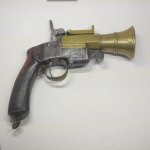
Brass barrel 16ga "Dragon", the handgun version of a blunderbuss
The unusual rarities are the guns made entirely of brass, except for the moving parts – hammers, triggers, hands, springs and screws. It would make sense that these parts needed to be made of steel in order to prevent premature wear and failure. The curious part is the barrel and cylinder. Brass is a soft, malleable metal, hardly something one would trust with the pressures of a black powder explosion. Old brass barrel cannons and single-shot percussion guns have hefty, thick-walled barrels for this reason. It would seem that brass ought to be an entirely unsuitable material for making revolvers. Why, then did makers like Eugene Lefaucheux opt to manufacture these guns, to the same dimensions and clearances as an all-steel revolver? Some experts argue that these guns were simply salesmen’s samples, meant to be shown to prospective customers, while others argue that they were apprentices’ practice projects because brass was easier to work. Still others argue that these guns were made for use aboard ships, or in tropical environments where steel and iron is more susceptible to rust. Each of these arguments is plausible, but each also comes with reasons against them. The first, being a salesman’s sample, makes little sense. As a prospective customer I would want to see the real thing, not a brass mock-up. Perhaps they were salesman’s gifts to prospective customers? But why give someone a brass version of the real thing, and not the real thing??
The second argument, the apprentice’s project, also makes some sense, however all the specimens I have ever seen were fully finished, including the maker’s name and a serial number. If it was an apprentice’s practice project, surely they would have omitted the brand name and serial number…
The final argument for use aboard ships or in the tropics makes the most sense. It is true that steel and iron are prone to rust, and therefore malfunction in humid conditions, and making a gun from brass would help to prevent this. However, the most delicate parts, those which move the various components in concert are still made of steel, and one would think that being housed entirely in a brass “case” would make them subject to electrolysis, causing them to rust even more quickly! The thin barrel and cylinder walls, and the rifling in the barrel surely would mean a very short service life for such a gun…
Finally, some argue that the material is not brass at all, but bronze. A French metallurgist opined to this possibility that it was unlikely, as bronze is more brittle than brass and would be more likely to fail under pressure…
So, in the end, no one is entirely sure why these rare revolvers were ever manufactured…
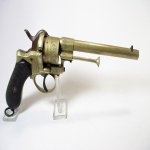
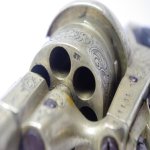
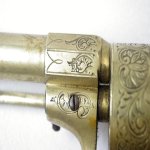
9mm Lefaucheux all-brass pin fire revolver
Among the American-made antiques we can find brass frames and trigger guards on a frequent basis. Colt’s percussion Pocket, Navy, Army and Police revolvers all have brass trigger guards and grip frames, which were silver plated. Moore, Whitney, Marlin, Brown and Merrimack all used brass frames on many of their pocket guns, but the barrels and cylinders, as well as all the moving parts were still made of cast steel. This choice of materials can be explained: brass is a lot easier to work and mill, and takes more easily to plating with nickel or silver. Steel is much harder, and takes more time to shape and finish. Plating metals also do not stick to iron and steel as readily as they do to brass. Making steel frames means higher production costs and more wear and tear on machinery and tools.
Brass barrel 16ga "Dragon", the handgun version of a blunderbuss
The unusual rarities are the guns made entirely of brass, except for the moving parts – hammers, triggers, hands, springs and screws. It would make sense that these parts needed to be made of steel in order to prevent premature wear and failure. The curious part is the barrel and cylinder. Brass is a soft, malleable metal, hardly something one would trust with the pressures of a black powder explosion. Old brass barrel cannons and single-shot percussion guns have hefty, thick-walled barrels for this reason. It would seem that brass ought to be an entirely unsuitable material for making revolvers. Why, then did makers like Eugene Lefaucheux opt to manufacture these guns, to the same dimensions and clearances as an all-steel revolver? Some experts argue that these guns were simply salesmen’s samples, meant to be shown to prospective customers, while others argue that they were apprentices’ practice projects because brass was easier to work. Still others argue that these guns were made for use aboard ships, or in tropical environments where steel and iron is more susceptible to rust. Each of these arguments is plausible, but each also comes with reasons against them. The first, being a salesman’s sample, makes little sense. As a prospective customer I would want to see the real thing, not a brass mock-up. Perhaps they were salesman’s gifts to prospective customers? But why give someone a brass version of the real thing, and not the real thing??
The second argument, the apprentice’s project, also makes some sense, however all the specimens I have ever seen were fully finished, including the maker’s name and a serial number. If it was an apprentice’s practice project, surely they would have omitted the brand name and serial number…
The final argument for use aboard ships or in the tropics makes the most sense. It is true that steel and iron are prone to rust, and therefore malfunction in humid conditions, and making a gun from brass would help to prevent this. However, the most delicate parts, those which move the various components in concert are still made of steel, and one would think that being housed entirely in a brass “case” would make them subject to electrolysis, causing them to rust even more quickly! The thin barrel and cylinder walls, and the rifling in the barrel surely would mean a very short service life for such a gun…
Finally, some argue that the material is not brass at all, but bronze. A French metallurgist opined to this possibility that it was unlikely, as bronze is more brittle than brass and would be more likely to fail under pressure…
So, in the end, no one is entirely sure why these rare revolvers were ever manufactured…
9mm Lefaucheux all-brass pin fire revolver