Brass options....questions

cdn1canhunt

CGN frequent flyer
Rating - 100%
3   0   0
So I'm in the market to buy some new brass but can decide which is the best avenue??

1) buy some cheap 1x fired ( mixed stamp etc..)
2) pony up and buy some new quality brass ( lapua or )
3) buy some loaded quality ammo, shoot and save brass

As a shooter I mainly hunt, not a competition shooter but when I shoot from the bench I love one hole groups. I enjoy making quality ammo. I know if I buy new brass or ammo I get new brass fire formed in my rifle. If I buy cheap 1x fired I will get to prep and clean( oh the fun), it was shot in someone else's rifle and will be mixed stamp.

As a hunter one hole groups are not required. And I'd hate to loose 4-5 lapua brass in the snow or mud while hunting. I try to pick up all my brass but inevitably some will get lost so maybe the cheapo brass is the right direction.

All thoughts and opinions welcome
 
Depending on the calibre and brass availability #3 maybe the best option.
I have no issue with 1F brass but I don't mix headstamps.
Animals aren't brass snobs so they won't care if you are using Lapua.
 
Depending on the gun, two and three can both be options. Mixed headstamp is for plinking ammo.

Lapua brass is surprisingly cheap for what you are getting. Its pretty tough stuff; and a case can be made for it ending up being cheaper. Unfortunately it doesn't come in all calibers.

There are many instances where factory ammo loaded in premium brass ends up being about the same or cheaper than the same brass empty. Happens a lot with Nosler and Weatherby (Norma).

Its good that you realize that one hole accuracy isn't necessary for hunting. It's become an end in itself for many; and it is an interesting aspect of the hobby. In the pursuit of close range groups with hunting rifles you may not notice any difference between premium and regular brass at all. The biggest differences (when they show up) are at very long range. On the other hand, I can't remember it ever hurting anything.

 
I'm a cheap bastard and buy bulk once fired military 5.56 and 7.62 cases and sort the case into practice plinking and the best cases for more accurate ammo.ck

The problem today is Remington and Winchester are not what they once were and quality control is governed by the company share holders.

And it would also be a waste of money to buy Lapua brass and not have good dies and gauges to check concentricity

Your question depends on the caliber and the type hunting and range you do the hunting at.

Just remember when you are standing on your hind legs shooting off hand and pumped with adrenalin you will not see any difference in cases.

P.S. I cry even if I loose a Winchester case. :(

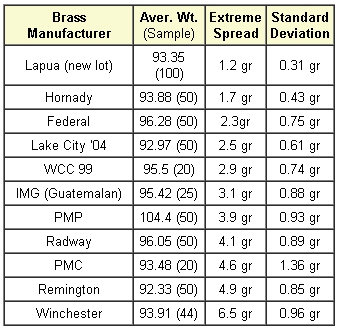
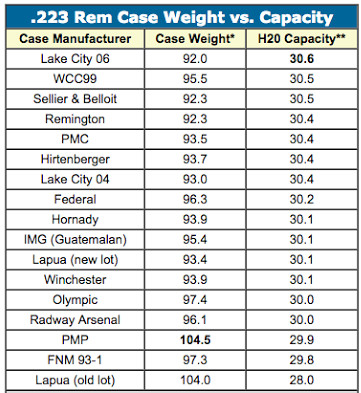
Example below of .223/5.56 cases, weight variations and case capacity. And you can see the military Lake City 5.56 cases come in fourth place for weight uniformity at a fraction of the cost of Lapua


PExmCCk.jpg


LjAQ7L9.jpg
 
One other thing, I found this video last night and you people be the judge. But after testing many type and brands of .223 dies the Forster full length benchrest dies out performed every brand of die especially bushing dies.

Please note the variations in neck runout when using a bushing die below, bushing dies work best with neck turned brass in tight neck chambers. The problem is when you reduce the neck diameter .004 or more with a bushing die it can induce neck runout. And if you do not neck turn your brass Redding recommends sizing the inside neck diameter .004 smaller than bullet diameter and use the expander that comes with their bushing dies.

NOTE, in the video the Forster expander was removed and a expander die was used. To me this makes no sense because all of my Forster dies using their high mounted floating expander produced the most concentric cases with the least neck runout. That being said if you do not have Forster dies and use other brands a expander die will reduce neck runout vs the standard lower mounted expanders that can be locked down off center.


Bottom line, why buy Lapua brass and then use a die that causes neck runout.
 
I'm a cheap bastard and buy bulk once fired military 5.56 and 7.62 cases and sort the case into practice plinking and the best cases for more accurate ammo.ck

The problem today is Remington and Winchester are not what they once were and quality control is governed by the company share holders.

And it would also be a waste of money to buy Lapua brass and not have good dies and gauges to check concentricity

Your question depends on the caliber and the type hunting and range you do the hunting at.

Just remember when you are standing on your hind legs shooting off hand and pumped with adrenalin you will not see any difference in cases.

P.S. I cry even if I loose a Winchester case. :(

Example below of .223/5.56 cases, weight variations and case capacity. And you can see the military Lake City 5.56 cases come in fourth place for weight uniformity at a fraction of the cost of Lapua

PExmCCk.jpg


LjAQ7L9.jpg
Well done Ed as usual..
 
Interesting read, I never thought there would be such a difference.

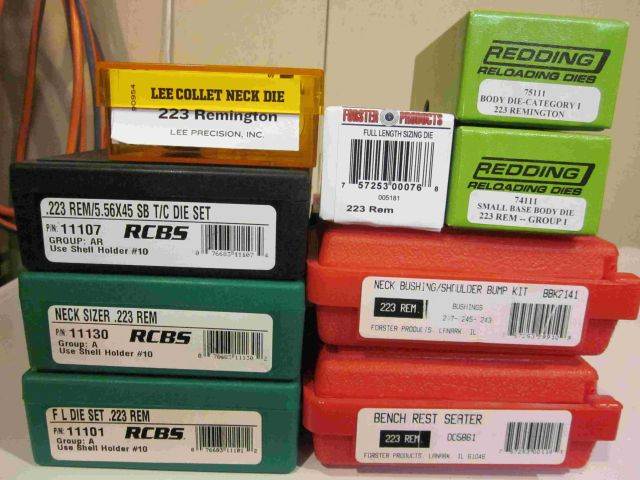
Below are some of the .223 dies I tested, missing from the photo is a Redding full length bushing die. And any make bushing die produced more neck runout than standard Forster full length benchrest dies.

A bushing floats in the bushing die and can move from side to side and even tilt when sizing a case. To get the most out of a bushing die you need a tight neck chamber and neck turned the brass. The main problem with a bushing die are the larger neck diameter in factory SAAMI chambers. And when the case neck is reduced .004 or more in diameter it will induce neck runout. On top of this if the case necks are not turned it causes unequal forces on the neck adding to the neck runout.

This is why the Lee collet die is more popular than bushing dies because it produces cases with less neck runout.

At the Whidden custom die website they tell you they get the most concentric cases with non-bushing full length dies. This is because the body and neck of the case is fully supported and aligned in the die. And a standard non-bushing neck sizing die does not align and support the case body with the case neck in the die. Meaning the bushing can move during the sizing operation. And I have Remington .223 cases with over .009 neck thickness variations. And only the Forster die holds and centers the case neck in the die when the expander enters the neck.

Bottom line, too much of what benchrest shooters do with their custom made rifles works it way down to the average reloader and is not needed. And the Forster benchrest dies are cheaper than redding dies and produce "less" neck runout.

pltdloo.jpg


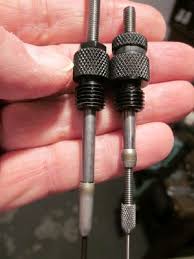
And by adding the Forster expander and spindle assemblies to my older RCBS dies this also greatly reduced neck runout. Below on the left the RCBS expander raised as high as it will move. And on the right the Forster high mounted floating expander assembly that is a direct replacement.

5kfnKwd.jpg
 
I like your thinking....

I'm retired and my spending is supervised by my Finance Minster and she wants to go on another caribbean cruise to get warm. :(

The advantage to Lapua brass is the cases are more uniform and they need very little case prep.

But by buying cheaper brass and doing "more" case prep you save money.

And I'm retired with nothing to do and all day to do it. :d
 
Last edited:
Back
Top Bottom