British Columbia black powder and rifle building supply suggestions

1899

CGN Ultra frequent flyer
Rating - 100%
35   0   0
Location
West
Hi folks! I have a Kibler Southern Mountain Rifle on the way and am looking for suggestions on places that stock both shooting supplies - powder, lube, patches, cleaning products, as well as products for wood and metal finishing - stuff like iron nitrate, for example.

Also, let's hear about your suggestions on finish for the fancy maple stock! I think I prefer a darker look for the stock and maybe brown on the metal bits. Any suggestions and/or photos for inspiration?

This is my first assembly so I don't know how long it will take, but I will post pictures when finished.

Thanks!
 
Hi folks! I have a Kibler Southern Mountain Rifle on the way and am looking for suggestions on places that stock both shooting supplies - powder, lube, patches, cleaning products, as well as products for wood and metal finishing - stuff like iron nitrate, for example.

Also, let's hear about your suggestions on finish for the fancy maple stock! I think I prefer a darker look for the stock and maybe brown on the metal bits. Any suggestions and/or photos for inspiration?

This is my first assembly so I don't know how long it will take, but I will post pictures when finished.

Thanks!
Rustywood
 
For "iron nitrate", purchase ferric nitrate crystals from an online chemical supplier in Canada. Once mixed with water, it is the same as the iron nitrate or "aqua fortis" sold for finishing and at a fraction of the cost. While ordering that, you might want to also order some tannic acid powder - read on.
Ferric nitrate/aqua fortis really makes the grain in curly maple pop and generally produces medium to dark browns. Each piece of wood reacts differently, so impossible to accurately predict the actual shade produced without doing a test on some scrap from the same piece of wood, or doing a test inside the barrel channel. The ferric nitrate reacts with the tannins naturally in the wood to produce the color. The color can be enhanced and darkened by applying tannic acid before applying the ferric nitrate and blushing but, depending on the wood, the color can come out very dark. It can be rubbed back to obtain a lighter color and, perhaps, enhance the contrast. I have recently switched from using boiled linseed oil products to polymerized tung oil for a finish, and much prefer the tung oil. It dries much more quickly, is more water resistant and the finish can be built up from flat to a medium gloss. Lee Valley sells both polymerized and pure tung oil.
I have built a number of Kibler kits and have an SMR, which will be significantly modified, on the bench right now. You will not be disappointed with the quality of a Kibler kit.
This is the rifle the Kibler kit is primarily modelled after:
https://americanlongrifles.org/forum/index.php?topic=59088.0
My objective is to bring the Kibler SMR closer to it's roots.
Enjoy the journey
 
Anything from spit (always available) to Crisco can be used as a lube. Do an internet search for suggestions.
Don't buy precut patches. Most folks use 100% cotton pillow ticking or light denim for patching. You will likely find that something between .016" and .022" works best. You have to experiment with ball size/patch thickness combinations for best performance.
All you need for cleaning is good old warm (not hot) water. Hot water can cause flash rusting. Use any good non detergent oil for lubrication/protection. My favorite rust preventative is RIG grease, which can be purchased on Amazon.
The metal finish will be a problem since sources in Canada appear to be non existent and US suppliers will not ship to Canada due to hasmat restrictions. You can brew your own if you have a source for nitric acid and are comfortable working with chemicals that can cause serious bodily harm. There are always the cold bluing products but, in my opinion, the results are anything but attractive or durable. Perhaps someone will jump in with a solution I had not thought of.
 
everything B_noser said.... I use the crystals, I think I had to get them from the US - but 500g will last a VERY long time - definitely 25+ guns.
As noted the colour depends on the tannins in the wood - but you can increase the contrast between the curls by applying the ferric nitrate solution and sanding back a very little bit - the darker curls are basically end grain and absorb the solution more readily. Never tried adding tannic acid directly though.

Your other options are aniline dyes or leather dyes. I've had 'meh' experiences with aniline dyes, not generally UV safe and tend to bleed through oil finishes (you need a polymer finish or sealant)
Leather dyes on the other hand are freaking awesome - don't bleed and UV safe (check the label) They do not, however, mix well and do not play well with steel wools

The nice thing with all 3 finishes is they don't obscure the grain like a stain does

+1 on the tung oil.
 
The striped cotton pillow ticking is great if you can find it but I have found that different color stripes mean different thickness with red being thinner than the blue or brown so measure before you buy if possible. Brown stripped ticking is .016 to .018' and works best for me using balls that are .010' under bore diameter: that is a .530" ball in a 54 cal barrel. Google "Moosemilk" for patch lube...there are lots of recipes. I f you can find only denim then "8 ounce" is about .018" and works best for me. Be sure to NOT get the modern stretchy stuff...just plain cotton denim.
 
Thank you for the excellent information! What wonderful summaries.

I was flailing around thinking about metal finishing and came across blacksmiths using Danish oil / linseed oil and beeswax.I couldn’t find online examples of these finishes being used for muzzle loaders. The oil requires heating the metal to 400 F or so, which seems quite high to me. The beeswax needs much lower heat, but the finish is not dark like with the oil.

I’ll keep looking around.
 
Birchwood Casey sells a "Plum Brown" browning solution that works well on small parts but just takes more applications with larger parts like a barrel to get the results looking even. I get mine at Cabelas/Bass Pro but other gun shops may have it.
 
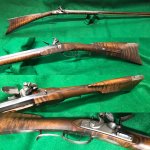
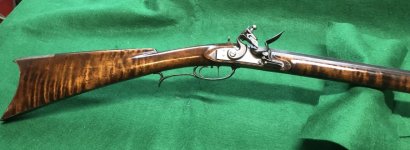
Good luck, you will love this rifle. I assembled a 45 SMR and love it to bits. I used Aqua fortis and polymerized tung oil from Lee Valley tools. I made this rifle a bit more anique finish so used a bit of rust blue on the barrel but only a couple of rounds of rust/card/boiling. Browning is really nice on these rifles too. IMG_4192.jpeg25C86C97-AC43-41A7-817F-B7FD7867BAB7.jpegIMG_3664.jpegIMG_3661.jpegIMG_3652.jpeg
 
That looks amazing! And thanks for the suggestion of Birchwood Casey Plum Brown - I saw some at the local gun shop a couple of days ago and was wondering if it would work well.
 
Good luck, you will love this rifle. I assembled a 45 SMR and love it to bits. I used Aqua fortis and polymerized tung oil from Lee Valley tools. I made this rifle a bit more anique finish so used a bit of rust blue on the barrel but only a couple of rounds of rust/card/boiling. Browning is really nice on these rifles too.

Are you using FFFg in yours?

Could you show us a closeup of that peep sight you made? Something like that would likely help my aging eyes!
 
Are you using FFFg in yours?

Could you show us a closeup of that peep sight you made? Something like that would likely help my aging eyes!
I have used both ffg and fffg, in my SMR i have been using fffg but there isn’t a problem with ffg if you cant find the 3f.

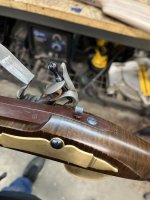
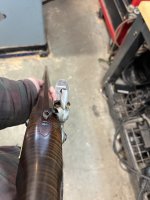
Here are pics of my lollipop sights. Normally I tap and drill the tang and add it that way. For my SMR the tang is very small so I just made a replacement tang screw with a lollipop on the top. You could braze or silver solder a lollipop to the included tang screw and it would do the same job. Obviously take the screw out before doing that!

IMG_3594.jpegIMG_3593.jpegIMG_6180.jpegIMG_6179.jpegIMG_6178.jpeg
 
Great ideas and I did the same for a NW Trade Gun I used to own. I noticed that you coned the aperature both front and back on the long rifle sight: that will yield a sharper image than a "long" hole through a 1/8" lollipop. I tended to leave the rear side flat and finished black then cone the peep hole from the front so the peep hole is actually only about 1/32" long from front to back, regardless of the diameter of the peep hole.
 
Back
Top Bottom