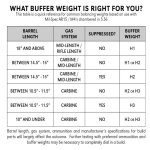
Buffer tube weights?

It depends, but if you’re running carbine/intermediate/rifle length gas, regular mass BCG, and a presumably NR length 223/5.56 barrel carbine buffer should be fine.
 
longer the barrel the lighter the weight, assuming you are building a NR rifle a 2.9 oz is all you needed

Unless you’re over gassed due to port size... (my slr beat my buffer up)

If you buy an adjustable gas block, get the lightest buffer.

If you have a fixed gas block, check your ejection pattern and increase weight if need be.
 
Will be running 18.6 223 wylde barrel, rifle length tube, fixed gas block

Have you selected a buffer and spring yet? I would go with the giesselle or however you spell it unit.

It’s probably cheaper to buy the h1 first, because you can easily drop weight. Standard carbine unit is probably 60 bucks. The tri coil and decent buffer is like 80. If you decide you wanna lower the weight, you can take the tungsten slug out and easily make one from steel or aluminum. If you buy a carbine unit, and need more weight it will cost you at least the difference to find a tungsten weight or new buffer. This way you get the quality spring too.

My 20” fixed gas block 223 modern sported runs best between a H1 and H2. Hindsight being 20:20 id have built it with an adjustable block.
 
I personally feel adjustable gas block route is preferable to messing with buffer weight/spring. It addresses the problem (over gassing) at the source. Keeps your upper/bcg running cleaner, and keeps your lower interchangeable with different uppers.
 
It really doesn’t matter. Buffer weight is more about reliability in a full auto setup. Do some run smoother, sure.
 
I personally feel adjustable gas block route is preferable to messing with buffer weight/spring. It addresses the problem (over gassing) at the source. Keeps your upper/bcg running cleaner, and keeps your lower interchangeable with different uppers.

Respectfully, I would suggest the opposite. Assuming your barrel isn't ridiculously overgassed, and it's hard to drill too big of a hole on a rifle length barrel(It's already pretty big), an adjustable gas block is a point of failure. The mechanism is prone to carbon build up and sometimes to a point that it's not serviceable, while stripping an adjustment screw is also a possibility if you're unlucky. On the other hand, buffer weights are just drop in and requires no tools to adjust, they are completely swappable and will never "get stuck" over time. So unless the adjustment mechanism is developed as a design like ACR, XCR or similar, I wouldn't mess with an adjustable gas block if reliability is what you prioritize. However if it's just gun games you're building it for, you can't go wrong with anything.
 
Last edited:
Respectfully, I would suggest the opposite. Assuming your barrel isn't ridiculously overgassed, and it's hard to drill too big of a hole on a rifle length barrel(It's already pretty big), an adjustable gas block is a point of failure. The mechanism is prone to carbon build up and sometimes to a point that it's not serviceable, while stripping an adjustment screw is also a possibility if you're unlucky. On the other hand, buffer weights are just drop in and requires no tools to adjust, they are completely swappable and will never "get stuck" over time. So unless the adjustment mechanism is developed as a design like ACR, XCR or similar, I wouldn't mess with an adjustable gas block if reliability is what you prioritize. However if it's just gun games you're building it for, you can't go wrong with anything.

I have 2 uppers with different gas system lengths, so I want to keep my lower as generic carbine buffer system. I don't need the "5 hour gun battle in full auto" sort of reliability, I just need it to work under normal civilian conditions. Using Superlative Arms adjustable block on one of the uppers, which is I think designed to not expose threads to carbon build up. I don't have that much rounds on it yet, but heard good reviews in terms of reliability.
 
longer the barrel the lighter the weight, assuming you are building a NR rifle a 2.9 oz is all you needed
Buffer weight was actually designed to increase as barrel weight increases. The more mass the barrel has, the more the bolt carrier will rebound upon smashing against the barel extension, the more weight the buffer needs to have to counteract this rebound in order to prevent light primer strikes in FA.


How people choose buffer weight nowadays has little to do with the original design and intent.
 
I have 2 uppers with different gas system lengths, so I want to keep my lower as generic carbine buffer system. I don't need the "5 hour gun battle in full auto" sort of reliability, I just need it to work under normal civilian conditions. Using Superlative Arms adjustable block on one of the uppers, which is I think designed to not expose threads to carbon build up. I don't have that much rounds on it yet, but heard good reviews in terms of reliability.


That I would agree. If there's other priorities like sharing lowers or tuning for softest recoil impulses, being able to fine tune with a quality adjustable gas block is great.

Adjustable gas blocks aren't what high speed tactical operators use though and we know looking uber cool is what matters. ;)

Different strokes for different folks I guess.
 
Caliber, port size, barrel length, weight of bcg, etc all play a roll. There are adj ones so you can modify the weight till the rifle will barely cycle with your choice of ammunition.

In my experience you get a smoother shooting rifle (less recoil impulse) felt by the shooter than just going to an adj gas block and using any old buffer you have lying around
 
Back
Top Bottom